- Card number
- 8
- Arcana
- Minor Arcana
- Suit
- Swords
- Element
- Air
- Rank
- Eight
- Yes or no reading
- No
Eight of Swords
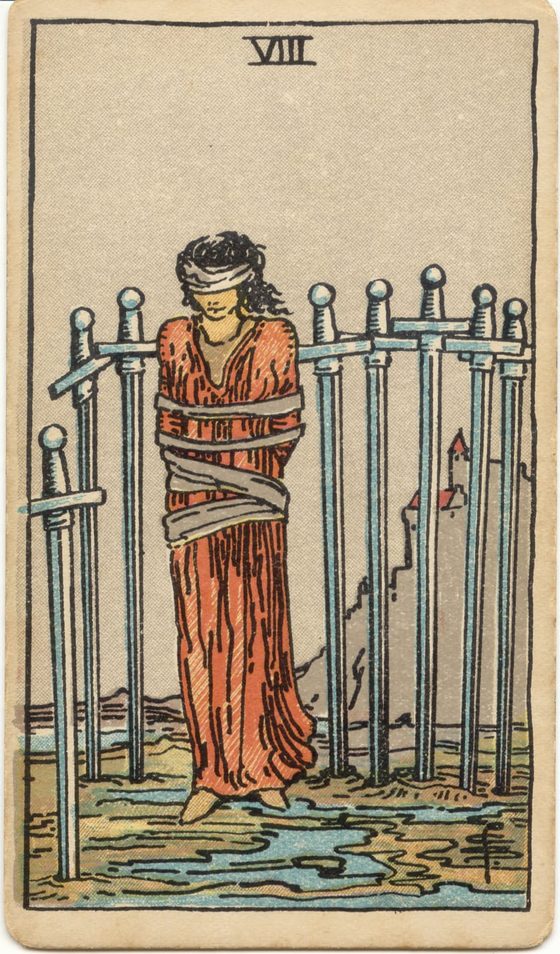
A bound and blindfolded woman standing among eight swords, on ground she could walk off. The card describes a situation experienced as a trap, and asks how much of the trap was built from outside.
- restriction
- self-limitation
- feeling trapped
- powerlessness
- avoidance
- release
- clear sight
- freedom
- deeper denial
- resignation
What the card shows
A woman stands in shallow standing water on marshy grey ground. She is bound with strips of cloth wound around her arms and torso, and a band of the same cloth covers her eyes. Her gown is red and her feet are bare.
Eight swords are planted point-down in the mud around her, five to one side and three to the other, forming a broken fence rather than a cage. There is a wide gap ahead of her and open ground behind. In the distance, on higher rock, stands a castle with a squat tower. The sky is pale and the light is flat. She is not touching any of the swords, and none of them is touching her.
Upright meaning
The Eight of Swords describes a situation the querent experiences as a trap. The binding is real enough to feel, and the card takes it seriously. This is not a card that tells anyone to cheer up. What it does is draw the trap accurately, which means drawing the gaps in it as well.
Most of the restriction here is procedural rather than physical. The querent has usually accepted a set of terms about what is possible, what would happen if they spoke, what other people would do, and has stopped testing whether those terms still hold. The blindfold is the operative detail. She cannot see that the swords do not close.
That is not the same as saying the way out is easy, and it is not the same as saying the situation is her fault. Some of the cloth was tied by other people. Read the neighbours: with The Devil the binding is something the querent is choosing and calling necessity; with Nine of Swords the trap is mostly happening at three in the morning; alongside Eight of Cups the exit already exists and is being refused.
Upright in love
In a relationship reading, the Eight of Swords usually describes someone who feels they have no moves. They cannot say the thing, cannot leave, cannot ask, because of consequences they have modelled in detail and never tested.
Sometimes that model is accurate. There are relationships where speaking honestly does cost something real, and the card does not pretend otherwise. More often the constraint has quietly outgrown its cause: a rule set during one bad month is still running two years later.
The card cannot tell you which of those you are in, and it says nothing about what the other person is thinking. It describes your range of motion as you currently believe it to be.
Upright in work
At work this is the role that has closed in. The querent knows the job is wrong, or the manager is a problem, or the project is going nowhere, and has a fully formed argument for why nothing can be done: the market, the visa, the mortgage, the timing.
Some of those constraints are load-bearing. Many are inherited from a version of the situation that no longer exists. The card asks which is which, and it asks for evidence rather than confidence.
It is also, occasionally, a card about being managed into helplessness, in a place where every route is presented as blocked. That reads differently, and the surrounding cards will usually say so.
Upright in money
In money questions the Eight of Swords is the feeling of having no financial options. Payments that arrive before the salary does, a debt that seems to preclude every decision, a number the querent has stopped looking at.
The blindfold matters here more than anywhere. Avoidance makes a money problem feel larger and vaguer than it is, and the vagueness itself becomes part of the trap. Writing the actual figures down usually changes the shape of the situation, even when it does not change the total.
That is an observation about not looking. It is not advice about what to do with money.
Upright as feelings
As someone's feelings, this is stuck rather than cold. There is often real attachment here, held underneath a conviction that expressing it would make things worse. The person may read as distant or unavailable. What the card actually shows is someone who believes they have no permitted move, which is a different thing from not caring.
Upright as advice
Write down the constraint you believe you are under, in one sentence, and then write down how you know it is still true. If the evidence is older than a year, test it before you plan around it. Do one small thing the rule says you cannot do, and watch what actually happens.
Reversed meaning
Reversed, the Eight of Swords reads two ways that pull in opposite directions.
The first is release. The blindfold comes off, the terms get tested, and the situation turns out to have more room in it than it had from the inside. This is the reading most books lead with, and it is genuine: reversals of this card often mark the point where someone finally says the thing out loud and the ceiling does not fall in.
The second is the trap tightening. The querent has stopped experiencing the restriction as a restriction and started calling it realism. Nothing has changed except that the argument for staying has got better. Reversed cards in this suit often describe an internal process going further inward, and this is that.
The spread decides. If the neighbouring cards describe movement, action or another person, read release. If they describe repetition, isolation or the same problem in a new costume, read the second. Treating it as automatic good news because it is upside down is the commonest error with this card.
Reversed in love
Either a constraint in the relationship that finally gets named, a conversation both people had been treating as impossible, or the opposite: a person who has settled into the constraint and now defends it. The reversal describes movement in the belief, not necessarily in the relationship. Someone can become entirely comfortable inside a situation they still describe to others as a trap.
Reversed in work
A restriction at work that turns out to be negotiable once somebody asks. Or a querent who has stopped asking and reframed a stalled career as a sensible choice. The second version is harder to spot from the inside, because it sounds mature. Look at whether anything material has changed or only the way it is described. Four of Swords nearby leans toward genuine rest rather than resignation.
Reversed in money
The figures get looked at, or they get avoided more elaborately. Reversed, this card sometimes marks the moment someone finally opens the account and finds the situation survivable. It just as often marks the point where not-looking becomes a settled habit with a justification attached. The card is describing attention, not amounts, and nothing here says which way the money itself is going.
Reversed as feelings
Feelings that have either been let out or sealed further in. If released, there is often relief mixed with embarrassment at how long the silence lasted. If not, what shows is someone who has made peace with not being understood and no longer expects to be asked.
Reversed as advice
Take the blindfold off in one specific place. Describe the constraint to one person who is not inside the situation, and let them say it back to you. If it sounds smaller out loud than it did in your head, act on that. If it sounds worse, you have learned something too.
Symbolism in the 1909 image
The eight swords. Planted point-down in the mud and arranged with a gap in them. They fence her in only if she walks in one direction. Swords in this deck stand for thought, speech and judgement, so the enclosure is usually read as one built out of reasoning rather than out of walls.
The blindfold. The card's working part. She is not held by the swords, she is held by not seeing them. Most of the standard reading rests on this single detail, which is why the card is so often turned into a lecture.
The bindings. Wound around the arms and torso, not the legs. She can walk. The drawing gives no indication of who tied them, and that silence leaves the card's most interesting question genuinely open rather than settled in favour of self-sabotage.
The standing water. Shallow, grey and going nowhere. Water is unusual in this suit, and it is often read as feeling seeping into a situation that is nominally about thought.
The castle on the rock. Distant, higher up, and behind her. Read variously as the authority that put her there, the home she came from, or the safety she is cut off from. Smith's drawing supports none of the three over the others, and books that state one confidently are guessing.
Where this meaning came from
The Eight of Swords has no ancient meaning to recover. In the fifteenth-century Italian decks the numbered swords were pip cards in a trick-taking game: eight swords drawn on a card, arranged decoratively, with no scene and no story. Whatever the number meant, it meant it in the context of taking tricks.
Divinatory meanings for the pips arrive with the eighteenth- and nineteenth-century French occultists, Etteilla in particular, who assigned keywords to every card in the deck. The Eight of Swords in that tradition carried notions of criticism, sickness and bad news. Those readings were assigned rather than discovered.
What almost every English-language reader actually means by this card is the 1909 illustration. Pamela Colman Smith gave the numbered cards full narrative scenes, which the earlier decks did not have, and the bound woman is entirely her invention. There was no blindfolded figure to inherit.
Waite's note in The Pictorial Key to the Tarot (1910) is characteristically terse: bad news, crisis, conflict, and a mention of the figure being bound. The modern reading about self-imposed limitation is a later development, extrapolated from Smith's picture rather than from Waite's text. That is worth knowing when a book presents it as ancient wisdom.
The common misreading
The most common misreading is the cheerful one: telling the querent that the trap is imaginary and they can leave whenever they like. Some of the bindings in this card were tied by other people. Telling someone in a controlling relationship, an exploitative job or an immigration bind that the swords are only in their head is not an insight, it is a failure to look.
The opposite error is treating the card as a verdict. It describes a situation as currently experienced, not a fixed condition, and it explicitly draws a gap in the fence. A reading that leaves someone more convinced they are stuck has not read the picture either.
The third is the reversal reflex, assuming that upside down means freedom. The reversal reads at least two ways, and one of them is worse than the upright.
A smaller one: this card is often used to diagnose someone who is not in the room. A spread cannot tell you that another person is trapped, in denial or secretly unhappy. It can describe what the querent believes about their own range of motion, which is the only thing they are in a position to test.
Questions to sit with
- Which of the constraints you are under have you actually tested in the last year?
- Who tied this, and are they still holding the other end?
- What would you do first if the restriction lifted tomorrow, and is any part of that available now?
- Is there someone outside the situation who could tell you whether it looks the way it feels?
Pull this card in a real spread.