- Card number
- 4
- Arcana
- Minor Arcana
- Suit
- Swords
- Element
- Air
- Rank
- Four
- Yes or no reading
- It depends
Four of Swords
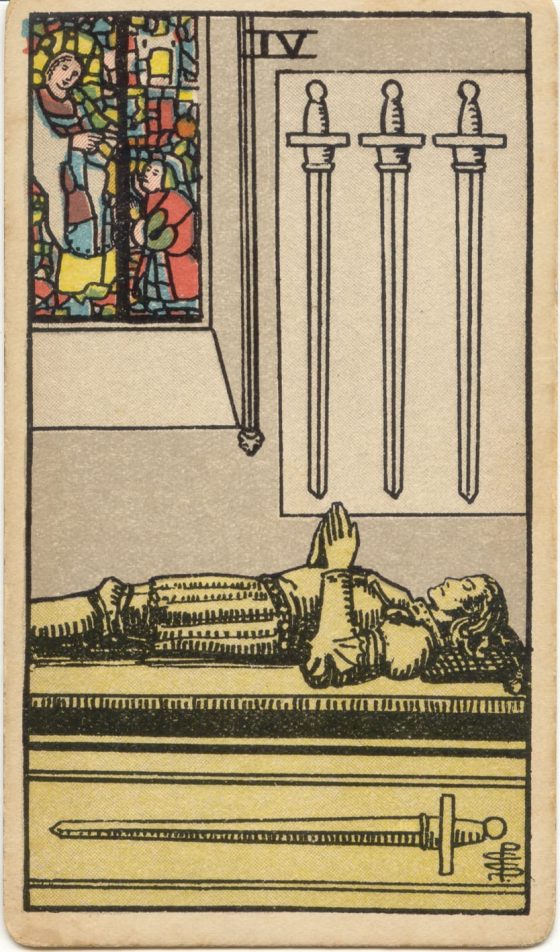
A stone knight lies on a tomb with three swords on the wall above him. The Four of Swords is a stop rather than an ending, and it does not say whether the stop was chosen.
- rest
- recovery
- retreat
- pause
- convalescence
- burnout
- restlessness
- returning
- no respite
- re-engagement
What the card shows
The figure of a knight lies full length on a raised tomb inside what looks like a chapel. He wears armour, his hands are pressed together on his chest in prayer, and his face is turned upward. Figure and tomb are drawn in the same pale stone colour, with no break between them.
Three swords hang point-down on the wall above him, evenly spaced and parallel. A fourth is carved in relief along the side of the tomb beneath him, lying horizontally. In the upper left is a stained-glass window in yellow, red, blue and green showing a small kneeling figure facing a larger standing one. A lamp hangs on a cord below the window. Nothing in the picture is in motion.
Upright meaning
The Four of Swords is a stop. After the grief of the three, the suit pauses, and Smith drew the pause as a tomb in a chapel rather than as a bed or a garden. That choice is the card's whole argument: this is rest with weight on it, the kind taken because it has become unavoidable.
Upright it usually describes recovery, withdrawal or convalescence. Time off, a retreat, a period of deciding nothing, a stretch in which the only sensible activity is repair. Nothing is being fixed in this card; something is being left alone long enough to mend. It is one of the very few cards in the deck that recommends doing nothing, and it means it.
What it does not describe is resolution. Three of the four swords are still in the picture, hung on the wall within reach. The conflict has been put down, not settled. Beside Three of Swords it reads as the necessary aftermath of something that hurt. Beside The Hermit the withdrawal reads as chosen and productive. Beside Nine of Swords, rest is what is missing rather than what is happening.
Upright in love
A relationship in a quiet phase, deliberately or otherwise. Time apart, a conversation shelved by agreement, a couple recovering from something rather than working on it. It can also describe one person stepping back to think, which is not the same as leaving and is frequently mistaken for it.
The card is unromantic and largely benign. It does not predict a return and it does not predict an end; it describes an interval. Where the question is about someone else, the most it will say is that they are not currently engaged with the situation. That could be rest, illness, avoidance or plain lack of capacity, and this card cannot tell those apart.
Upright in work
Leave, sick leave, gardening leave, a sabbatical, or a project deliberately paused. It also covers the quieter version: a person still at their desk who has stopped putting anything into the job while they recover from something else.
As advice it is unusually direct for the tarot. Stop. The card does not treat rest as a reward for finishing, which is the framing most workplaces use; it treats rest as the condition for being able to work at all. If a decision is waiting, the Four of Swords suggests the decision is not the problem, and that you are not currently in a state to make it well.
Upright in money
A pause in financial activity. No moves, no new commitments, a period of leaving things where they are. It can also mark a time when income has stopped or been suspended, which is not always voluntary and is not always a crisis.
Nothing here is advice about what to do with money, and the card has no view on any particular decision. What it describes is a state in which decisions are best not made: depleted, recovering, not thinking clearly. That is an observation about the person, not about the account.
Upright as feelings
Withdrawn rather than cold. As someone's feelings, this is a person who has stepped back from the situation in order to recover, and whose silence is usually about their own capacity rather than about you. It says nothing about what they will feel when they return, and it does not promise that they will.
Upright as advice
Stop for a fixed period, and tell the people affected how long. Put down one thing this week that you have been carrying out of habit rather than necessity. The card's instruction is not to solve anything today. The swords will still be on the wall when you get up.
Reversed meaning
Reversed, the Four of Swords goes two ways, and they ask for opposite things.
The first is the rest ending. Coming back, resuming, the convalescence over. Most books read the reversal this way and it is often right: the pause has done its work and the situation is beginning to move again. Whether that is welcome depends on whether the rest was long enough, and the card does not measure that, or say who decided that it was over.
The second is rest refused or unavailable. Burnout, insomnia, a person who cannot stop or is not permitted to. Here the reversal describes the upright image being denied rather than completed, and it is the harder of the two to spot, because from the outside it looks like somebody functioning.
Which one applies depends on the spread. Cards of pressure and depletion argue for the second; cards of movement argue for the first. Compare The Hanged Man, where the suspension is accepted rather than resisted.
Reversed in love
Either a couple coming back into contact after a break, or one person unable to take the space they need and staying present while running on nothing. The second is common and rarely named out loud. If the spread is otherwise busy and strained, read exhaustion rather than reunion, and notice that a reunion in that state tends to reproduce whatever caused the break.
Reversed in work
Returning to work, or never having really left it. The reversal often marks the person who took the leave and answered messages throughout, and the card is unsentimental about how that ends. As advice, if the pause is over, check that it actually happened; if it has not happened yet, stop arranging your schedule so that it cannot. Neither reading is a prediction about your job.
Reversed in money
Financial activity resuming after a quiet period, or a person who cannot afford to stop and is making decisions from inside that constraint. The second is the more important reading and it is not a moral failing, it is a description of circumstances. The card offers nothing about the money itself, only the observation that choices made without any margin tend to be worse than the same choices made with one.
Reversed as feelings
Re-engaging, or being unable to disengage. As someone's feelings, this can be a person coming back to the situation with something left to give, or one who has never stopped turning it over and is worn thin. The card marks a change in availability rather than in affection.
Reversed as advice
If the rest is done, re-enter deliberately and pick up one thing rather than all of them. If the rest never happened, cancel something this week and do not replace it. The card is unusually literal here, and it is not satisfied by a plan to rest later.
Symbolism in the 1909 image
The effigy. Knight and tomb are drawn in the same stone, which makes the figure a monument rather than a sleeping man. That is the detail that keeps this card from being cosy. Waite lists tomb and coffin among its meanings and does not soften it either.
The three hanging swords. Point-down on the wall, evenly spaced, within reach. The conflict has been set aside rather than resolved. Nothing has been destroyed or surrendered; the swords are simply being stored.
The fourth sword. Carved along the side of the tomb, beneath the figure, lying flat. It is the only one out of use. Read as the burden that has actually been put down, against the three that have not.
The stained-glass window. A small kneeling figure facing a larger standing one, in the only bright colour on the card. Usually read as prayer or supplication. It is also the only place in the picture where two people appear together.
The chapel. Enclosed, plain, and empty of anyone living. Rest here is formal and it is not homely. Smith could have drawn a bed, and drew a tomb.
Where this meaning came from
The Four of Swords started as four swords on a pip card in the fifteenth-century Italian packs, where tarot was a card game and no card in it carried a meaning of any kind. Swords were simply one of the four suits in play.
The divinatory layer came from eighteenth-century France, where Antoine Court de Gebelin and then Etteilla assigned readings across the whole deck. Etteilla's entry for this card runs to solitude, retreat and hermitage, which is close to how it is still read. The Egyptian ancestry claimed for tarot at the same time was invented.
Waite kept that sense. In The Pictorial Key to the Tarot (1910) he gives the card vigilance, retreat, solitude, hermit's repose, exile, and then tomb and coffin, which is a wider and darker range than the modern reading usually admits.
The tomb scene is Pamela Colman Smith's invention. English packs before 1909 showed four swords and nothing else, so the chapel, the effigy and the window are all hers. She was paid a flat fee for the whole deck and signed the cards with a monogram of her initials.
The common misreading
The first misreading is the tomb. The card gets read as death, or as a warning about someone's health, on the strength of a piece of church furniture. Effigies were ordinary in the chapels Smith was drawing from, and the figure is stone throughout. Nothing in the image describes a person dying.
The second is the modern one, and it is gentler and more misleading. The card gets handed over as self-care: take a bath, book a weekend away. Waite's own list for it includes exile. A great deal of the rest this card describes is neither chosen nor pleasant, and dressing an enforced stoppage up as a treat leaves the querent with nothing true to hold.
The third runs the other way. Because the figure is doing nothing, the card gets read as avoidance, and a querent who genuinely needs to stop is told they are hiding. Whether rest is retreat or evasion is decided by the rest of the spread and by facts the reader does not have, and suspicion is a poor default.
Questions to sit with
- What have you been carrying this week that you could put down without anything breaking?
- Is this pause something you chose, or something that happened to you?
- Who have you not told that you need to stop, and what do you think they would say?
- When the rest ends, what is the first thing you intend to pick up again, and why that one?
Pull this card in a real spread.