- Card number
- 15
- Arcana
- Major Arcana
- Suit
- Major Arcana
- Element
- Earth
- Rank
- Trump
- Roman numeral
- XV
- Zodiac attribution
- Capricorn
- Yes or no reading
- No
The Devil
A horned figure perched on a plinth, with a man and a woman chained beneath it by loose collars. The Devil is the card of an arrangement somebody is choosing, and of the reasons it is hard to see as a choice.
- attachment
- compulsion
- dependency
- bargain
- materialism
- release
- detachment
- breaking free
- rationalising
- deeper hold
What the card shows
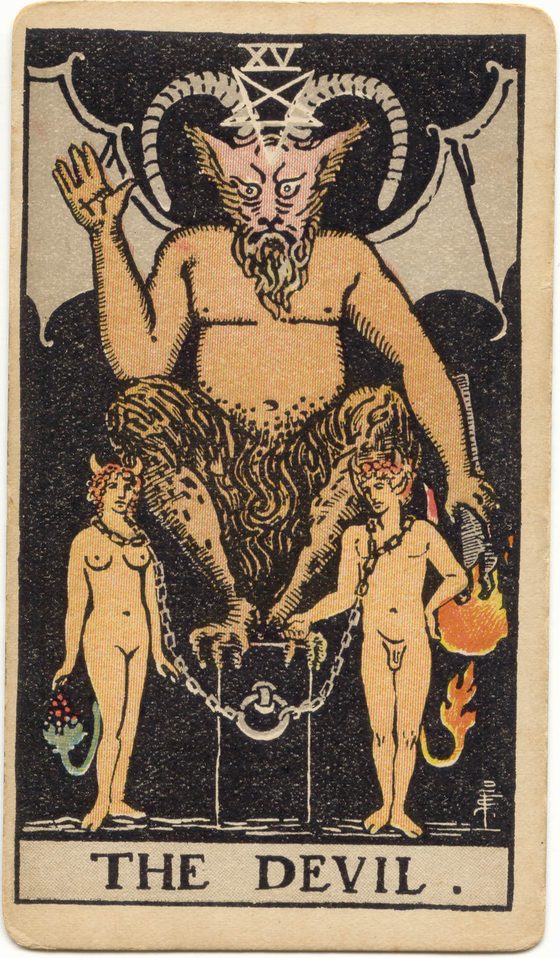
A large figure crouches on a pale rectangular plinth against a solid black ground, filling the upper part of the card. It has a horned goat's head with pointed ears and a beard, a bare human torso, dark bat wings, shaggy legs and clawed feet gripping the block. A white five-pointed star, point down, sits on its forehead between the horns. Its right hand is raised, palm out and fingers spread; its left holds a lit torch angled downward.
Beneath the plinth stand a naked woman on one side and a naked man on the other, each collared and chained to a ring set into the front of the block. Both have small horns and a tail: hers ends in a cluster of grapes, his in flame. Neither is looking up at the figure above them. The chains hang slack and the collars sit loose on their shoulders.
Upright meaning
The Devil describes an arrangement somebody is inside and has some part in maintaining. Not evil, and not a person. The card is about attachment, and the detail Smith put into it is that the chains are loose. The collars would come off over their heads. That is the whole card, and it is the part most readings skip past.
Upright, it usually marks something the querent knows is not good for them and is continuing anyway, or a situation where a cost is being paid quietly and never counted. Habits, obviously. But also arrangements: a job kept for reasons nobody says out loud, a relationship held together by dependency, a story about oneself that is doing a lot of work.
It is not a condemnation, and reading it as one makes it useless. People stay in arrangements because they are getting something, and identifying what is far more informative than any judgement. Beside The Lovers, which Smith drew with the same two figures unchained, it reads as a bond that has become a binding. Beside Four of Pentacles it reads as holding on well past the point of use.
Upright in love
In a relationship reading this is attachment with some compulsion in it: intensity that keeps two people in a pattern neither would defend if they had to describe it to somebody else. It can be sexual, and it often is, and there is nothing in the card saying that is a problem in itself.
What it does say is that something is holding beyond preference. The useful question is what each person is getting from the arrangement, because they are getting something. Readings that treat this card as a warning to leave usually fail, because the querent already knows the situation is not good and has stayed regardless. Ask what the chain is for before advising anybody to take it off.
Upright in work
A job kept for the money, a role that has become an identity, a workplace everybody complains about and nobody leaves. The Devil at work is usually about a bargain somebody made once and has long since stopped reviewing.
It also describes ambition with a compulsive edge, where the work is not so much chosen as needed. The card is neutral about that, and plenty of good work comes out of people who cannot stop. The reading turns on whether the querent can name the exchange they are in, what they give and what they get, and most people find that considerably harder to say out loud than they expect to.
Upright in money
Debt in the ordinary sense, and the psychological version of it: money used to hold a situation in place. Spending as a substitute for something else, or an income that has locked in a set of obligations nobody would choose from scratch.
The card is not financial advice and offers no forecast. What it points at usefully is the difference between what an arrangement costs and what it is doing, two questions people habitually merge into one. A large number is not automatically a trap and a small one is not safety. What makes it this card is whether the querent feels able to change it.
Upright as feelings
Strong feeling with something compulsive in it: wanting rather than liking, or an attachment the person would not choose if they were calm. It can be intense and genuine at the same time. What the card does not describe is contentment. There is pressure behind this feeling, and pressure is not the same thing as depth.
Upright as advice
Write down what you get from the arrangement, honestly, before you decide anything about leaving it. The advice on this card is diagnostic rather than moral. You will not get out of something whose function you have not identified, and calling it a weakness is one of the ways of not identifying it.
Reversed meaning
Reversed, The Devil goes two ways, and the difference matters more here than on most cards.
The first is release. The chain comes off: a habit ended, an arrangement finally seen clearly, a hold that has stopped working. This is the reading most books give and it is often correct, particularly where the surrounding cards describe movement.
The second is the opposite. The attachment has gone deeper and become less visible: rationalised, normalised, defended. Reversed can mark the point where somebody stops noticing the arrangement at all, which is worse than the upright and looks a great deal calmer. It is the harder of the two to raise with a person, because they are not in any distress about it.
The spread decides, and so does one plain question: is the querent talking about this more freely than before, or less? Release usually arrives with speech. The second reading usually arrives with a very reasonable explanation. Ask how long that explanation has been in use, and whether it changed when the situation did.
Reversed in love
Either a couple getting out from under something that had them both, a pattern named and a dependency addressed, or an unhealthy arrangement settling into a version of itself that nobody objects to any more. Reversed, this card can describe two people who stopped fighting about the thing because they have both agreed not to see it. Which reading applies depends on whether anything actually changed or only the noise level.
Reversed in work
Leaving a job that had a hold, or renegotiating a bargain that had run one way for years. Or the reverse: somebody who has fully adapted to a situation they used to complain about, which reads as maturity and is sometimes the opposite of it. Ask what they used to object to and when they stopped. The answer is usually a date, and usually one they remember.
Reversed in money
Debt cleared, an obligation escaped, spending brought back under some kind of deliberate control. Or money trouble that has stopped being discussed rather than stopped existing. The reversal is not a forecast about amounts and is not advice. Its useful question is whether the situation changed or only the querent's willingness to describe it, and those two look identical from outside for quite a long time.
Reversed as feelings
Somebody working their way out of a compulsive attachment, or somebody who has settled into it so thoroughly that it now feels ordinary. The reversal does not tell you which. Both read from outside as a person who has calmed down about you, and only one of them is free.
Reversed as advice
Take one chain off and see what happens, rather than trying to dismantle the whole arrangement at once. Reversed, the advice here is small and specific: remove a single component of the pattern for a fixed period, and pay close attention to what you reach for instead.
Symbolism in the 1909 image
The loose chains. The collars around the two figures' necks sit wide on their shoulders and the chains hang slack. Smith drew it that way on purpose and Waite points it out. The most important detail on the card is that nobody is actually being held.
The inverted torch. Held in the left hand, lit, angled downward. A downward torch is the classical sign for a life ending, and here it illuminates none of the black background and sits close enough to the man's tail to be setting it alight. It is doing no work at all as a light.
The reversed pentagram. On the forehead, point down. In Eliphas Levi's nineteenth-century occultism this is the standard sign for matter placed above spirit, and it is Levi's figure Smith is drawing here rather than any older devil.
The tails. Hers ends in a cluster of grapes, his in flame, usually read as appetite in two forms. Worth noticing that they have grown these since The Lovers, where the same two figures appear with neither tails nor horns.
The plinth. A plain pale block, lit against a solid black field, with the ring for the chains set into its front. It is conventionally described as a half-cube, a cube standing for the material world with half of it cut away, though what Smith actually drew is a rectangle and the reading is supplied by the commentators rather than the picture.
Where this meaning came from
The Devil is not present in the earliest surviving Italian tarot decks. The oldest hand-painted sets, the Visconti-Sforza among them, are missing this card and The Tower, and there is no way now to know whether they were painted and lost or never made at all. The card enters the standard sequence later, through the cheaper printed decks.
In the Marseille pattern it is a horned figure on a pedestal with two small bound attendants, which is the composition Smith kept. It carried no divinatory meaning, because the deck was for playing a game. The occult layer arrives in eighteenth-century France with Antoine Court de Gebelin and Etteilla, and the Capricorn attribution comes from the Golden Dawn.
The particular devil in the 1909 image is very specific and very recent. It is Eliphas Levi's Baphomet, drawn in his Dogme et Rituel de la Haute Magie (1854): goat's head, human torso, wings, raised hand. Levi's figure was itself an assembly of borrowed parts, invented in the nineteenth century and presented as ancient. Waite's 1910 commentary is unusually direct about the card describing bondage that is self-imposed, and that is the reading which has stuck.
The common misreading
The Devil gets read as evil arriving from outside: a bad person, a curse, some force acting on the querent. Nothing in the picture supports that. The two human figures are not restrained by anything they could not remove, and the horned figure is not touching them. Reading it as external is comfortable and it discards the only useful part of the card. Compare Eight of Swords, which makes the same point with a bound figure and no devil in it at all.
The second misreading is moralising. Readers use this card to disapprove, of a relationship or a habit or somebody's sex life, and dress the disapproval up as a reading. The card describes attachment and cost. It does not rank which attachments are acceptable, and a reader who supplies that ranking is doing something other than reading.
The third is the assumption that naming a pattern ends it. Recognition is not release. People can describe their own arrangement with real accuracy for years and stay inside it the whole time. If a querent already knows what the card is about, the honest move is not to tell them again but to ask what the arrangement is doing for them, because it is doing something, and that is the question nobody asks.
Questions to sit with
- What are you getting from this arrangement that you have never said out loud?
- If the chain came off tomorrow, what would you have to do that you are not doing now?
- Who else benefits from you continuing exactly as you are?
- When did you last object to this, and what changed between then and now?
Pull this card in a real spread.