- Card number
- 4
- Arcana
- Minor Arcana
- Suit
- Pentacles
- Element
- Earth
- Rank
- Four
- Yes or no reading
- No
Four of Pentacles
A crowned figure holds four coins with every part of his body at once. The Four of Pentacles describes holding on, which can be prudence or fear, and the picture declines to say which.
- security
- retention
- control
- boundaries
- saving
- release
- hoarding
- suspicion
- letting go
- stalemate
What the card shows
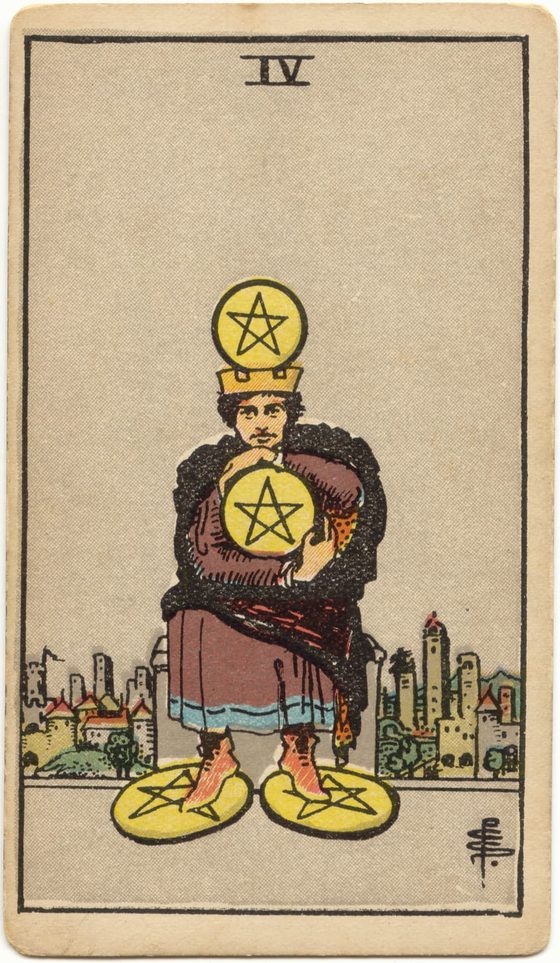
A crowned man sits on a low grey block at the edge of a city. A pentacle stands upright on top of his crown, facing the viewer. He holds a second pentacle against his chest with both arms wrapped around it. The remaining two are under his feet, one beneath each shoe, and both feet rest flat on them.
He wears a heavy black cloak with a fur-trimmed collar over a maroon robe, and dark hair beneath the crown. His shoulders are hunched forward and his elbows are locked in. He is not looking at any of the four discs; he faces straight out of the frame, past the viewer, and his expression is closed rather than frightened. Behind him a city runs across the full width of the card, towers and roofs in green and red, small and detailed. Above it the sky is blank.
Upright meaning
The Four of Pentacles describes a grip. Something is being held and not let go of: money, a position, a version of events, a person. Waite's line for it is exact and unsentimental, he holds to that which he has, and the card is at its most useful when read that literally.
What makes it hard to read is that holding on is sometimes correct. A person with four coins and no income is not being greedy by keeping them. The card describes the posture without grading it, and the grading has to come from the question and the rest of the spread. Security and hoarding look identical from the outside, and this picture is the outside.
The cost is visible, though, and it is worth naming. Both hands, both feet and the head are committed. Nothing in this arrangement can pick anything else up. Beside Five of Pentacles the holding reads as reasonable, a response to real scarcity. Beside Six of Pentacles it reads as a refusal to circulate. Beside The Devil the grip has become the thing that owns him.
Upright in love
In a relationship reading this is a card about withholding, and the withheld thing is usually not affection. It is access: to time, to plans, to money, to the parts of a life that get shared when people commit. Someone is keeping a reserve.
There is a reasonable version. People who have lost things guard what is left, and a partner in that position is not being cruel. There is also an unreasonable version, where the reserve has outlived the reason for it and has simply become how the person operates. The card cannot distinguish them, and it is worth saying plainly: it also cannot tell you what the other person is thinking. It describes a pattern you can observe, not a private motive.
Upright in work
Territory. A role held tightly, information not passed on, a process nobody else is allowed to touch. The Four of Pentacles at work is often the person who has made themselves indispensable and is now stuck being indispensable.
It also describes an organisation rather than a person: budgets frozen, headcount held, a company that is protecting what it has instead of doing anything new. Neither reading is automatically a criticism. Protecting a position is a legitimate strategy and sometimes the only one available. The question the card raises is whether the grip is still a decision or has become a habit, and habits are much harder to notice from inside. Compare Eight of Pentacles, where the hands are busy making rather than holding.
Upright in money
The obvious reading, and the one most books give: saving, retaining, not spending. Waite adds legacy and inheritance to the list, which is a reminder that the card can describe money arriving and being kept rather than money being hoarded from nothing.
What the card marks is the relationship, not the balance. A person with very little who cannot spend and a person with a great deal who cannot spend draw the same card. That relationship is worth examining, and nothing on this page is advice about what to do with your accounts. The one honest observation is that money held this tightly is not doing anything, which is a fact about the arrangement rather than a judgement of it.
Upright as feelings
As someone's feelings, this is attachment that has gone rigid. They do not want to lose you and they are not willing to open anything up in order to keep you. That is a real and common position, and it is not the same as coldness. It is closer to fear wearing a very steady face.
Upright as advice
Pick one thing you are holding and open your hand on it deliberately, in a small way, this week. Lend the tool, share the file, say the number out loud. The point is not generosity. The point is finding out whether you are choosing to hold on or no longer able to stop.
Reversed meaning
Reversed, this card breaks in two directions that point opposite ways, and the spread has to settle it. The first is the grip loosening: a release, spending after a long period of not spending, information finally shared, a position given up. Read this way the reversal is a relief.
The second is the grip tightening past function. The same posture, more of it, and now it costs something visible: relationships strained by suspicion, opportunities refused because taking them would mean risking what is held. Waite's reversed keywords lean this way, suspense and delay and opposition, which is a picture of things not moving.
Neither reading is the default. Look at the question. A spread about whether to make a purchase reads the reversal one way; a spread about why someone has stopped speaking to you reads it the other. And notice that both readings can be true in different areas of the same life. People often let go of money and grip a grievance, or the reverse.
Reversed in love
Either something long withheld is finally being offered, or the withholding has become the whole relationship and both people have organised around it. The first is worth meeting halfway. The second is the harder situation, because nobody is doing anything dramatic and there is nothing obvious to point at. Reversed, this card often marks the moment a reserve stops being protective and starts being the reason the other person is tired.
Reversed in work
Control released, or control clamped down. In the first case someone has delegated, opened the process, handed over the password; in the second, a bottleneck has hardened into policy. Both are visible from the outside and neither requires guessing at anyone's motives. The practical test is whether work can proceed when the person holding it is away. If the answer is no, the reversal is describing a structural problem, not a personality.
Reversed in money
Spending after a freeze, or a freeze that has stopped being prudence. Reversed, this card is often drawn by people who have just made a large purchase and want to know if it was sensible, and it will not tell them. What it does describe is a change in the grip. Whether the change is release or panic is decided by the surrounding cards and by facts this card has no access to. No page can tell you what to do with your money, and this one is not going to try.
Reversed as feelings
Either someone is finally letting go of a position they have held for a long time, or the holding has hardened into resentment that no longer needs a reason. Reversed, the card describes movement in the grip. It says nothing about the direction, and asking directly will get you further than the card will.
Reversed as advice
Name the thing you are afraid of losing, in one sentence, without justifying it. Then check whether that fear is about the present or about something that already happened. The reversal is workable once the fear has a date on it, and unworkable while it stays general.
Symbolism in the 1909 image
The pentacle on the crown. Standing upright on top of the crown, facing the viewer, unsecured. It is the only one he is not physically gripping, and it is the one that would fall first if he moved. Read as material concern occupying the mind; read also as the least stable part of the arrangement.
The pentacle at the chest. Held with both arms, close, in the position a person uses for something they expect to be taken. This is the gesture the card is named for, and Waite's line for it is that he holds to that which he has.
The two under the feet. One beneath each shoe, flat. He is standing on his assets, which keeps them safe and also means he cannot walk. The drawing makes immobility a consequence rather than a metaphor.
The city behind. Drawn across the whole width of the card behind him, in colour, with towers and roofs and no figures in any of it. The place with other people in it is somewhere he is not. Whether he has left it or is guarding its edge is not shown.
The stone seat. A plain block, no throne, no cushion. The crown says one thing about status and the furniture says another, and the gap between them is part of what makes the card uncomfortable.
Where this meaning came from
The four of coins began as a pip card in the Italian tarot of the fifteenth century, where it had no picture and no meaning. Its job was to lose tricks.
Meaning was attached in eighteenth-century France by Court de Gebelin and Etteilla, along with the Egyptian origin story that later scholarship dismantled. Etteilla's lists are where a good deal of the modern keyword vocabulary actually starts.
Pamela Colman Smith drew the scene in 1909. Waite's description in The Pictorial Key to the Tarot (1910) is one of his most quoted and most economical: a crowned figure with a pentacle over his crown, clasping another with hands and arms, two more under his feet, and the summary line that he holds to that which he has. His divinatory meanings are the surety of possessions, cleaving to that which one has, gift, legacy, inheritance. Reversed: suspense, delay, opposition.
The Golden Dawn title is Lord of Earthly Power, Sun in Capricorn. Notably, neither Waite nor the Golden Dawn calls the card greed. The moralising reading, miser and hoarder, is a later English-language addition, and it has stuck harder than either source.
The common misreading
The Four of Pentacles is the most moralised card in the suit. Books call the figure a miser and readers pass the judgement on, and none of that is in the picture or in Waite. What is drawn is a man holding four coins. Whether four coins is a fortune or everything he has left is not shown, and that difference is the whole moral question.
The second misreading is telling someone they need to open up. It is a comfortable thing for a reader to say and it assumes the reader knows the querent's circumstances better than the querent does. A person guarding what is left after a real loss is behaving sensibly. The card describes the grip; it does not certify that letting go would be safe.
The third is subtler. Because the card is about money in most books, the non-financial versions get missed: holding a grudge, holding a story about what happened, holding a role in a family that everyone including you has outgrown. Those grips are harder to see and cost more. Compare Nine of Pentacles, where someone has enough and is not braced against losing it.
Questions to sit with
- What exactly are you holding, and when did you decide to hold it?
- If you lost it tomorrow, what would actually change in your day?
- Who has asked you for something you did not give, and what was the real reason?
- Is this grip protecting you now, or protecting you from something that already happened?
Pull this card in a real spread.