- Card number
- 6
- Arcana
- Minor Arcana
- Suit
- Pentacles
- Element
- Earth
- Rank
- Six
- Yes or no reading
- Yes
Six of Pentacles
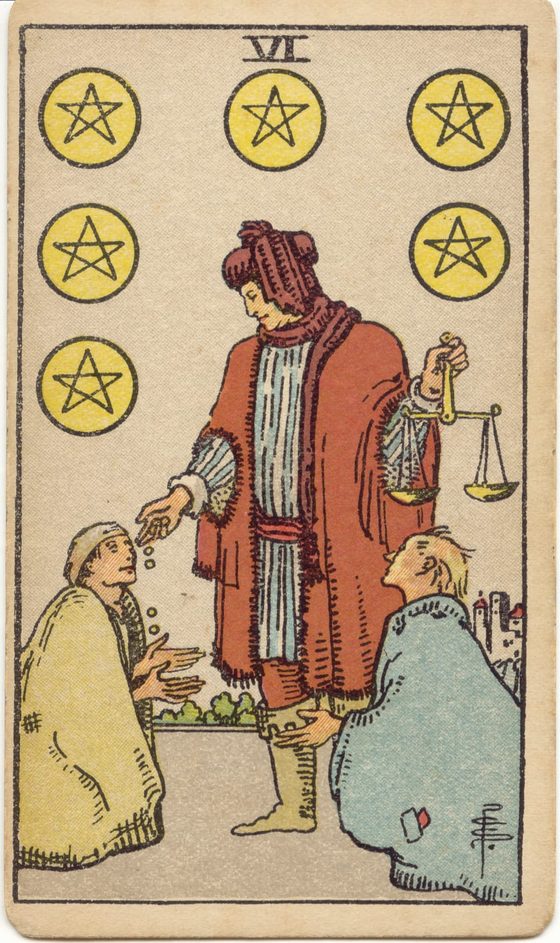
A man with scales in one hand drops coins into another man's palm. The Six of Pentacles describes help that arrives with a measurement attached, and it is worth asking who is holding the scales.
- giving
- receiving
- charity
- patronage
- measured help
- strings attached
- debt
- withdrawn support
- power imbalance
- refusal
What the card shows
A man in a long red robe stands at the centre of the picture, his head bent toward the figure on his right. In one raised hand he holds a pair of balance scales, the two pans hanging level. His other hand is extended downward, releasing a small stream of coins into the open palms of a man kneeling in front of him.
A second kneeling figure is at his other side, in a blue cloak, hands together, looking up at him. Both kneeling men are wrapped in plain hooded cloaks, one yellow and one blue. The standing man wears the red robe over a striped undergarment, with a dark headdress. Six pentacles are set in the air around him: three down the left edge, two down the right, and one directly above his head. Behind him is a low wall and, at the right edge, a small city.
Upright meaning
The Six of Pentacles describes an exchange in which the two sides are not equal. Something is given and something is received, and the person giving decides how much. Waite reads it warmly, a merchant distributing to the needy, a testimony to his success and his goodness of heart, and that reading is available. So is a colder one.
The scales are the difficulty. Generosity does not usually require measurement. What the picture shows is help being weighed, which makes it charity rather than gift, and charity is a relationship with a shape: one person standing, two kneeling, and the terms set at the top. None of that makes the help less real. It makes it conditional, and the conditions are what a reading should name.
The card sits between two positions and does not tell you which one you occupy. That is the first question to settle in a spread. Beside Five of Pentacles the reading is about help finally reaching someone. Beside Justice the scales sharpen into a question about whether the distribution is fair. Beside Four of Pentacles it becomes a picture of what having and not having look like from a distance.
Upright in love
In a relationship reading this card describes an imbalance that both people are aware of. One is giving more, money, time, emotional labour, practical support, and the arrangement is functioning on that basis rather than in spite of it.
That is not necessarily unhealthy. Most long relationships pass through periods where one person carries more, and the carrying is what makes them long. What the card asks is whether the imbalance has been named. Unnamed, it accumulates as obligation on one side and resentment on the other, and both are hard to reverse. Where the question is about a new relationship, the card is worth reading as a caution about the terms being set early and quietly.
Upright in work
Sponsorship, funding, a mentor, a raise, a resource allocated. The Six of Pentacles at work usually means something is being given to you by someone with the authority to give it, and the authority is part of the reading.
It also describes the giving side: managing a budget, deciding who gets headcount, being the person other people have to ask. That position is more uncomfortable than it looks from below, and the card is honest about the discomfort. In either position the useful question is the same one: what is the money for, and what does accepting it commit you to? Compare Three of Pentacles, where the exchange is skill for sign-off rather than resources for compliance.
Upright in money
Money moving between people who are not equals: a loan from a relative, a grant, a bonus, support given or received. The card marks the direction of flow and the fact that someone set the amount.
What it does not describe is a transaction between equals. If a spread about a straightforward sale or wage produces this card, look again at whether the parties really are on level terms. The one thing worth carrying away, and it is an observation rather than advice: money that comes with a measurement usually comes with an expectation, and the expectation is often unstated. Asking what it is, out loud, at the time, costs less than discovering it later.
Upright as feelings
As someone's feelings, this is care exercised from a position. They want to help you and they are comfortable being the one who helps. That is genuine and it is also a role, and roles are hard to step out of. If the question is whether they see you as an equal, this card is not encouraging on that point.
Upright as advice
Whichever side of the exchange you are on, say the terms out loud before the money moves. If you are giving, say what you expect and what you do not. If you are receiving, ask. The card's damage is done almost entirely by things nobody said at the time.
Reversed meaning
Reversed, this card divides and the two halves point in opposite directions. The first is generosity turning into something else: help given with strings, debt disguised as a gift, a benefactor who has begun to expect return. Waite's reversed keywords are the harsh set, cupidity and envy and jealousy, and they fit this reading.
The second is the balance being questioned from below. The person kneeling has begun to notice the scales. Reversed, the card can describe someone refusing help that costs too much, or reassessing an arrangement they had accepted for years. That is not ingratitude, although it will be described that way by the person holding the coins.
There is a third and duller possibility: help that has simply stopped, without malice, because the giver's circumstances changed. Deciding between the three is not a matter of intuition. Look at whether the surrounding cards describe motive, refusal, or plain change, and read the one the spread supports rather than the one that makes the better story.
Reversed in love
The imbalance has become a lever, or it has become intolerable to the person underneath it. In the first case help is being used: a favour recalled during an argument, a contribution mentioned once too often. In the second, someone who has been receiving has started to want the account settled so they can stand up. Neither is dramatic from outside. Both change what the relationship is for, and the change usually happens before anyone says anything about it.
Reversed in work
Funding withdrawn, sponsorship that has quietly lapsed, or a raise that arrived with an unstated obligation attached. The reversal also covers the other direction: someone declining a promotion, a secondment or a mentor because the terms are wrong. Look at whether the spread describes an authority acting or a person refusing. And be careful of the flattering assumption that the querent is the injured party; in a fair number of these readings the querent is the one holding the scales.
Reversed in money
A loan that has turned out to have terms, help that has stopped, or a debt between people who called it a gift. Reversed, this card is often about the gap between what was said when money changed hands and what is being said now. Nothing here is financial advice. What the card is good for is prompting the ordinary, awkward step: write down what was actually agreed, and check whether the other party would describe it the same way.
Reversed as feelings
Either generosity that has curdled into expectation, or gratitude that has run out. Reversed, this card often describes someone who feels they have given enough and has started keeping count without saying so. Counting is the signal. The feeling itself may still be warm, and that is what makes the situation confusing.
Reversed as advice
Settle the account, in whichever direction it runs. If you owe, name the amount and a date. If you are owed, decide whether you are giving it away or collecting it, and then say which. The reversal gets worse the longer the arrangement stays unstated, and it does not resolve itself.
Symbolism in the 1909 image
The scales. Held up in one hand, pans level. Books read them as fairness and just measure. What they actually establish is that the giving is being calculated, and that the calculation belongs to one party. Smith drew them raised and prominent, higher than the hand that gives.
The falling coins. Released, mid-air, into an open palm. The gesture is dropping rather than handing. It is a small distinction and the drawing insists on it: the two hands do not touch.
The kneeling figures. Two of them, one receiving and one not. Waite's text mentions only the distribution; Smith drew a second man who is waiting. Whether he is next or is being passed over is not shown, and it is the most uncomfortable open question on the card.
The six pentacles. Set in the air rather than held or fixed to anything: three down the left edge, two down the right, and one directly above the standing man's head. They are the only floating objects, which places the wealth in the picture as a fact of the scene rather than a possession being handled.
The robe and the cloaks. The clothing does all the work of establishing the relationship. Nobody in the picture has to be identified; a heavy red robe against two plain hooded cloaks makes the difference in station legible in a second, which is exactly how it works outside the picture too.
Where this meaning came from
The six of coins was a pip in the Italian tarot of the fifteenth century, and the tarot of that period was a game. The interpretive apparatus came later, in eighteenth-century France, from Court de Gebelin and then Etteilla, whose Egyptian account of the deck's origins was invented and has since been demolished.
Waite's description in The Pictorial Key to the Tarot (1910) is warmer than most of his entries: a person in the guise of a merchant weighs money in a pair of scales and distributes it to the needy and distressed; it is a testimony to his own success in life, as well as to his goodness of heart. His divinatory meanings are presents, gifts, gratification, with a second account offering vigilance and present prosperity. Reversed: desire, cupidity, envy, jealousy, illusion.
The Golden Dawn title is Lord of Material Success, Moon in Taurus. What is worth noticing is how far Waite's cheerful gloss sits from the scene Smith actually drew. He describes a good man; she drew a transaction with a second beggar in it who is not receiving anything.
Smith drew all seventy-eight cards in roughly six months in 1909, for a flat fee, and signed them with a monogram. The Sola Busca deck, photographs of which had entered the British Museum shortly before, is the only earlier deck known to illustrate its pip cards, and she is generally thought to have seen it.
The common misreading
The most common misreading is that the Six of Pentacles is simply a card of generosity. It is a card of generosity with a set of scales in it. The measurement is not incidental decoration; it is the largest object in the composition after the figures, and it establishes that the help is being rationed by someone who has the standing to ration it.
The second is assuming the querent is the giver. Readers do this almost automatically, because giving is the flattering position and the standing figure is the visual centre. In a great many readings the querent is on the ground. Deciding which without asking is how a reading turns into a story about the reader's assumptions.
The third is treating the second beggar as scenery. He is drawn carefully, hands together, waiting, and nothing in the picture says he will be helped. That figure is the card's honest content: distribution means some people get and some do not, and being one of the ones who does not is not a moral fact about them. Compare Five of Pentacles, which shows the same people outside the frame of anyone's generosity.
Questions to sit with
- In this situation, are you the one setting the amount or the one receiving it?
- What was said out loud when the help was offered, and what was only implied?
- If you stopped giving tomorrow, what would you be afraid of losing?
- Who is waiting alongside you, and are they getting the same answer?
Pull this card in a real spread.