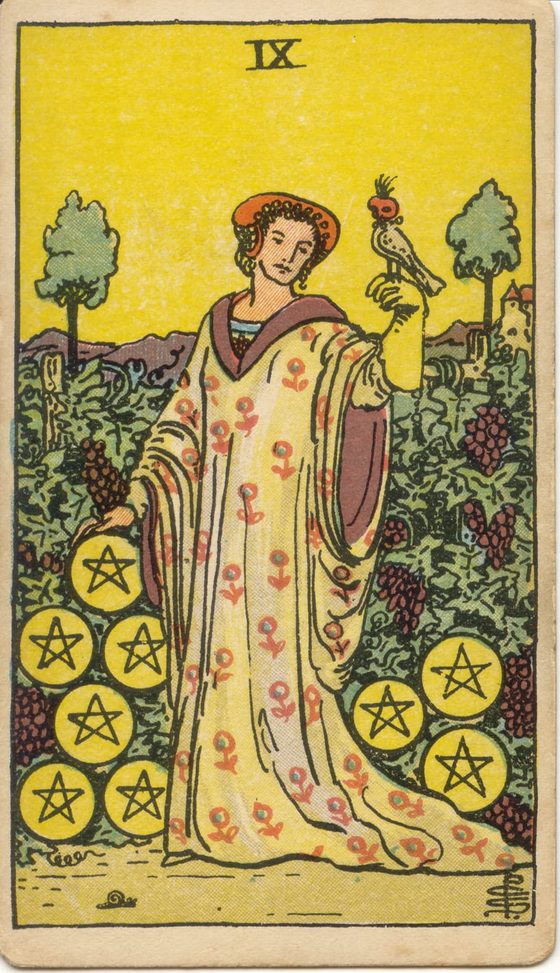
- Card number
- 9
- Arcana
- Minor Arcana
- Suit
- Pentacles
- Element
- Earth
- Rank
- Nine
- Yes or no reading
- Yes
Nine of Pentacles
A woman stands alone in her own vineyard with a hooded bird on her wrist. The Nine of Pentacles describes self-sufficiency that took time to build, and the solitude in it is not accidental.
- self-sufficiency
- security
- independence
- discipline
- earned comfort
- precarious
- isolation
- display
- overwork
- closed off
What the card shows
A woman stands among grapevines under a flat yellow sky. Her gown is long and heavily patterned, a pale ground worked all over with a red flower motif, and a red cap sits over her curled hair. Her left hand is raised in front of her, gloved, with a small hooded falcon perched on it. Her right hand rests on one of the pentacles among the leaves.
Nine pentacles are distributed through the vines, six in a cluster on her left and three on her right, among broad leaves and dark bunches of grapes. A slim tree stands at each side and low hills run behind the vines. Over the vines on the right, the roof and wall of a house are just visible. On the ground near the hem of her gown, a snail is drawn crawling across the earth. There is no other figure anywhere in the picture.
Upright meaning
The Nine of Pentacles describes a position that has been arrived at rather than given. Someone has enough, controls the ground they are standing on, and does not currently need anyone's permission. Waite's list runs to prudence, safety, success, accomplishment, certitude, discernment, and for once the keywords match the picture.
The card's specific content is independence, and independence has a shape. She is alone in her own ground. There is no other person in the frame and no indication that one is expected. Whether that is peace or isolation is not decided by the drawing, and it is usually not decided by the querent either; most people in this position hold both at once.
It is also a card about time. Vines take years. Nothing here is sudden, and nothing here was easy, which is why the card sits badly next to readings about luck. Beside Eight of Pentacles it reads as the years of work having produced something. Beside Four of Pentacles it becomes a contrast: the same security, held without a grip. Beside Ten of Pentacles the question shifts from what you have to who else it is for.
Upright in love
In a relationship reading this card is about the person rather than the pair. It describes someone who is complete on their own terms and is not looking for a relationship to fix anything. That is a good position to be in and it changes what a relationship has to offer to be worth having.
It often appears for people who have chosen to be single, and it is not a consolation prize when it does. It also appears for people in relationships whose partner has become an addition rather than a foundation. Where the question is about whether someone will commit, this card does not answer it; it describes what they are without the commitment, which is a different and sometimes more useful fact.
Upright in work
Autonomy. Working for yourself, or holding a position secure enough that nobody is checking. The Nine of Pentacles at work usually means the proving is finished, and what remains is running the thing you built.
The trade-off is in the picture. She is in her own vineyard with a bird on her hand, and there is nobody else there. Autonomy means no colleagues, no shared load, no one who understands the work well enough to argue about it. For people who have wanted independence for years, arriving at it is often quieter than expected. Compare Three of Pentacles, which has all the friction and all the company that this card does not.
Upright in money
Money that is already there. Not income arriving but a position established: savings, ownership, a business that runs, a house that is paid for. The card marks security rather than growth, and the security came from a long process rather than an event.
Two honest limits. The card says nothing about the size of the sum, only about the relationship to it: a modest position held calmly draws the same picture as a large one. It gives no guidance about what to do next, and this page has no advice on investments, property or savings. What it does describe well is the quality of not having to consult anyone before spending, which is the part of financial independence people underestimate.
Upright as feelings
As someone's feelings, this is warmth without need. They like you, and their life is not waiting on you. That is a stable place to be liked from, and it is also a card that gives you very little to push against. If you were hoping for evidence of longing, this is not it, and the absence is not coldness.
Upright as advice
Spend one afternoon this week using what you have built rather than maintaining it. Sit in the garden. The Nine of Pentacles fails when the person who earned the position keeps working as though they had not, and the failure is invisible because it looks exactly like diligence.
Reversed meaning
Reversed, the card splits and the halves are close to opposites. The first is the independence turning out to be less solid than it looked: a business that depends on one client, savings that cover three months rather than three years, autonomy that exists because nobody has tested it yet. Waite's reversed list is harsher still, roguery and deception and bad faith, which reads now as a warning that the display and the position may not match.
The second is independence that has hardened into avoidance. Nothing has gone wrong with the money or the house. What has gone wrong is that self-sufficiency has become a reason not to need anyone, and the solitude has stopped being a choice. This is the version people recognise slowly, because from inside it feels like competence.
The spread decides. If the surrounding cards concern other parties, resources or promises, read the first. If they concern isolation, refusal or repetition, read the second. And note that neither reading is about failure. Both describe something working, in one case less securely than it appears and in the other more completely than is good for the person inside it.
Reversed in love
Either self-sufficiency being performed rather than possessed, or self-sufficiency used as a wall. The first is someone insisting they need nothing while arranging their life around a person who has not noticed. The second is someone who genuinely needs nothing and has stopped being reachable. Reversed, this card is worth reading against the querent's actual behaviour rather than their account of it, and the useful test is what they have declined recently and what it cost them to decline it.
Reversed in work
Autonomy that turns out to be precarious, or autonomy that has become a room with the door shut. The first is the freelance position resting on a single relationship. The second is the person who has been independent long enough that collaborating would now be genuinely difficult. Neither is a crisis and both are worth naming early. If the surrounding cards involve other people, look at whether they are clients, colleagues or absences, because the answer changes the reading entirely.
Reversed in money
Security that is thinner than it looks, or a comfortable position being maintained at a cost nobody is counting. Waite's reversed keywords include bad faith and voided project, which in a money reading usually points at a gap between the account and the accounts. This page cannot audit anything and offers no financial advice. What the reversal is good for is prompting the boring check: how many months would the current position last if the main source stopped tomorrow, and do you actually know the number?
Reversed as feelings
Either contentment that is being displayed rather than felt, or genuine contentment that has quietly closed a door. Reversed, this card describes a person whose self-possession has become the answer to every question about them. Whether that is peace or a very well-kept distance is something you will learn from what they do, not from what they say.
Reversed as advice
Ask someone for something you could manage without. A hand with a job, an opinion, an afternoon. Reversed, this card is not corrected by shoring up the position; it is corrected by testing whether the walls around it still open. Pick one and find out.
Symbolism in the 1909 image
The hooded falcon. Perched on her gloved hand, hood on. A hooded bird is calm because it cannot see. Read as controlled instinct, discipline, appetite kept in hand. The uncomfortable half of the reading is that the control is achieved by blinding, and Smith drew the hood clearly.
The snail. Crawling on the ground by her hem, easy to miss, and the most deliberate small thing on the card. Slow, carrying its own house, in no danger. It is the card's statement about the pace at which any of this was arrived at.
The vines. Heavy with fruit, mature, planted years before the moment shown. Vines are the standard emblem of a long return, and they are the only thing in the picture that could not have been acquired quickly.
The gown. Pale, worked all over with a red flower motif often read as marigolds. Elaborate enough to be impractical in a working vineyard, which places her as the owner rather than the labourer.
The house. Visible over the vines on the right, roof and wall only. Waite calls the setting a manorial house and a wide domain. It is drawn small and partly hidden, so the card shows the estate without letting it dominate the woman standing in it.
Where this meaning came from
In the Italian decks of the fifteenth century the nine of coins was nine discs on a plain ground, part of a trick-taking game with no divinatory function. Meanings were attached in eighteenth-century France by Court de Gebelin and Etteilla, together with the Egyptian origin story that later scholarship has entirely discredited.
Waite's description in The Pictorial Key to the Tarot (1910) is one of his more expansive: a woman, with a bird upon her wrist, stands amidst a great abundance of grapevines in the garden of a manorial house; it is a wide domain, suggesting plenty in all things. His divinatory meanings are prudence, safety, success, accomplishment, certitude, discernment. Reversed: roguery, deception, voided project, bad faith.
The Golden Dawn title is Lord of Material Gain, Venus in Virgo, which accounts for the card's combination of comfort and exactness better than either the picture or Waite's list does on its own.
The falconry detail is Smith's and would have been legible to an Edwardian audience as a mark of landed status. Smith herself owned nothing comparable. She was paid a flat fee for the deck in 1909, signed the cards with a monogram, later ran a small press and lived her last years in Cornwall, and died in 1951 in debt.
The common misreading
The Nine of Pentacles is routinely read as a reward, and readers hand it over as though it were a congratulation. It is a description of a position, and positions are held rather than won. What the drawing shows is someone standing in something that requires continuing to exist: the vines need tending, the ground needs keeping, and none of that is in the picture because she is not doing it at this moment.
The second misreading is romanticising the solitude. She is alone, and books convert that into serene independence without pausing on it. Whether the aloneness is chosen, accepted or endured is not shown, and the reader who decides it for the querent has substituted a preference for a reading. Ask instead.
The third is the hood on the bird. It is regularly read as mastery over one's instincts, which is flattering. What is drawn is an animal kept calm by being prevented from seeing. Applied honestly, that raises a question the cheerful version never gets to: what has this person had to stop looking at in order to be this composed? Compare The Empress, whose abundance is not managed at all.
Questions to sit with
- What did this position cost, and would you pay it again?
- Is being alone in this something you chose, or something you got used to?
- What have you stopped looking at in order to keep things calm?
- If the main source of this security stopped tomorrow, how many months would it last?
Pull this card in a real spread.