- Card number
- 10
- Arcana
- Minor Arcana
- Suit
- Pentacles
- Element
- Earth
- Rank
- Ten
- Yes or no reading
- Yes
Ten of Pentacles
Wealth that has outlived the person who made it. The Ten of Pentacles is the card of structures that hold, of family, property and institutions, and it describes continuity rather than happiness. The two are often confused.
- legacy
- inheritance
- family wealth
- long-term security
- establishment
- disputed estate
- family conflict
- unstable foundation
- costly obligation
- broken tradition
What the card shows
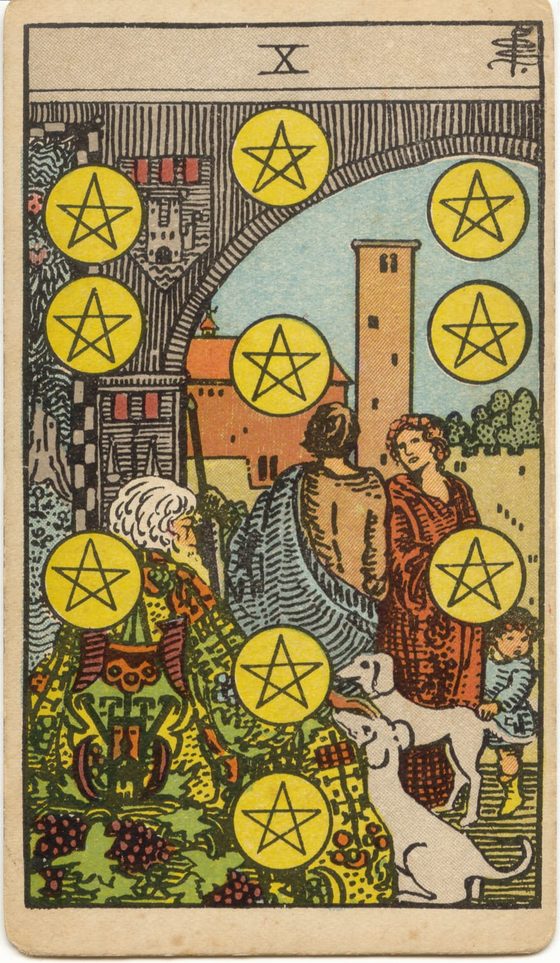
An old man in a long robe covered with grape clusters and geometric pattern sits at the left of the frame, half cut off by its edge, his head in profile, turned down toward the ground. Two white dogs stand between him and the rest of the group; the nearer one has its head lifted toward him.
To his right, under a wide stone archway, a man with his back to us and a woman in red stand facing each other. A child in pale clothing holds the woman's robe with one hand and reaches down toward the second dog with the other. Through the arch there is a town with a tall square tower. Heraldic devices are drawn on the wall beside it. Ten pentacles are laid across the whole scene in the branching arrangement of the Kabbalistic Tree of Life, attached to nothing in the picture.
Upright meaning
The Ten of Pentacles is the end point of the suit: earth accumulated until it stops being one person's achievement and becomes a structure. A family business. A house that has held three generations. A pension, an estate, a surname that opens doors. What the card marks is that the thing now exists independently of whoever built it.
Drawn upright it usually says the querent's situation is durable, and that its durability comes from something older than they are. That cuts both ways. Structures that hold you up also hold you in place. It is the natural counterweight to the Nine of Pentacles, where the security belongs to one person and can be walked away from; here it is shared, and leaving has a price attached.
The card says nothing about whether the arrangement is warm. For that you need its neighbours. Beside the Ten of Cups it reads as a life that is both solid and liked. Beside a card of conflict or exclusion it reads as an institution someone is being kept outside of, or kept inside of.
Upright in love
In a relationship reading this card describes the long horizon: shared property, meeting the family, a partnership other people already treat as a settled fact. It often appears when a relationship stops being private and starts having obligations attached to it, whether that is a lease, a child, a set of in-laws or a joint account.
That is not the same as intimacy and the card does not claim it is. It describes the frame rather than what is inside it. Where the question is whether a relationship is happy, this card answers a different one: whether it is built to last, and what it would cost to take apart.
Upright in work
Established work. The old firm, the family trade, the institution with a pension scheme and a fifty-year archive. Upright, the card favours staying and compounding over starting again: seniority, a reputation other people maintain on your behalf, work that continues after you have left the room.
It can also describe inheriting a role rather than winning it, which is a real advantage and a real complication. If the spread is asking whether to take the safe position, this card is the safe position, drawn without any comment on whether safe is what you want. The Eight of Pentacles nearby puts the emphasis back on the work itself rather than what surrounds it.
Upright in money
Money that is structural rather than earned this month: property, inheritance, a business with a balance sheet, finances that need more than one person's signature. The card describes accumulation that has hardened into an arrangement.
Because more than one person stands inside that arrangement, the useful question here is rarely how much. It is who has access, who decides, and what happens when someone dies or leaves. Those are answerable questions, and the card points at them rather than at a number.
Upright as feelings
As someone's feelings, this is a person who has already placed you in a long-term picture and is thinking in years, households and families meeting. It is settled, unromantic regard. It can be deep commitment and it can be someone counting you as an asset in a plan. The card does not distinguish between the two.
Upright as advice
Write down what you are actually building and who is meant to inherit it. Not a feeling, a list with names on it. If the answer to who benefits is unclear, or if the honest answer is nobody, deal with that before you add another year to the structure.
Reversed meaning
Reversed, the Ten of Pentacles splits into two readings that point in opposite directions.
The first is the structure failing. Money that held a family together becomes the thing dividing it: a contested will, a business nobody agreed to run, property that costs more to keep than it returns. Upright the card is durability; reversed in this sense it is durability shown to be brittle, usually at the point where the founding generation is no longer there to arbitrate.
The second is the structure standing perfectly well and somebody deciding to step out of it. Refusing the inheritance, the family trade, the mortgage, the expected life. Read this way the reversal is not loss but cost. It marks that the exit has a price, not that the exit is wrong. The Hierophant reversed carries a similar flavour.
Which of the two applies is decided by the question and by what else is on the table, never by the reversal on its own.
Reversed in love
Either a relationship coming apart along its financial and family seams, where the argument is about the house, the account or the parents, or a person quietly declining the version of partnership that was assumed for them. Reversed, this card often marks the moment the practical scaffolding of a relationship gets examined for the first time. That examination is not the same as the relationship ending, though from outside the two can look alike.
Reversed in work
A stable position that has quietly stopped being stable, or a stable position being left on purpose. Family businesses, long tenures and inherited roles all read here. The reversal asks whether the security on offer is real or only the appearance of it, and whether the price of staying has been counted recently. Compare the Eight of Cups, which describes the same departure with none of the money attached.
Reversed in money
Shared money going wrong at the joins: an estate in dispute, an asset nobody can sell because too many people own it, an arrangement everyone assumed was settled and nobody wrote down. Reversed, the card points at the paperwork rather than the balance. It can also mark a deliberate refusal of money that arrives with conditions attached, which is a legitimate reading and an easy one to miss if you are only looking for loss.
Reversed as feelings
Someone whose commitment has become entangled with obligation to the point where they can no longer separate the two. Or someone who has decided the long-term picture they were placed in is not one they want, and has not said so yet. Reversed here usually means unspoken rather than absent.
Reversed as advice
Find out what the arrangement actually is. Read the agreement, ask who owns what, get the terms into writing rather than memory. Most of the damage this reversal describes comes from things assumed by everyone and confirmed by nobody, and confirming them is work you can start this week.
Symbolism in the 1909 image
The ten pentacles. Arranged in the branching pattern of the Kabbalistic Tree of Life and laid over the scene rather than held by anyone in it. Waite's circle read the arrangement as the completion of the suit. It is worth noticing that no figure in the drawing touches one.
The old man. Seated at the far left, partly cut off by the frame, in a robe covered with grape clusters and geometric pattern. Richly dressed and entirely uninvolved. The books call him the patriarch; the picture shows a man nobody is speaking to.
The two dogs. White, standing in the foreground between the old man and everyone else, the nearer one with its head lifted toward him. Usually read as loyalty and domestic peace. They are also the only creatures in the frame paying him any attention at all.
The archway. A wide stone arch with a town and a tall square tower visible through it, and heraldic devices drawn on the wall beside it. Read as lineage and property. It is also a threshold, and the couple are standing under it, neither in nor out.
The child. Holding the woman's skirt with one hand and reaching for a dog with the other, the only figure interested in something other than money or conversation.
Where this meaning came from
The suit began as coins. In the fifteenth-century Italian decks tarot was a trick-taking game and the denari were pip cards: ten coins arranged on a plain ground, no scene, no people. There was nothing to interpret because nothing was meant to be interpreted.
The interpretive layer arrives in eighteenth-century France, through Antoine Court de Gebelin and then Etteilla, who assigned divinatory meanings to a deck that had never carried any. Nearly every claim made in that period about Egyptian origins is now known to be invented.
What makes this particular card readable at all is Pamela Colman Smith. For the 1909 deck she drew a full scene on every numbered pip, which almost no earlier deck had done. The fifteenth-century Sola-Busca is the known precedent, and Smith had seen photographs of it at the British Museum. The family, the dogs and the arch are hers, not Waite's.
Waite's own list in The Pictorial Key to the Tarot (1910) is oddly clerical for a card now read as happiness: gain, riches, family matters, archives, the abode of a family. Archives. He was describing records and property, not a warm evening.
The common misreading
The Ten of Pentacles is the card most often used to end a reading on a comfortable note. It turns up, somebody says legacy and generational wealth, and the spread closes. That reading is not wrong so much as unearned. The card describes a structure, not a transfer, and nothing in it says any of it is coming to the querent.
The second misreading is happy family. Look at the picture. The old man sits at the left edge of the frame, turned toward the dogs rather than toward the people. The couple are talking to each other. Nobody is talking to him. Families that hold property together are not automatically families that like each other, and the drawing is unusually honest about the difference.
The third is treating it as the answer to any question. Asked whether to leave a job, a city or a marriage, this card is routinely read as a reason to stay. It is at least as often a description of what makes leaving expensive. Cost is not the same as verdict, and this card does not supply the verdict.
Questions to sit with
- What in your life would carry on if you stopped maintaining it, and what would stop within a month?
- Who else has a claim on the thing you are building, and do they know they have one?
- Is the security you are counting on inherited, earned, or borrowed against?
- If you left this arrangement, what exactly would you owe, and to whom?
Pull this card in a real spread.