- Card number
- 10
- Arcana
- Minor Arcana
- Suit
- Cups
- Element
- Water
- Rank
- Ten
- Yes or no reading
- Yes
Ten of Cups
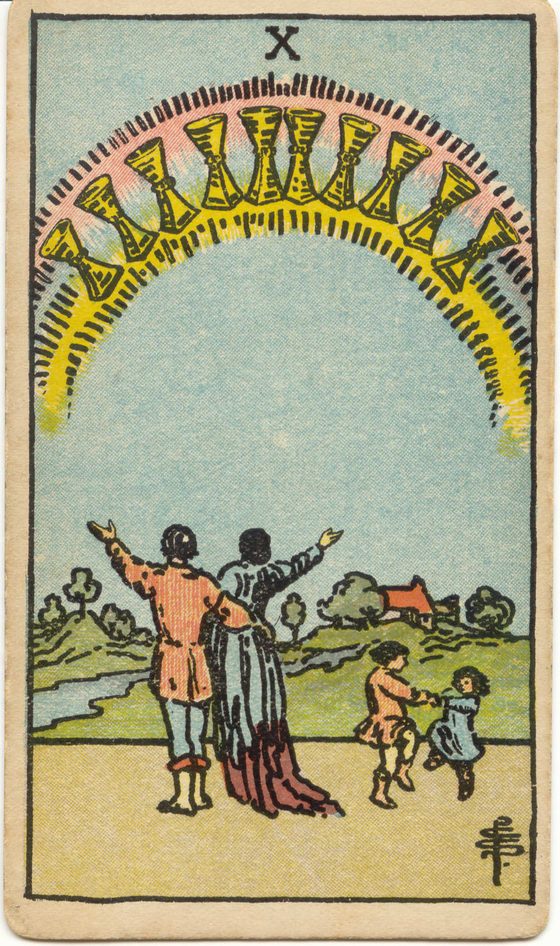
A couple stand with their arms raised beneath a rainbow of ten cups while two children dance beside them. The Ten of Cups is an image of a settled life, and an image is not the same as a forecast.
- harmony
- family
- contentment
- belonging
- settled
- appearances
- disconnection
- strain
- false calm
- upheaval
What the card shows
A man and a woman stand together on grass in the left foreground, seen from behind. His right arm is around her waist and his left is raised; her right arm is raised too. Both are looking up and away from the viewer.
Above them a broad rainbow arcs across the sky with ten golden cups set into it in a curve. To the right, two children hold hands and dance in a circle, facing each other rather than the sky. Behind, a river bends past a low rise on which a small house stands among trees. The land is green and cultivated and the light is even. Nobody in the picture is holding a cup.
Upright meaning
The Ten of Cups is the picture the rest of the suit gets measured against. Waite reads it as contentment and repose of the entire heart, the perfection of that state, and extends it to human love and friendship generally, and to the town or country the querent lives in. It is the most domestic card in the deck.
Upright it describes a settled arrangement holding together: people in the same situation who are glad about it, over a stretch long enough to be called a life rather than a moment. Notice that nobody in the drawing is doing anything. The card describes a condition, not an achievement, and it says nothing about how the condition was reached or what it costs to keep.
It is also the card most often asked to make a promise, and it cannot. Beside the Nine of Cups it reads as private satisfaction widening to take in other people; beside the Four of Wands it reads as the settled version of the same celebration. What is drawn is an image in the sky. The house on the rise is on the ground. The rainbow is not.
Upright in love
In a relationship reading the Ten of Cups describes the version people mean when they say things are good: two people aligned, a shared household, an absence of the things that make a relationship hard to talk about.
Its honesty is in what it leaves out. The family is shown from behind. No faces, no conversation, no account of how anything is divided. Waite's reversed reading of this card is repose of the false heart, and the fact that he needed such a phrase suggests he knew how easily the upright picture can be posed. Where the question is whether a relationship is genuinely well, this card describes how it appears, and appearances in long relationships are usually accurate but not reliably so.
Upright in work
At work the Ten of Cups is unusual because it barely mentions work. It describes a life the job supports rather than a job that is going well, and it often appears when the honest answer to a career question is that the career is not the important variable in it.
Where it does describe work directly, it points at a team or a practice people stay in for years without resentment. That is rare and worth naming when it appears. It is not a card of advancement. Nothing in it suggests promotion, and reading it as one usually means importing ambition into a picture that contains none.
Upright in money
In money questions the Ten of Cups reads as enough, distributed. Not accumulation, but a household that works. Where the Ten of Pentacles counts what a family owns, the Ten of Cups describes what it is like to live there.
It offers no numbers and no timing, and it is not guidance about any decision. If it has a practical use in a money reading, it is as a prompt to ask what the money is for, since the picture is entirely about the thing money was supposed to buy and shows none of the money itself.
Upright as feelings
As someone's feelings, the Ten of Cups is settled affection with a future attached to it. Not infatuation. Somebody imagining an ordinary life with you rather than an intense one. It is warm, undramatic and about the long shape of things. The card describes the picture in their head. It cannot tell you whether they have said any of it out loud.
Upright as advice
Say the ordinary appreciative thing you assume is already understood, to the person you assume understands it, and be specific rather than general. This card rewards maintenance rather than gesture, and maintenance is mostly saying out loud what has gone without saying for too long. Do it this week.
Reversed meaning
Reversed, the Ten of Cups reads two ways a reader should not blur together.
The gentler one is the picture no longer matching the life. Everything looks correct from outside and something inside it has gone quiet. No incident, no villain, only an arrangement being maintained past the point where anyone is really in it. This is the common modern reading and it fits most spreads.
Waite's is harder. He gives the reversed Ten as repose of the false heart, indignation, violence. That is unusually blunt language from him, and it is worth knowing the tradition contains a reading in which the calm is a cover. It should not be reached for casually. No card can tell you that a household is unsafe, and a reader who implies otherwise is guessing about people they have never met.
The picture does not choose between them. If the surrounding cards are mild, read the first. If the question concerns something the querent is describing very carefully, the second exists in the source and can be raised as a question rather than stated as a finding.
Reversed in love
Reversed in love, either a relationship being performed rather than lived, with the shape kept up because dismantling it would cost more than continuing, or a genuine disruption to a settled arrangement. Waite's reversed phrase, repose of the false heart, belongs here and is the harshest line he wrote about any cup. It is a possibility to hold rather than a verdict, and the card cannot tell you what anybody is actually doing.
Reversed in work
At work the reversal usually points outward: a job that is fine and a life around it that has thinned. It can also describe a team whose good relations have hardened into a rule against raising anything difficult. Neither is a crisis. Both are the sort of thing that runs for years because there is never an obvious moment to mention it, and the reversed Ten is often the card that supplies the moment.
Reversed in money
Reversed, either a household stretched to keep up an appearance, with spending shaped by how the life is supposed to look rather than by what it costs, or a shared arrangement where money has stopped being discussed at all. The card points at the mismatch between the picture and the accounts. It does not say which way the mismatch runs, and none of this is advice about anybody's finances.
Reversed as feelings
Either warmth that has become a habit and stopped being felt, or someone holding a picture of a shared future they have not tested against the actual person. The reversal is about the distance between the image and the feeling. It does not say the feeling is absent, only that the image has got ahead of it.
Reversed as advice
Ask the question you have been avoiding precisely because everything seems fine. One question, asked plainly, of the person it concerns. If the arrangement is sound it will survive being asked about. If the asking is the frightening part, that is the thing to look at first.
Symbolism in the 1909 image
The rainbow. Ten cups set into an arc of colour in the sky. A rainbow is the standard emblem of a promise kept, and it is also the one weather effect that cannot be walked up to. Smith drew it above the figures and out of reach, and every reading of this card has to decide what to do with that.
The children. Two of them dance to the right, holding hands, facing each other. Waite is explicit that they have not observed the wonder and are happy after their own manner. The happiest figures in the picture are the ones not looking at the cups.
The raised arms. Both adults have an arm up toward the rainbow, and his other arm is around her. It is a gesture of display as much as of joy. They are presenting the view, with their backs to the viewer.
The house. Small, on a rise, among trees, at some distance. It is the only solid thing in the card, and Smith drew it a great deal smaller than the rainbow.
The river. It bends past the property and out of the frame. Water in this suit is feeling, and here it is running through the land rather than held in any of the ten cups.
Where this meaning came from
The ten of cups spent three centuries as a rank. In the Italian decks the minor suits were pips, and ten cups on a card meant ten cups: no scene, nothing to interpret, a value in a game.
Divinatory readings for the minors came with the eighteenth-century French occultists. Etteilla assigned meanings to the whole pack in the 1780s, and for this card the tradition already leaned toward the town or family of the querent, which is why Waite's reading still includes the place a person lives.
Smith's 1909 drawing fixed the modern picture. Waite's commentary in The Pictorial Key to the Tarot (1910) describes a man and woman, evidently husband and wife, contemplating the cups in wonder and ecstasy, with two children dancing near them who have not observed the wonder, and a home-scene beyond. His divinatory line is contentment and repose of the entire heart. His reversed line is repose of the false heart, indignation, violence.
That reversal is worth sitting with. The tradition that produced the most reassuring card in the deck produced, for the same card upside down, one of its bleakest phrases.
The common misreading
The Ten of Cups is the card people most want to be a prediction. Draw it in a question about a relationship and it gets read as confirmation that the relationship will last. Nothing in the drawing supports that. The card shows a state, not a sequence, and Waite's own line describes contentment rather than duration.
The second misreading is treating it as a standard. Because the picture is a couple, two children, a house and a garden, the card gets used to measure lives against that arrangement. Smith drew one version of a settled life in 1909. It is not the specification. A person living alone can draw this card and be reading it correctly, and the habit of hearing marriage and children in it says more about the reader than the picture. Where The Lovers is about a choice, the Ten is about a condition.
The third: the children are not looking at the rainbow. Waite says so directly. Any reading that treats the image in the sky as the source of the family's happiness is contradicted by the man who commissioned the drawing.
Questions to sit with
- What in this picture do you actually have, and what are you assuming comes with it?
- Whose version of a good life are you measuring yours against?
- What has gone without saying here for so long that nobody says it?
- If the arrangement stayed exactly as it is for ten years, what would you want to change now?
Pull this card in a real spread.