- Card number
- 4
- Arcana
- Minor Arcana
- Suit
- Wands
- Element
- Fire
- Rank
- Four
- Yes or no reading
- Yes
Four of Wands
Four staves, a garland, and people already celebrating. The Four of Wands marks the point where something built becomes stable enough to be shown to others. It describes an arrival, not a guarantee that it lasts.
- celebration
- homecoming
- stability
- belonging
- milestone
- premature celebration
- stagnation
- delayed milestone
- hollow display
- unsettled home
What the card shows
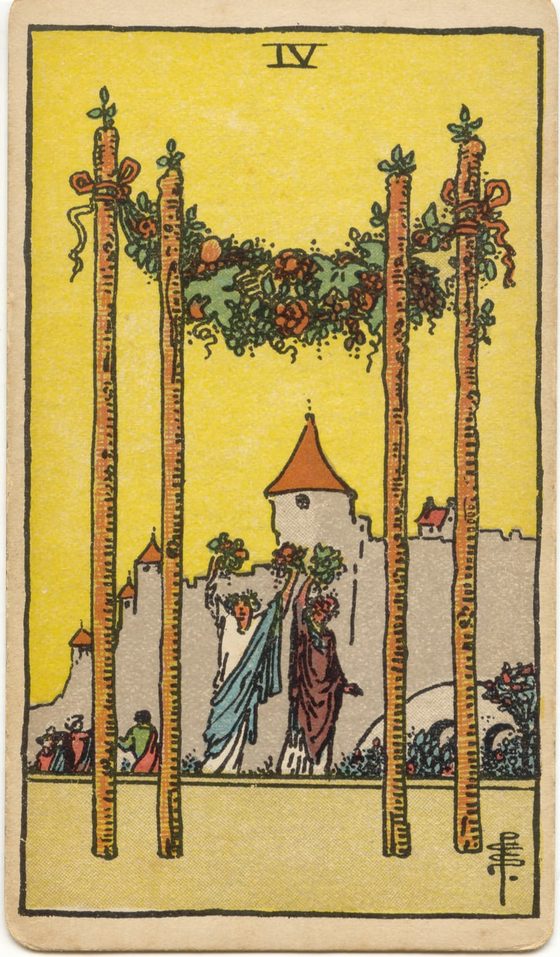
Four staves stand upright in the foreground, evenly spaced and planted in bare ground. Each is topped with green shoots. Strung between their tips is a heavy garland of flowers, fruit and leaves, sagging slightly under its own weight. The staves are the tallest things in the picture and they frame everything behind them.
Beyond the garland, two figures in pale robes raise bouquets above their heads. Further back a small crowd stands near a stone bridge, and behind that a walled building with square towers. The sky is flat yellow with no clouds and no sun drawn in it. Nobody in the picture is looking out at the viewer, and no single figure is placed at the centre.
Upright meaning
The Four of Wands is the moment a piece of work becomes solid enough to stand without being held. Four staves, planted, carrying a garland between them: the structure is doing the work now, and there is enough slack in the situation for people to gather under it. It is the first genuinely settled card in the suit.
Read upright, it usually describes homecoming, completion of a stage, or a threshold crossed in company rather than alone. The emphasis falls on the shared part. Something private has become public, and other people are now involved in it. The card is about the moment being witnessed. That is what separates it from the solitary planning of Two of Wands and the waiting of Three of Wands.
What the card does not promise is permanence. Four is a stable number, not a final one, and the suit continues into open conflict at Five of Wands. Neighbouring cards decide the reading: beside cards of building the Four reads as an earned pause, and beside cards of strain it reads as a celebration held slightly too early, or held to convince someone.
Upright in love
In a relationship reading the Four of Wands describes a relationship that has become visible to other people. Moving in together, an engagement, meeting families, or simply the point where the two of you stop explaining yourselves and are treated as a unit. The card is about recognition more than it is about feeling.
That has a cost the cheerful picture hides. Once something is public it is harder to change quietly. If the question is whether a relationship is settled, this card says the surrounding structure is settled. It does not say the same about what either person actually wants, and it says nothing at all about the other person's private thoughts.
Upright in work
At work this is the launch, the handover, the project that finally ships and gets named in front of the wider team. It marks a stage closing rather than a career changing. The team is the point: the Four of Wands rarely describes solo achievement, and if it turns up for a solo question it is often pointing at who else made the thing possible.
It can also describe a workplace where belonging has been established, a probation period passed, a role that has stopped feeling provisional. Read it as a description of standing, not of pay or promotion. Those are different questions and this card does not answer them.
Upright in money
In money questions the Four of Wands tends to describe a base that now holds: a deposit paid, a debt cleared, an arrangement that has stopped needing constant attention. The relief is real and it is worth naming.
What the card does not do is forecast. It describes the current footing, not the next twelve months, and a stable footing is exactly the condition under which people take on more than they should. If the question is whether to commit to something larger on the strength of this stability, the card has no opinion. That decision belongs to arithmetic you can check.
Upright as feelings
As someone's feelings, this is comfort rather than intensity. It reads as settled, welcoming, glad to have you in the picture: the feeling of wanting to introduce you to people rather than the feeling of wanting you alone. It is warm and it is not urgent. Read alongside a card of desire it can look tepid; read alongside a card of instability it looks like safety.
Upright as advice
Mark it. Say out loud, to the people who were part of it, that a stage has closed. A meal, a message, a short speech, something with a date on it. This card fails when the work runs straight into the next thing and nobody registers that the first one finished.
Reversed meaning
Reversed, the Four of Wands splits two ways and they pull against each other. The first is a celebration that is not earned: the announcement made before the thing is finished, the party thrown to make a shaky arrangement look solid to whoever is watching. The garland is up and the staves are not planted. Everyone involved can feel the gap, and nobody says so.
The second is stability that has quietly become confinement. Nothing is wrong. The structure holds, the people are the same people, and that is the problem. The reversal here is not disorder but a threshold nobody wants to cross, because crossing it would disturb something that works. Comfort and stagnation look identical from inside.
The card does not choose between these. The question and the surrounding spread do. Near cards of conflict the first reading is likelier; near cards of stasis, the second. A reader who reaches for a cancelled celebration every time this card lands upside down is reciting a keyword, not reading a spread.
Reversed in love
Either a relationship being displayed as more settled than it is, the public version running ahead of the private one, or a settled relationship where the next threshold keeps not arriving and neither person will name why. Both are real readings of this reversal and they are opposites. Ask which one the rest of the spread supports. The card describes the gap between how a relationship looks and how it is, not who is at fault for the gap.
Reversed in work
A launch announced before the work is done, or a milestone that gets no acknowledgement at all and quietly drains the people who hit it. It can also mark a team that has become comfortable enough to stop changing: everyone gets on, nothing improves. Which reading applies depends on whether the spread is describing pressure or drift. Neither version is a prediction about your job.
Reversed in money
Spending to mark something that has not actually happened yet, or a base that looks stable because nothing has been examined in a while. The reversal points at the distance between the appearance of security and the state of the ledger. It is a prompt to look at the numbers, not a warning about them, and this card is not the place to get an answer about what to do with money.
Reversed as feelings
Warmth that is being performed rather than felt, or warmth that is genuine but has gone flat through repetition. Someone can be entirely fond of you and entirely unwilling to move anything forward, and this reversal covers that state without judging it. The card does not tell you which of the two you are looking at.
Reversed as advice
Work out which reversal you are in before doing anything. If the celebration is early, postpone it and finish the thing. If the structure has gone stale, name the threshold you have been avoiding and put a date on it. Doing the wrong one of these makes the situation worse, so decide first.
Symbolism in the 1909 image
The four staves. Planted in bare earth, not held by anyone. They are read as a completed frame, four being the number of stable structure. Worth noting that they carry the garland but enclose nothing; there are no walls between them. The shelter is implied, not drawn.
The garland. Flowers, fruit and leaves strung across the tops, heavy enough to sag. Usually read as harvest and celebration. It is also the only thing in the picture connecting the four staves to each other, and it is the least durable material in the image.
The two figures with bouquets. Arms raised, faces indistinct. Books read them as a welcoming party. Smith drew them small and without detail, which makes them ambiguous: a greeting and a crowd look much the same at that scale.
The stone bridge and the walled building. A settled, defended place in the middle distance. Read as home, security, an institution. The figures are outside it, in the open, not inside the walls.
The bare foreground. The ground the staves are planted in is empty and undecorated. Whatever the celebration is, it is happening at the edge of the settled place rather than inside it.
Where this meaning came from
The numbered cards of the four suits began as the pip cards of a fifteenth-century Italian trick-taking game. A four of batons was a four of batons: a rank in a suit, with no picture and no meaning attached. For roughly three hundred years nobody read it for anything.
Divinatory meanings were fixed onto the pips in eighteenth- and nineteenth-century France, first through Antoine Court de Gebelin's speculations and then in the systematic lists sold by Etteilla. Those lists gave the fours of batons associations with settlement and domestic peace that later writers inherited without checking where they came from.
The picture most English readers have in mind is from 1909, drawn by Pamela Colman Smith under Arthur Edward Waite's direction. Smith gave the minor cards full scenes rather than repeated pips, which is why the Four of Wands has a garland and a crowd at all. Waite's own note in The Pictorial Key to the Tarot (1910) is short: country life, harvest home, repose, concord. Almost every modern paragraph about this card is a longer version of that sentence.
Smith was paid a flat fee for the whole deck and signed the cards only with her monogram. The scenes that make the minor arcana readable at all were her invention.
The common misreading
The Four of Wands is the card people use to promise a wedding. It does not promise one. It describes a threshold crossed in public, and weddings are one instance of that among many: a housewarming, a graduation, a return home, a contract signed in front of witnesses. Reading it as an engagement announcement is reading one example as the whole meaning.
The second misreading is treating it as unambiguously good news, and therefore as a card that cancels the difficult cards around it. It does not cancel anything. Beside Five of Wands or Ten of Wands it often describes a celebration held by people who are already exhausted.
The third is quieter. Because the card is warm, readers skip past the reversal's second meaning, comfort that has hardened into avoidance, and reach only for the cancelled party. That reading is available and it is usually the less interesting of the two. Stability that nobody will disturb is a harder thing to say out loud, which is exactly why it gets left unsaid.
Questions to sit with
- What stage has actually closed here, and have you told anyone that it closed?
- Who else has a claim on this that you have not acknowledged out loud?
- Is the public version of this situation ahead of the private one, or behind it?
- What would have to change for this arrangement to stop being comfortable, and are you avoiding that?
Pull this card in a real spread.