- Card number
- 3
- Arcana
- Minor Arcana
- Suit
- Wands
- Element
- Fire
- Rank
- Three
- Yes or no reading
- It depends
Three of Wands
A card about waiting for something already sent out. The Three of Wands describes the interval after commitment, when the work is done, the result is not yet visible, and there is nothing useful left to do.
- waiting
- foresight
- commitment
- patience
- expansion
- delay
- interference
- impatience
- setback
- overreach
What the card shows
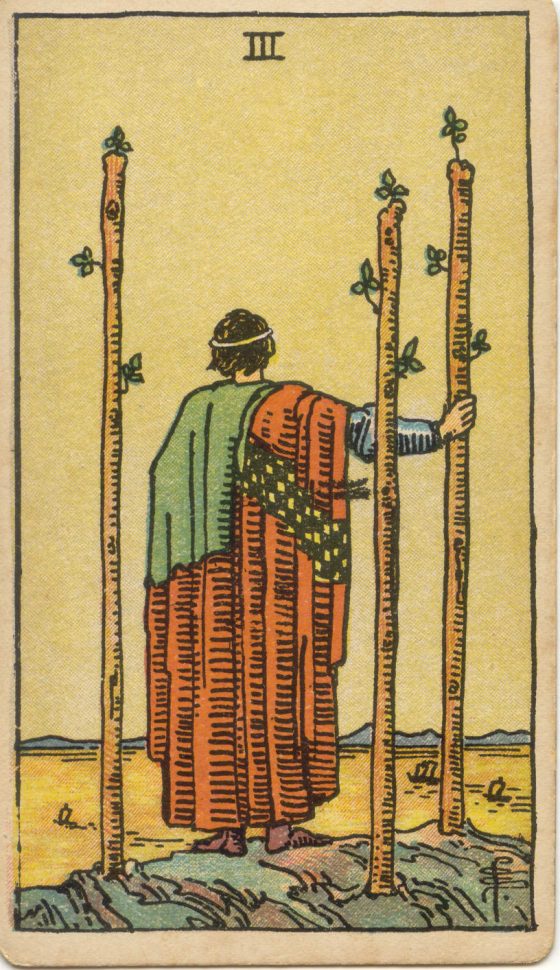
A figure stands on a rocky ledge with his back fully to the viewer, looking out over water. He wears a long orange robe with a green cloak over one shoulder and a patterned band across his back, and a plain circlet around his head. His right arm is extended and his hand rests on one of the staves.
Three tall staves are planted around him, all still in leaf: one at the far left, and two on the right, one of which he is holding. Below and beyond the ledge, a wide yellow bay stretches to a low blue coastline, with small ships visible on the water. The sky is a flat yellow. Nothing in the scene is moving.
Upright meaning
The Three of Wands is the card of the wait after the commitment. The Two was the decision; here the decision has been acted on and the result is somewhere out on the water. The figure has his back to us because there is nothing to see in his face. The whole content of the card is in what he is looking at.
Drawn upright it usually describes a situation where the work has genuinely been done and the outcome is now outside the querent's control. Applications submitted, a product shipped, a message sent, a business launched. This is a materially different position from waiting for something you have not started, and the card is precise about which one it means.
The difficulty it describes is the specific discomfort of having nothing useful left to do. Most people fill that interval with activity that does not help. Waiting well is a skill and it is mostly restraint. Beside Two of Wands, which precedes it, the plan has become a commitment; beside Eight of Wands the waiting is nearly over, because that card is the same energy in transit.
Upright in love
In relationship readings the Three of Wands usually means something has been said and the answer has not come back yet. A confession made, an invitation extended, a boundary stated. The querent has done their part and the situation now belongs to somebody else.
It is a good card for the honesty of the position and a poor one for reassurance. Nothing in it indicates what the answer will be, and the figure is looking at an empty bay. Where the question is whether to send another message, the card is fairly clear: the ships are already out, and sending more will not make them arrive sooner. It may make them arrive differently.
Upright in work
At work the Three of Wands is the period after submission. The proposal is in, the launch has happened, the applications are with the panel. Work continues, but not work that changes this particular outcome.
It reads well for anything where the querent's contribution is complete and the assessment sits elsewhere. It reads poorly as a card of activity, because it describes the opposite. The practical use of this card at work is that it distinguishes between two states that feel identical from inside: waiting for a result, and waiting because you have not finished. Only one of them is improved by working harder, and the Three of Wands is describing the other.
Upright in money
In money questions the Three of Wands describes returns that have been committed and not yet arrived. An invoice sent, work delivered and not yet paid, a venture running that has not reported.
The card gives no indication of the amount and no indication of whether it comes back at all. Ships on a horizon are the oldest image in commerce for exactly this: capital that is out of your hands and out of your sight. What the card does say is that the exposure already exists. Decisions about further commitment are better made after this one resolves, not because the card forbids them, but because you currently have less information than you will have shortly.
Upright as feelings
Settled expectation. As someone's feelings, the Three of Wands describes a person who has made up their mind, has communicated it in some form, and is now waiting to see what you do. There is patience in this position and there is also a limit to it, which the card does not specify.
Upright as advice
Do not send the follow-up. Pick one thing that is genuinely unrelated to this outcome and give the waiting period to that instead. The Three of Wands is specifically the card for situations where further effort on the same matter makes things worse rather than better, and the discipline it asks for is leaving something alone.
Reversed meaning
Reversed, the Three of Wands gives two readings that both involve the wait going wrong, in opposite directions.
The first is delay and the frustration attached to it. Something expected has not arrived, timelines have slipped, and the querent is holding a position that has cost more than it was supposed to. This is the standard reading and it is usually accurate about the facts.
The second is interference. Reversed, the card frequently describes someone who has not been able to leave the thing alone: chasing, following up, adjusting the submission after it was submitted, contacting the person who was given time to think. The waiting has been filled with activity, and the activity is now part of the outcome. From inside this feels like diligence.
The distinction matters because the responses are opposite. The first calls for patience with better information. The second calls for stopping. If the querent can list four things they have done about this in the last week, and none of those things were requested, the reversal is describing the second.
Reversed in love
Either an answer that is taking much longer than expected, or a querent who has made the waiting unbearable for both parties by not leaving it alone. The second is more common than people admit and is one of the few things in a reading that is entirely within the querent's control. Reversed, this card is also drawn where somebody is waiting for a reply to a message the other person did not read as a question.
Reversed in work
Timelines slipping, or a person undermining their own submission by continuing to work on it. Reversed, this card turns up around processes that have a stated decision date which has passed, and around candidates who have followed up three times. The first is genuinely outside your control. The second is the only part of the situation that is not, which makes it the part worth attending to. Where the surrounding cards show conflict rather than delay, read Seven of Wands instead: that card is about defending a position, not waiting on one.
Reversed in money
Payment later than agreed, or money committed to a venture that has stopped reporting. Reversed, the card is a reasonable prompt to find out which of those you are in, because they call for different actions: one needs a chase, the other needs a decision about whether to commit anything further. The card offers no opinion on the venture itself, only on the fact that you are currently operating without information you are entitled to.
Reversed as feelings
Patience running out, or patience that was never really there. Reversed, this position often describes someone who has been waiting for the querent to do something and has stopped expecting it. That is a quieter state than anger and considerably harder to reverse, because nothing about it announces itself.
Reversed as advice
Find out the actual decision date and then stop touching it until that date passes. If there is no stated date, ask for one once, in writing, and then stop. Reversed, this card describes a situation being damaged by attention, and the instruction is to give it none for a defined period.
Symbolism in the 1909 image
The turned back. He is the only figure in the suit drawn entirely from behind. No expression is available, which means the card gives the reader nothing to work with about how he feels. That is unusual and it is probably deliberate: the subject of the card is the horizon, not the man.
The three staves. Planted in the ground rather than held, all still in leaf, spaced apart. He has one hand on one of them. Read as ventures under way. The detail that matters is that they are fixed in place: this is not a card about carrying anything.
The ships. Small, distant, on the water below. Usually read as enterprises returning. Nothing in the drawing indicates whether they are coming in or going out, and the card is frequently read as the first when the second is equally available.
The yellow sky and water. Smith flooded the whole background with flat yellow, so that sea and sky are almost the same colour. It removes depth from the view. The effect is that the horizon looks close and unreadable at once, which is a reasonable picture of waiting.
The high ground. He is standing on a rocky ledge above everything else in the picture. Elevation is normally drawn as advantage. Here it mostly means he can see a long way and cannot reach any of it.
Where this meaning came from
The Three of Wands has no independent history worth the name. In the Marseille and earlier Italian decks it is three batons in an arrangement, with no scene, no figure and no assigned meaning. It existed to be a rank in a card game. Any account that traces this specific image back to medieval symbolism is describing something that was drawn in 1909.
The Golden Dawn gave the card the title Established Strength and assigned it to the Sun in Aries in the 1880s, as part of the systematic scheme that filled in the pips. Etteilla had produced an earlier and unrelated set of meanings a century before. Both are inventions, made roughly a hundred and a hundred and thirty years ago respectively, and both are frequently presented as ancient.
Pamela Colman Smith drew the figure on the cliff, the bay and the ships, and that picture is the reason the card reads as waiting for returns rather than as established strength. Waite's entry in The Pictorial Key to the Tarot is brief and mentions a merchant looking out for his ships, a commercial reading that fits the drawing and sits loosely on the Golden Dawn title it was supposed to illustrate.
The common misreading
The Three of Wands is widely reported as a card of ships coming in. The drawing does not support the certainty. The ships are small marks on a distant bay and nothing indicates their direction. The card describes a person watching for a result. It does not describe the result, and a reading that promises the ships are inbound has decided something the picture left open.
The second misreading is the travel one, inherited from the Two. Because there is water and boats, this card gets read as a journey. The figure is not going anywhere; he is standing on a rock with his hand on a fixed staff, looking. If anything is travelling in this card it is not him, and the difference between going somewhere and watching for something to come back is the entire content of the image.
The third is the most practically damaging. Because the card feels active, querents read it as an instruction to push. It is the opposite. This is the one card in the suit that describes a situation where additional effort is either useless or harmful, and the most common way people mishandle this position is by filling the wait with contact that was not asked for. Compare The Chariot, which is the card for when pushing is the answer.
Questions to sit with
- What is currently out of your hands, and when will you actually know?
- What have you done about this in the last week that nobody asked you to do?
- If the answer comes back no, what is the next thing you would do?
- Are you waiting for a result, or waiting because you have not finished?
Pull this card in a real spread.