- Card number
- 2
- Arcana
- Minor Arcana
- Suit
- Wands
- Element
- Fire
- Rank
- Two
- Yes or no reading
- It depends
Two of Wands
A card about the moment after a first success, when the next move has to be chosen. The Two of Wands describes planning from a position of safety, and the safety is part of the problem.
- planning
- scope
- choice
- foresight
- ambition
- deferral
- overreach
- stalling
- poor timing
- indecision
What the card shows
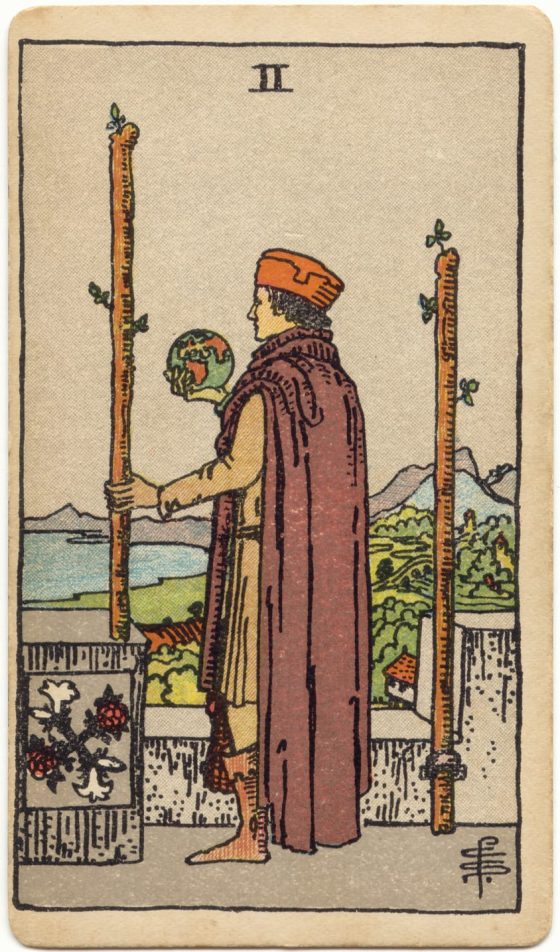
A man in a long red cloak and an orange cap stands on the stone rampart of a castle, seen from behind and slightly to the side. He holds a small globe in his right hand, close to his chest, and looks out past it. His left hand grips a tall staff that stands beside him.
A second staff is fixed upright to the wall on the right, unattended. On the parapet at the lower left is a stone panel carved with white lilies and red roses arranged in a cross. Beyond the wall, water opens out on the left and green land with a red-roofed building lies on the right, with mountains behind.
Upright meaning
The Two of Wands is the card of the second decision, the one that comes after something has already worked. The Ace of Wands was the impulse; this is the point at which it has produced enough to be worth protecting, and the question becomes whether to extend it or to hold what exists.
Drawn upright it usually describes someone with a real position and a real choice: a business that works locally and could go further, a skill that has an audience and could have a larger one, a life that is comfortable and could be different. The card is about scope. It is a card of choice without pressure. Nothing in it is urgent, which is precisely why the decision can be deferred indefinitely.
The tension is drawn into the picture. He is on his own wall, holding a globe, looking at a horizon he is not standing in. One staff is in his hand and the other is bolted to the wall. Beside Three of Wands, which follows, the decision has been made and he has moved to the edge; beside cards of comfort it reads as a plan that will stay a plan.
Upright in love
In relationship readings the Two of Wands usually describes a person deciding how much of their life to open up. The connection exists and works; the question is scope. Whether to introduce someone to the rest of your world, whether to move, whether to make room.
It often appears where one person is content with the current arrangement and the other is looking at the horizon. That asymmetry is the card's characteristic shape, and it is worth naming rather than smoothing over. The Two of Wands does not say which position is correct. It says a decision about size is being avoided by at least one person, and that the comfort of the present arrangement is what makes avoiding it easy.
Upright in work
At work this is the expansion decision. The role is secure, the work is competent, and there is a larger version available that would cost something to reach. It is the card of the person who could apply and has not, or the business that could open a second location.
It reads well for planning, market assessment and any question about scale. It reads poorly for questions about whether to persist with something that is already failing, because the Two of Wands assumes a working position as its starting point. Compare The Emperor, which describes holding territory rather than considering more of it, and note that the Two contains no obligation to move at all.
Upright in money
In money questions the Two of Wands describes a stable position with an unused option in it. Savings that could be doing something, a skill that could be charged for, capacity that is currently idle.
The card is about whether to extend, not about what to extend into, and it offers no view on any specific choice. What it does describe accurately is the psychology: a comfortable position makes deferral cheap, and deferral has a cost that does not appear on any statement. If a decision here has been open for more than a year, that is itself the information the card is providing.
Upright as feelings
Interest that has been considered rather than felt suddenly. As someone's feelings, the Two of Wands suggests a person who has thought about you in the context of their whole life and has not finished deciding what to do about it. That is more flattering than it sounds and slower than most querents want.
Upright as advice
Set a date by which the decision gets made, and tell one other person what the date is. The Two of Wands describes a choice that is genuinely open and will stay open forever unless something external closes it. A deadline you have told somebody about is the cheapest available external thing.
Reversed meaning
Reversed, this card divides into two situations that look similar from outside and require opposite responses.
The first is the plan that has stopped being a plan. Reversed, the Two of Wands often describes someone who has been intending to expand for years, who can describe the larger version in detail, and who has taken no step toward it. The globe is being held rather than travelled. Nothing has gone wrong; nothing has happened either.
The second is expansion attempted without a base. The card upright assumes a secure position to plan from. Reversed, that assumption can fail: someone extending into something new while the thing that funds them is deteriorating, or committing to scale before the current version reliably works. This version is the more dangerous of the two and it is drawn less often.
The spread separates them. Cards of stability nearby, with the reversal, point to the first. Cards of strain or overreach point to the second. The first is fixed by acting. The second is fixed by stopping, and telling one from the other is most of the reading.
Reversed in love
Either a relationship where the bigger conversation keeps being postponed, or one where somebody is making plans the other person has not agreed to. The second is the less comfortable reading and it is worth checking for. Reversed, the card can also describe someone weighing a relationship against everything else in their life and finding the comparison difficult to say out loud.
Reversed in work
Expansion planned and never begun, or expansion begun without the base to support it. Reversed, the first shows up as a strategy document that is now three years old. The second shows up as a second commitment while the first is still consuming everything. Both are common. The distinguishing question is whether the existing thing currently runs without the querent's constant attention, and that question has a factual answer.
Reversed in money
Capital sitting idle for longer than intended, or capital committed to an extension the current position cannot carry. Reversed, this card is less about the amount than about the sequencing: whether the thing being expanded from is actually stable. That is checkable and is frequently not checked, because checking it is a slower and less interesting activity than planning the expansion.
Reversed as feelings
Someone still weighing, or someone who has weighed and does not want to report the result. Reversed, this position often describes a person for whom the feeling is not the difficulty; the difficulty is where it fits with everything else they have arranged. That is not indifference, though it is frequently experienced as it.
Reversed as advice
Take the smallest irreversible step available. Not more planning, not another version of the document: something that cannot be undone quietly, like telling someone or paying a deposit. Reversed, this card describes a decision that has been kept reversible for so long that reversibility has become the actual choice.
Symbolism in the 1909 image
The globe. Small, held close to the chest, with continents marked on it. The world is in his hand at a scale that fits in a palm. That is either mastery or a model, and the card's whole ambiguity is contained in which one you take it for.
The two staves. One is held; the other is bolted to the wall behind him. Only one of them is going anywhere, and he is holding the one that is not attached. Books read the pair as choice. The drawing suggests something more specific: one option is already fixed in place.
The wall. He is standing on his own battlement, which is to say inside his own defences. Everything he is looking at is outside them. The card is often glossed as vision, and the more accurate description is vision from safety.
The lilies and roses. Carved into a stone panel on the parapet, arranged as a cross. The same two flowers appear together on The Magician. Usually read as desire and purity in balance, which is a Golden Dawn convention rather than anything the picture explains.
The land and the water. Sea on one side, cultivated ground with a building on the other. Two directions, both drawn, neither favoured. Smith gave the two halves of the view roughly equal space, and nothing in the composition indicates which way he is going to go.
Where this meaning came from
Like all the numbered Minors, the Two of Wands had no picture and no meaning for most of its history. In the Marseille pattern it is two crossed batons on a plain ground, a card in a trick-taking game with a rank and a suit and nothing else. There is no medieval tradition of a man on a rampart holding a globe, because there was no man, no rampart and no globe.
Meanings for the pip cards were manufactured twice. Etteilla produced a set in the 1780s as part of the first commercial cartomancy system. The Golden Dawn produced a more systematic scheme in the 1880s, in which this card was titled Dominion and assigned to Mars in Aries. Nearly every modern keyword for the Two of Wands descends from that Golden Dawn title.
Pamela Colman Smith invented the scene itself for the 1909 deck. Waite's The Pictorial Key to the Tarot describes it briefly and slightly oddly, dwelling on a lord looking out over his possessions and calling it a card of a man whose success has left him unsatisfied. That note of dissatisfaction is Waite's, it is not in the Golden Dawn material, and it is the most useful thing anyone has said about the card.
The common misreading
The Two of Wands is routinely read as travel. The globe is doing all the work in that reading, and a globe held in a hand is a model of the world rather than a journey through it. Waite mentions no travel in his entry. The association appears to have arrived later, by way of the object, and it has been repeated ever since without anybody re-examining it.
The second misreading is treating the card as a decision already made. It is a card about standing still with options, drawn from inside a fortification. Everything in it is preparatory. Readers who report that this card means expansion is under way have moved the querent one card forward in the sequence, which is a real and consequential error when the actual position is that nothing has been committed.
The third is the flattering reading. Because the figure is well dressed and stands on his own wall, the card gets read as a picture of achievement. Waite's own gloss is unusually sour about this: he describes a man who has what he wanted and is not satisfied by it. That reading is available in the drawing, it is older than the cheerful one, and it is almost never the one a querent is offered.
Questions to sit with
- What is the larger version of your current situation, and what would the first step toward it cost?
- How long has this decision been available to you?
- What are you protecting by not deciding?
- If you chose to stay exactly as you are, could you say that out loud as a decision rather than a delay?
Pull this card in a real spread.