- Card number
- 1
- Arcana
- Major Arcana
- Suit
- Major Arcana
- Element
- Air
- Rank
- Trump
- Roman numeral
- I
- Planetary attribution
- Mercury
- Yes or no reading
- Yes
The Magician
Tools laid out on a table and one hand raised to the sky. The Magician is the card of having what a situation requires. Whether that capacity gets used honestly, or used at all, is the part the card leaves open.
- manifestation
- skill
- resourcefulness
- focus
- initiative
- manipulation
- untapped talent
- poor planning
- deception
- self-doubt
What the card shows
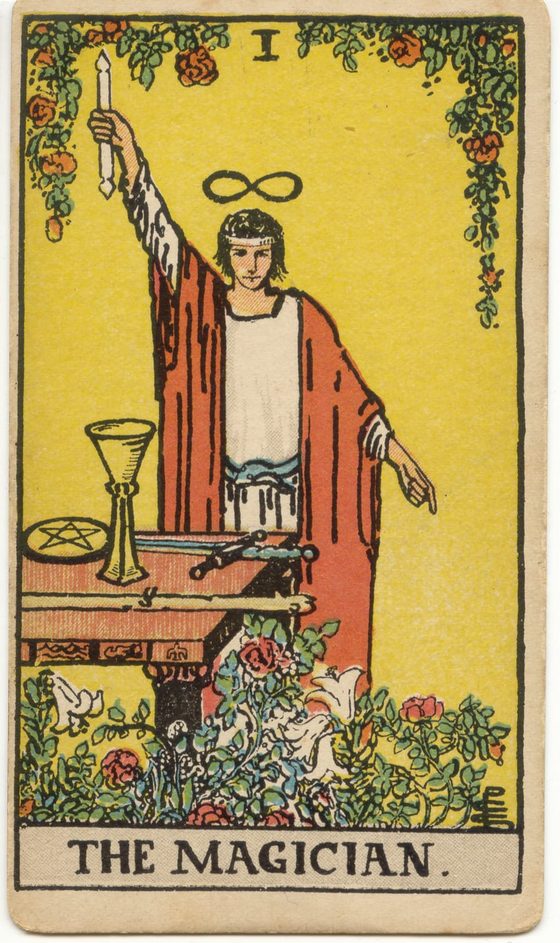
A figure stands behind a table in a garden, facing forward. The right arm is raised overhead holding a short white wand; the left arm points down at the ground, index finger extended. Above the head floats a horizontal figure eight. A snake belt is fastened at the waist, biting its own tail. The robe is white, the outer cloak red.
On the table lie four objects: a cup, a coin marked with a pentagram, a sword, and a wand. Roses and lilies grow around and above the table, the roses red, the lilies white. A trellis of roses hangs over the figure's head. The background is plain yellow. Nothing in the picture is in motion.
Upright meaning
The Magician describes a situation in which the means are already present. Everything needed is on the table, in reach, and the question is not whether the resources exist but whether the person will pick them up. The card is numbered one: it is the first act after the open-ended step of The Fool, the moment where potential is given a direction.
Drawn upright, it usually points to competence rather than luck. Skill, timing, articulacy, the ability to make something happen through deliberate effort. Waite associated the raised wand and the lowered hand with the transmission of something from above to below, but the practical reading most readers use is simpler: intention becoming action. It is also a card about being seen doing it, since the table is set out in the open.
What the card cannot tell you is what the intention is for. A capable person and a capable manipulator draw the same card. It describes a posture, not a purpose. Beside The High Priestess it reads as knowledge being put to use; beside cards of concealment such as the Seven of Swords it reads as skill turned toward getting away with something; beside cards of exhaustion it can mean the tools are there and the will is not.
Upright in love
In a relationship reading, The Magician usually describes agency rather than feeling. Someone in this situation has the capacity to shape it: to say the thing that needs saying, to make the arrangement work, to start the conversation that has been postponed.
That is not the same as sincerity, and the card is careful about the difference. Charm is one of the tools on the table. Where the question is about someone else's intentions, this card tells you they are capable and persuasive, which is information about their skill and not about their honesty. Read it with what surrounds it.
Upright in work
At work this is the card of being equipped. The brief is within your range, the skills are ones you have already used, and what remains is execution. It often turns up for people who are underestimating themselves, and occasionally for people who are not.
It also describes visible competence: presenting, pitching, negotiating, teaching. Work where the effect depends on how well you communicate what you already know. The Magician is not a card about credentials. Waite's figure has no title and no institution behind him, which is exactly what separates this card from The Hierophant, where the authority is borrowed from a structure rather than demonstrated.
Upright in money
In money questions The Magician points at your own capacity to earn, negotiate or restructure rather than at an amount arriving. The resources in the picture are tools, not treasure. The coin on the table is one of four objects and is not singled out.
Read practically, it often marks a situation where the numbers can be changed by something you do: asking, quoting differently, selling a skill you have not been charging for. It says nothing about whether a specific decision is sound. That question needs facts the card does not contain, and a person qualified to look at them.
Upright as feelings
As someone's feelings, The Magician is interest with intent behind it. Not a drifting attraction but one that has already started planning how to act. It can read as focused and flattering, or as calculated, and the drawing does not distinguish between the two. What it does say is that the attention is deliberate.
Upright as advice
Pick one thing off the table and use it this week. The Magician's failure is not incapacity, it is inventory: assembling skills and options and never spending any of them. Choose the single tool the situation actually calls for, name it before you start, and put the other three away.
Reversed meaning
Reversed, The Magician most often reads one of two ways, and they point in opposite directions. The first is manipulation: the same skill, aimed at an outcome the other people involved have not agreed to. Persuasion that works because information is being withheld. It can also describe skill used on oneself, a story told convincingly enough that the teller believes it.
The second is capability that never leaves the table. The tools are all still there, laid out, arranged, admired. Nothing gets picked up. This version is far more common in practice than the first and much less flattering to diagnose, because it looks like preparation. A person can spend years acquiring tools as a way of not being judged on results.
Nothing in the image decides between them. The question decides, and so do the cards around it. A reversal beside cards of confusion tends toward the second reading; beside cards of conflict, toward the first. A reader who always reaches for trickery is reading the reputation of the card rather than the spread.
Reversed in love
Either charm doing work that honesty should be doing, or a person who knows exactly what would improve the relationship and does none of it. Both are failures of use rather than of feeling. The reversal can also mark a mismatch of effort, where one person is managing the connection like a project and the other is simply in it. Look at whether the surrounding cards describe pressure or inertia; that is what separates the two.
Reversed in work
Overselling, or never selling at all. The first is a pitch that outruns what can actually be delivered; the second is competence that stays invisible because it is never claimed. Both are common and they need opposite corrections. The reversal can also describe a role where your skills are real but pointed at work nobody needed doing. Before treating it as a warning about someone else, check whether it is describing your own inventory.
Reversed in money
Money moved by persuasion rather than by arithmetic, in either direction: something sold to you well, or something you talked yourself into. The other reading is capacity left idle, an earning skill you have never put a price on. The card comments on the reasoning, not the amount, and it is not a judgement about any specific arrangement. Anything with real consequences here needs looking at properly, with numbers and with someone qualified.
Reversed as feelings
Attention that is performing rather than felt, or feeling that has been thought about so much it has not been expressed. In both cases the gap is between what is going on inside and what is being shown. The reversal does not say the feeling is false; it says the presentation is not a reliable guide to it.
Reversed as advice
Work out which reversal you are in before you correct anything. If you are persuading, stop and say the part you have been leaving out. If you are stockpiling, ship one thing unfinished this week and let it be judged. The two errors have opposite fixes, and applying the wrong one makes it worse.
Symbolism in the 1909 image
The four objects on the table. A cup, a pentacle, a sword and a wand: the four suits of the minor arcana, laid out where they can be reached. They are usually read as the full set of available means. The drawing gives no indication that the figure has used any of them; they are arranged, not disturbed.
The raised wand. Held vertically overhead in the right hand, white at both ends, with no obvious top or bottom. Waite read the gesture as drawing something down from above. It is also, plainly, a stage gesture.
The lemniscate. The horizontal figure eight above the head. Standard reading: unlimited potential or eternity. Worth noting that it was not in the older French decks in this form, where the magician wears a wide-brimmed hat drawn in a similar curve.
The snake belt. A serpent swallowing its own tail, worn as a belt rather than displayed. Read as renewal and self-sustaining cycles. It is also the least visible symbol on the card, which is either modesty or a joke.
The roses and lilies. Red roses and white lilies growing in the same bed, usually read as desire and purity held together. Smith drew them in unnatural abundance, more decorative border than garden, which makes the tidy symbolic split harder to sustain than the books suggest.
Where this meaning came from
The Magician began as il Bagatto in the Italian tarot of the fifteenth century, and the name is not flattering. It meant something like a trickster or a street conjuror, the lowest of the trump cards, and it carried no divinatory meaning because the deck was for playing a trick-taking game.
The occult reading arrives in eighteenth-century France. Antoine Court de Gebelin and later Etteilla rewrote the deck as Egyptian priestly wisdom, and the street performer was promoted to a magus. Almost every claim from that period about tarot's ancient origins has since been shown to be invented.
The card as English readers know it is the 1909 drawing by Pamela Colman Smith, made to Arthur Edward Waite's direction, with Waite's commentary in The Pictorial Key to the Tarot (1910). Waite's own gloss is deliberately vague; he was more interested in the gesture than in the fortune-telling. Modern keyword lists for this card are almost always paraphrasing him.
The trickster never entirely left. When a modern book warns that this card can mean deception, it is reaching back past Waite to the Bagatto, four hundred years earlier.
The common misreading
The most common misreading is treating The Magician as a guarantee of success. The card says the means are available. It says nothing about whether they will be used, used well, or used in time. Waite's text is notably restrained on this point, and the confident modern gloss is a later addition. It is not a promise; it is an inventory.
The second is reading it as a card about willpower and stopping there. That flatters the querent and closes the reading. The picture shows equipment, not effort, and the honest question it raises is uncomfortable: if everything needed is already on the table, why has nothing been picked up? Most people who draw this card do not have a resource problem.
The third is using it to answer questions about other people's motives. The Magician describes capability, and capability is morally neutral. Read as someone else's intentions it tells you they are persuasive, which is exactly the situation in which you should want evidence rather than a card.
Questions to sit with
- Which of the resources you already have are you not using, and what would using one cost you?
- Is the thing stopping you a missing skill, or a decision you have not made?
- Who would be affected if you used your influence here the way you know how to?
- What have you been preparing for long enough that preparing has become the activity?
Pull this card in a real spread.