- Card number
- 2
- Arcana
- Major Arcana
- Suit
- Major Arcana
- Element
- Water
- Rank
- Trump
- Roman numeral
- II
- Planetary attribution
- Moon
- Yes or no reading
- It depends
The High Priestess
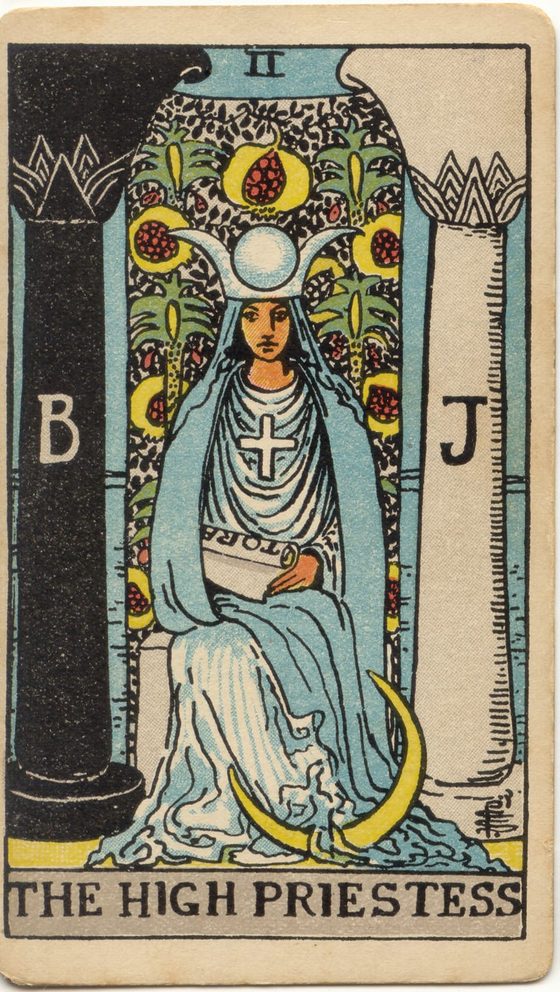
A seated figure between two pillars, with a scroll half hidden in her lap. The High Priestess is the card of knowledge that is present but not yet spoken, and of the difference between not knowing and not saying.
- intuition
- secrets
- stillness
- inner knowing
- patience
- withheld information
- ignored instinct
- secrecy
- hesitation
- disconnection
What the card shows
A woman sits between two pillars, one black and lettered B, one white and lettered J. She wears a blue robe that falls into a pool of drapery at her feet, and a horned headdress holding a full circle between the horns. A cross is worked into the front of her gown.
A partly rolled scroll rests in her lap, most of it covered by her cloak; the visible part is marked TORA. A crescent moon lies at her left foot. Behind her hangs a curtain patterned with pomegranates and palms, drawn across the space between the pillars so that only a strip of water is visible past its edge. She is looking directly out of the card.
Upright meaning
The High Priestess describes a situation where something is known but not yet available. The scroll is in her lap and mostly covered. The curtain is drawn. The card is not about ignorance; it is about information that exists and is being held back, sometimes by circumstance and sometimes by the querent.
Drawn upright, it usually counsels waiting and attention rather than action. Where The Magician is the card of picking things up and using them, this is the card of leaving them where they are until you understand what they are for. It sits between two of the most active trumps in the sequence, with The Empress immediately after it, and its function is to slow the run. It often appears when a decision is being pushed for before the facts are in.
The intuition reading, which is the one most modern books lead with, is a narrower claim than it sounds. It says a person already has an impression they have not examined, not that the impression is correct. Beside The Moon the card leans toward material that is genuinely unclear; beside a card of plain fact it more often means someone is choosing not to look. What it will not do is tell you what is behind the curtain.
Upright in love
In relationship readings The High Priestess usually marks something unspoken. A feeling that has not been declared, a history that has not been mentioned, an arrangement both people understand and neither has named.
The card does not say the silence is hostile. Some things are held back out of care, some out of self-protection, and some because saying them would make them real. Where the question is about another person's feelings, this card is honest about its limits: it says there is something not being said, and it does not say what. Where the silence has hardened into a standoff rather than a pause, the Two of Swords describes the same posture at closer range.
Upright in work
At work this is the card of the person who knows more than they are saying, which can be discretion or can be leverage. It also describes situations where the information you need exists inside the organisation and has not been shared with you.
As advice it usually favours research over announcement. Do not commit publicly to a position you have not tested. In a negotiation it reads as holding your figure back until you know theirs. The failure mode is obvious once named: waiting can be diligence, and it can be a way of never being wrong in public. The card does not distinguish, and the rest of the spread has to.
Upright in money
In money questions this card usually means the picture is incomplete. Figures you have not checked, terms you have not read, a cost someone has not mentioned. It reads as a pause rather than a direction.
It can also describe money deliberately kept private, which is not the same as money hidden dishonestly. The card gives no opinion on any specific arrangement and no view on whether a decision is sound. If something material is at stake, the missing information is the point, and it is worth getting from a person qualified to supply it rather than from a card.
Upright as feelings
As someone's feelings, The High Priestess is interest kept deliberately quiet. Something is felt and is being watched rather than acted on. It is not coldness and it is not indifference; it is a person waiting to see what the situation is before committing to a position in it. The card says the feeling exists. It does not say how strong.
Upright as advice
Write down what you already suspect, before you ask anyone else. The High Priestess is not advice to consult an oracle; it is advice to notice the impression you have been discounting and put it in words where you can test it. Then leave the decision alone for a week.
Reversed meaning
Reversed, this card splits into two readings that are close to opposites. The first is secrecy that has stopped being useful: information withheld past the point where withholding it was protective, by the querent or by someone else. Silence that has hardened into a habit. In a spread about a relationship this often reads as an omission rather than a lie, which is harder to name and harder to forgive.
The second is the opposite failure: an inner signal being ignored or talked over. Not because it is unavailable but because acting on it would be inconvenient. Readers often describe this as being disconnected from intuition, which overstates it. The plainer version is that someone has already noticed something and has decided not to count it.
There is a third, less charitable reading worth keeping in the set: knowledge used as status, held back so that holding it means something. Which of the three applies is decided by the question and the surrounding cards, not by the reversal itself.
Reversed in love
Something kept back too long, or an instinct about the relationship that is being argued away. Both show up as a gap between what a person knows and what they will say out loud. The reversal does not identify who is doing the withholding; querents assume it is the other person roughly as often as it is themselves. Read the surrounding cards for who is under pressure.
Reversed in work
Information kept from you, or information you are keeping from a decision you have already made. The reversal also covers the long research phase that has become a hiding place: more reading, more consultation, no position taken. In a team it can describe someone whose value depends on being the only person who knows how something works. None of these are the same problem, and the spread has to say which one you are looking at.
Reversed in money
Either something has not been disclosed to you, or you have been avoiding looking at the numbers yourself. Both produce the same feeling of not quite knowing where you stand, and only one of them is someone else's doing. The reversal is a prompt to check rather than a verdict on any arrangement, and it carries no opinion on what you should do with your money.
Reversed as feelings
Feeling that is being managed rather than felt, or feeling withheld as a form of control. In the milder version a person simply has not worked out what they think yet. In the harder version they have, and the not-saying is doing work. The card cannot tell you which, and neither can a reader who has only met one of the two people involved.
Reversed as advice
Say the thing you have been sitting on, or go and find the fact you have been avoiding. Pick whichever of those two you flinched at. The reversal is not asking for more reflection; you have had the reflection. It is asking for the sentence you have already composed and not sent.
Symbolism in the 1909 image
The two pillars. Black and white, lettered B and J. The letters stand for Boaz and Jachin, the pillars of Solomon's temple in the biblical account. Read as duality, and as a threshold. The figure sits exactly between them, which is usually taken as balance and is equally readable as being stuck.
The scroll. Marked TORA and mostly hidden under the cloak. The standard gloss is hidden or higher law. What the drawing shows is more specific: the document is present, in reach, and covered by the person holding it.
The curtain. Pomegranates and palms on a veil drawn between the pillars. It hides whatever is behind the seat, and the only clue to what that is comes from the narrow band of water visible at its edge. Books treat the pomegranates as fertility and the palms as their masculine counterpart; the drawing is not that tidy.
The crescent at her foot. A moon lying on the floor beside the hem, not worn and not held. Read as the lunar and the instinctive placed underfoot, meaning mastered rather than dismissed, though the picture allows both.
The water. A thin strip visible past the curtain, and the same water that runs through several later cards in the deck. It is the smallest detail on the card and the one most often missed, which is a reasonable thing for a card about overlooked information to do.
Where this meaning came from
In the fifteenth-century Italian decks this trump was la Papessa, the female pope, and it is the card that caused the most trouble. It appears to reference the legend of Pope Joan, and later Italian printers replaced it under church pressure with a figure called Juno.
The occult layer is French and eighteenth-century. Court de Gebelin and Etteilla recast the deck as Egyptian, and the Papess became a priestess of Isis. As with the rest of that tradition, the Egyptian claim was invented and has no documentary support.
Waite renamed the card The High Priestess for the 1909 deck and, in The Pictorial Key to the Tarot (1910), described her as the Secret Church and the highest of the esoteric grades. He was writing for readers inside his own order, and the passage is more allusive than instructive. Pamela Colman Smith's drawing is doing more work than his text.
The modern keyword intuition does not come from Waite at all. It arrives later, largely through twentieth-century popularisers, and it has almost entirely displaced the older reading of the card as institutional and hidden knowledge.
The common misreading
The most common misreading is treating The High Priestess as a guarantee that your instinct is right. The card says an impression exists. It does not certify it. A hunch and a bias present identically from the inside, and a card cannot tell them apart. Waite's own account of the card is about institutional secrecy, not personal instinct.
The second is using it to confirm that someone is hiding something from you. This is the reading querents want, and it is the one the card supports least. The figure in the picture is the one holding the scroll. Read literally, the withheld information in this card belongs to the person the card describes, and in a one-person reading that is usually you.
The third is treating patience as the answer every time this card appears. Waiting is sometimes the correct move and sometimes the expensive one, and the card gives no view on which. Used carelessly it becomes permission to defer a conversation indefinitely while calling the deferral wisdom.
Questions to sit with
- What do you already think is going on here, that you have not said to anyone?
- Is the information you are missing genuinely unavailable, or have you not asked for it?
- If you are staying quiet, who is that protecting, and is it still necessary?
- What would change if you found out you were right?
Pull this card in a real spread.