- Card number
- 2
- Arcana
- Minor Arcana
- Suit
- Swords
- Element
- Air
- Rank
- Two
- Yes or no reading
- No
Two of Swords
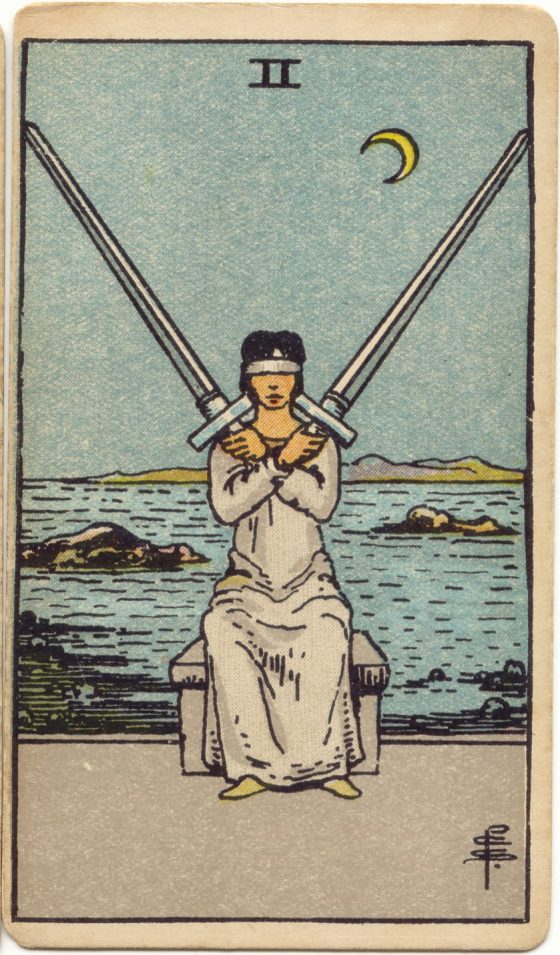
A blindfolded figure holds two crossed swords over her chest with the sea behind her. The Two of Swords is a decision being held off, and the card is honest that the balance costs something to maintain.
- stalemate
- avoidance
- difficult choice
- truce
- indecision
- impasse broken
- information revealed
- entrenchment
- forced choice
- evasion
What the card shows
A woman sits on a plain stone bench, facing forward, in a pale grey robe. A white cloth is bound over her eyes. Her arms are crossed at the wrist in front of her chest, and in each hand she holds a long sword, raised so the two blades form a wide V above her shoulders. Her feet are together on the ground.
Behind her is a flat expanse of water, broken by a scattering of small rocks and low islands. The far shore is a thin line. A crescent moon hangs in the upper right of the sky. There is no wind in the picture and nothing is moving. The swords are heavy and she is holding them at a difficult angle.
Upright meaning
The Two of Swords is a stalemate that is being actively held. Two options, two swords, and a person who has stopped looking at either. In most readings it describes a decision the querent is postponing, and the postponement is doing work: while nothing is chosen, nothing has to be lost.
The blindfold is the argument of the card. This is not someone who lacks information. It is someone who has arranged not to have it, because having it would make the choice obvious and the choice is one they do not want to make. That is a common and fairly human position, and the card is not contemptuous of it. Truces exist for reasons.
What the card will not do is tell you which way to go. It describes a posture, not an outcome. Beside Ace of Swords it reads as clarity available and declined. Beside The High Priestess the same stillness reads as legitimate waiting rather than avoidance. Beside Eight of Swords the avoidance has already hardened into a trap. The cards around it decide whether this is patience or paralysis, and those two are genuinely hard to tell apart from the inside.
Upright in love
A relationship in suspension. Nobody is leaving and nobody is committing; the difficult conversation keeps being scheduled and not held. It can also mark a person weighing two attachments and refusing to look at either clearly, which is usually more painful for the people either side of them than for them.
The card is neutral about whether the pause is fair. Some situations need time. Others are held still because a decision would cost the person holding it something they are not ready to pay. If the question is what someone else intends, the honest answer is that they have not decided, and this card cannot say when they will.
Upright in work
A decision stalled at work: two offers, two directions, two candidates, and a process that has quietly stopped moving. It often turns up where the deadlock is being maintained by someone who benefits from nothing changing, and that person is not always the obvious one.
As advice it points at the missing information rather than at the choice. Ask what you would need to know in order to decide, then find out whether you can actually get it. If you can, the stall is a research problem. If you cannot, waiting will not help, and you are choosing under uncertainty whether you admit it or not.
Upright in money
Two options on the table and no move made: a purchase deferred, a change of plan half-considered, accounts not opened. The card describes the avoidance rather than the amounts, and avoidance in money matters is rarely neutral, because the position keeps changing while nobody is watching it.
None of this is advice about what to do with the money. The card has no view on that and neither does a reading. What it flags is that the decision is currently being made by default, and default is still a decision.
Upright as feelings
Feelings deliberately not examined. As someone's feelings toward you, this is usually genuine ambivalence rather than concealment: they have not worked out what they think and are not currently trying to. It can read as coldness from the outside. From the inside it is more often stuckness, and the card does not say how long it lasts.
Upright as advice
Take the blindfold off before you decide anything. Write down the one fact you have been careful not to look up, and look it up today. If it turns out you already knew it, the honest task is not more research but admitting the choice is already made.
Reversed meaning
Reversed, the Two of Swords goes two ways and they are close to opposites, and only the spread decides which one is in play.
The first is the stalemate breaking. Information arrives, or somebody else moves, and the balance that was being held collapses. This is often a relief and it is not always chosen; the decision gets taken out of the querent's hands. Whether that lands well depends entirely on the rest of the spread.
The second is the stalemate hardening. The avoidance stops being a pause and becomes a position. The blindfold is no longer temporary, and the costs of not deciding have started to accumulate on other people. Where Three of Swords sits nearby, the delay has already done its damage. In this reading the card is markedly less sympathetic than it is upright.
Some books also give the reversal deceit, on the grounds that the blindfold has become a lie rather than a defence. That is available, but it is the least common of the three, and reaching for it first says more about the reader than about the spread.
Reversed in love
Either the impasse finally breaks, with a conversation happening or a choice being made, or it sets into something more permanent than either person intended. Both feel like movement to the person in the middle and only one of them is. If other cards in the spread describe pressure, expect the first. If they describe entrenchment, the second is likelier, and the cost is being paid by whoever is waiting.
Reversed in work
A deadlocked decision that resolves, often because someone senior stops waiting, or a stall that has quietly become the actual policy. The second is harder to see because it does not look like a decision. Nobody announces that the project is not happening; it simply stops being discussed. If the spread points that way, the useful move is to name the stall out loud rather than wait it out.
Reversed in money
A financial decision that gets forced, or an avoidance that has hardened into a habit with a running cost. The reversal often marks the point where not looking has become expensive: in fees, in a lapsed arrangement, in an option that closed while nobody was watching. The card does not tell you what to do about it, and it is not a judgement on the numbers, only on the looking away.
Reversed as feelings
Ambivalence that has either resolved or calcified. As someone's feelings, this can be a person who has finally worked out what they think, or one who has settled into not knowing as a permanent arrangement. The card does not say which, and it does not report what the resolution was.
Reversed as advice
Decide, or say plainly that you are not deciding and for how long. The second is a real option and it is honest; drifting is not. Give the pause an end date you would be willing to tell the other people affected, and then tell them.
Symbolism in the 1909 image
The blindfold. A white cloth tied over the eyes, and the detail the whole card turns on. Read as refusal to see, or as the impartiality Justice is usually given. Smith draws it as a plain bandage rather than a ceremonial band, which tilts it toward avoidance, but the ambiguity is real and old.
The crossed swords. Held at the wrists, blades apart, forming a wide V. They are balanced and they are also heavy, and nobody holds that pose comfortably for long. The equilibrium in this card has a running cost.
The water. Flat, scattered with small rocks and low islands. Water in this deck is usually feeling, and here it sits entirely behind her, unseen and unaddressed. She has her back to it.
The crescent moon. High in the upper right, and the only light in the picture. It gives enough to see by and not enough to see clearly, which is a fair description of what the querent is working from.
The stone bench. Low, plain, set at the edge of the water. She is seated rather than standing. This is a position she has settled into, not one she was caught in.
Where this meaning came from
The Two of Swords began as a pip card: two swords, no scene, in the fifteenth-century Italian packs where tarot was a trick-taking game. For most of its life this card had no picture beyond the count of its suit and no meaning attached to it at all.
Divinatory readings came out of eighteenth-century France, where Antoine Court de Gebelin and then Etteilla attached interpretations to the whole deck. Etteilla's readings for this card cluster around friendship and affection and have almost nothing to do with how it is read now. The Egyptian ancestry claimed for tarot in that period was fabricated.
The scene English readers picture is entirely Pamela Colman Smith's. Illustrating the Minor Arcana in 1909, she invented figures for pip cards that had never carried them, and the blindfolded woman is her invention rather than a tradition. Waite's line in The Pictorial Key to the Tarot (1910) is short: a hoodwinked female figure, conformity, equipoise.
So nearly everything a modern book says about this card is a reading of a drawing made in 1909 by an illustrator who was paid once and credited with her initials.
The common misreading
The commonest misreading is treating the Two of Swords as balance. The image is symmetrical and the word turns up in older keyword lists, so the card gets handed over as harmony or fair compromise. Look at the picture. The swords are heavy, the arms are crossed hard against the chest, and the eyes are covered. Whatever this is, it is not restful.
The second is the opposite error: reading the blindfold as pure denial and telling the querent they are hiding from the truth. Some people in this position are avoiding. Others are in a situation where the information genuinely is not available yet, and being told to open their eyes is useless advice delivered with confidence.
The third does real damage in relationship spreads. The card gets read as proof that the other person is stalling on purpose. It describes a stalemate; it does not assign a reason for it, and it certainly cannot report what someone else is thinking behind a decision they have not announced.
Questions to sit with
- What is the piece of information you have not gone looking for, and why have you not?
- Who is paying for this decision not being made, and is it you?
- If both options were equally acceptable, would you still be stuck here?
- What would have to be true for you to take the blindfold off tomorrow?
Pull this card in a real spread.