- Card number
- 1
- Arcana
- Minor Arcana
- Suit
- Swords
- Element
- Air
- Rank
- Ace
- Yes or no reading
- Yes
Ace of Swords
A hand comes out of a cloud holding one sword, point up, crowned. The Ace of Swords is the moment a thing becomes clear enough to name, and naming it is not the same as it being welcome.
- clarity
- truth
- breakthrough
- decision
- directness
- confusion
- misinformation
- harsh words
- faulty premise
- cruelty
What the card shows
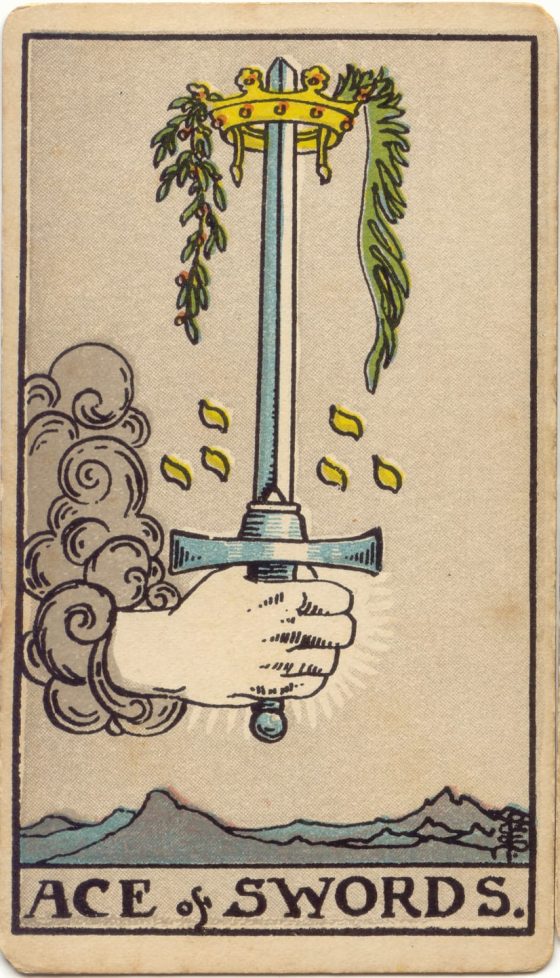
A hand emerges from a grey cloud on the left of the card, gripping the hilt of a long straight sword held point upward. The blade is double-edged and drawn plainly, without ornament. Around its tip sits a gold crown, tilted slightly, with the point passing through it.
A wreath of leaves hangs from one side of the crown and a palm branch from the other, both falling loosely down the blade. Six small yellow marks drift in the air on either side. Below, the ground is a low range of grey and blue mountains with no figures, no buildings and no path. The sky is empty. Nothing in the picture is in motion except the falling marks.
Upright meaning
The Ace of Swords is the suit of Swords in its rawest form: thought before it has been applied to anything. Swords in this deck govern language, judgement, conflict and grief, and the Ace is the point at which a situation stops being a fog and becomes a sentence you could say out loud. That is usually a relief. It is not always good news.
Drawn upright, it most often marks a clarity that is available rather than achieved. The insight is there to be taken; the card is a hand offering a sword, not a person using one. What gets done with it is the next card's business. In a practical spread it can describe the decision to finally name a problem, ask the direct question, or write the thing down.
The blade has two edges, which is the part most readings skip. The same clarity that ends your confusion can end someone else's comfort, and the card does not distinguish. Beside Justice it reads as a truth that will hold up under scrutiny. Beside Two of Swords it reads as the clarity a person is refusing. Beside Ace of Cups it is the head arriving where the heart already was.
Upright in love
In a relationship reading the Ace of Swords is the conversation that has been overdue. Something gets said plainly: what someone wants, what someone will not accept, what has actually been going on. The card favours saying it.
It is not a romantic card and it does not promise the exchange goes well. Clarity is good for a relationship the way surgery is good for a body, which is to say necessary and not the same as comfortable. Where the question is whether someone loves you, this card answers a different question, which is whether you are prepared to find out. Notice that before you treat it as an answer.
Upright in work
At work this is the card of the correct diagnosis. The confused project gets named, the real constraint is identified, the argument that has been going in circles is settled by someone finally stating the actual disagreement. It suits writing, analysis, law, negotiation, anything where precision is the product.
As advice it says be direct and be exact, in that order. Vague candour is not clarity, and the Ace is a fine instrument rather than a blunt one. It also carries a warning most books leave out: whoever says the true thing in the room is not automatically thanked for it. Decide whether you want to be right or want the outcome, because those are sometimes different.
Upright in money
Money seen clearly, often for the first time in a while. This is the card of actually opening the statements, running the numbers, and finding out what the position is rather than what it feels like. It suits an audit far better than a purchase.
The clarity is the whole of what the card offers. It does not say the figures are good and it does not endorse any particular move. If a decision is pending here, the Ace's contribution is to establish the facts first and treat the conclusion as a separate question.
Upright as feelings
As someone's feelings, this is a mind that has made itself up rather than a heart that has warmed. Clear, articulate, possibly blunt. It can be sudden honesty, and it can be a decision already taken and not yet delivered. The card describes definiteness rather than warmth, and it does not tell you which way the conclusion went.
Upright as advice
Write down, in one sentence, the thing you have been circling. Not the feelings around it, the claim itself. If you cannot get it into a sentence you do not have the Ace yet, and the useful work today is finding the sentence rather than acting on the fog.
Reversed meaning
Reversed, the Ace of Swords is read two ways that are close to opposites, and the spread decides which.
The first is clarity that has not arrived. Confusion, a decision made on bad information, an argument in which nobody can state what is actually being argued about. Here the sword is still in the cloud, and the querent is acting as though they know something they do not.
The second is clarity used badly. The truth is available and it is being wielded: honesty deployed as a weapon, the correct point made in the most damaging way available, cruelty conducted with complete accuracy. This reversal is not a failure of intelligence. It is a failure of restraint.
The two are told apart by what surrounds the card, not by the card. Confusion in the spread argues for the first; conflict and damage argue for the second. A reader who defaults to the same one every time is reciting a meaning rather than reading the spread.
Reversed in love
Either a couple talking past each other with neither able to name the real disagreement, or one person using the truth to wound. Both look like an argument from the outside and they need opposite responses. If the spread is heavy with confusion, more information will help. If it is heavy with conflict, more information will not, and what is missing is restraint.
Reversed in work
A decision taken on a premise nobody checked, or a workplace where being right has become more valuable than being useful. The second is commoner in practice and much harder to raise. As advice, work out which of the two you are in before you send anything in writing. Compare Five of Swords, which describes what is left after that argument has been won.
Reversed in money
Financial decisions made without the facts, or facts assembled to justify a decision already taken. The reversal marks a break between the numbers and the reasoning. It can also describe advice that is technically accurate and useless, which is common and hard to spot. The card cannot tell you whether a position is sound, and reversed it is specifically flagging that you may not be in a position to tell either.
Reversed as feelings
Confused feeling, or a settled feeling expressed harshly. As someone's feelings this can be genuine uncertainty they cannot articulate, or a conclusion delivered with more edge than the situation needed. The reversal says something has gone wrong between the thought and the words. It is not a reading of indifference.
Reversed as advice
Say less until you can say it accurately. Before the next message, separate the thing you know from the thing you have inferred, and send only the first. If you find you are mostly inferring, the honest action is to ask a question rather than make a statement.
Symbolism in the 1909 image
The sword. Straight, plain and double-edged, held point upward by a hand with no visible body attached. Read as intellect and truth. The double edge is not decoration: the instrument that clarifies is the instrument that cuts, and Smith gives it no guard worth speaking of.
The crown. Gold, tilted, pierced by the point rather than resting on it. Usually read as mastery or attainment. It is worth noticing that the sword goes through the crown, so the drawing supports authority won and authority impaled equally well.
The wreath and the palm. One hangs from each side of the crown, both drooping. The wreath is conventionally victory, the palm peace or martyrdom. Waite's text says almost nothing about them, and their limpness is the detail nobody explains.
The hand and cloud. The same device opens all four Aces. The suit's power is being offered, not exercised. Nobody in the picture is using this sword.
The mountains. Low, bare and drawn without a path. The suit of Swords consistently gets the emptiest landscapes in the deck, and this is the first of them.
Where this meaning came from
The Aces began as the ace of a suit in an ordinary fifteenth-century Italian pack, where swords were one of four suits used for trick-taking and carried no meaning of their own. Spanish and Italian playing cards still use swords as a suit today, with no divination attached to them at all.
Meaning was applied later. In eighteenth-century France, Antoine Court de Gebelin and then Etteilla assigned interpretations to every card, and the sword suit acquired its long association with conflict and misfortune. Etteilla's lists are largely arbitrary, and the Egyptian ancestry claimed for tarot in that period was invented.
The Hermetic Order of the Golden Dawn, and Waite after it, tied the four suits to the four elements and gave Swords to Air and to the intellect. That link is late nineteenth-century, not ancient.
The picture English readers know is from 1909, drawn by Pamela Colman Smith to Arthur Edward Waite's direction. Waite's entry in The Pictorial Key to the Tarot (1910) gives the card triumph and conquest, plus an unexplained note about excessive degrees in everything. Smith was paid a flat fee and signed the cards with her initials.
The common misreading
The Ace of Swords is most often misread as a verdict in the querent's favour. It turns up in a spread about a dispute and gets taken as confirmation that they are right. The card describes the arrival of clarity, not the content of it, and clarity has arrived just as often for the person on the other side of the argument.
The second misreading is treating it as a prediction of a breakthrough. Aces get read as things about to happen, and this one gets promised as news, a diagnosis, a decision arriving from outside. Nothing in the card says the insight comes to you rather than from you, and nothing in it carries a date.
The third is the sunniest and the most costly. Because the imagery is a crown and a laurel, the card gets read as an unqualified good and the suit it belongs to is quietly forgotten. Swords is the suit that also produces the pierced heart and the sleepless bed. An Ace opening a run of Swords is not announcing a pleasant month; it is announcing that something is about to be said.
Questions to sit with
- What is the one sentence about this situation that you have been avoiding writing down?
- Which part of what you believe here did you verify, and which part did you infer?
- If you say the true thing, who bears the cost of it, and have you counted that cost?
- Are you trying to be right, or trying to change the outcome?
Pull this card in a real spread.