- Card number
- 3
- Arcana
- Major Arcana
- Suit
- Major Arcana
- Element
- Earth
- Rank
- Trump
- Roman numeral
- III
- Planetary attribution
- Venus
- Yes or no reading
- Yes
The Empress
A crowned figure seated on cushions in a field of ripe wheat. The Empress is the card of things growing under conditions that suit them, and of the work of tending that nobody counts as work.
- abundance
- nurture
- fertility
- comfort
- growth
- depletion
- smothering
- stagnation
- neglect
- over-giving
What the card shows
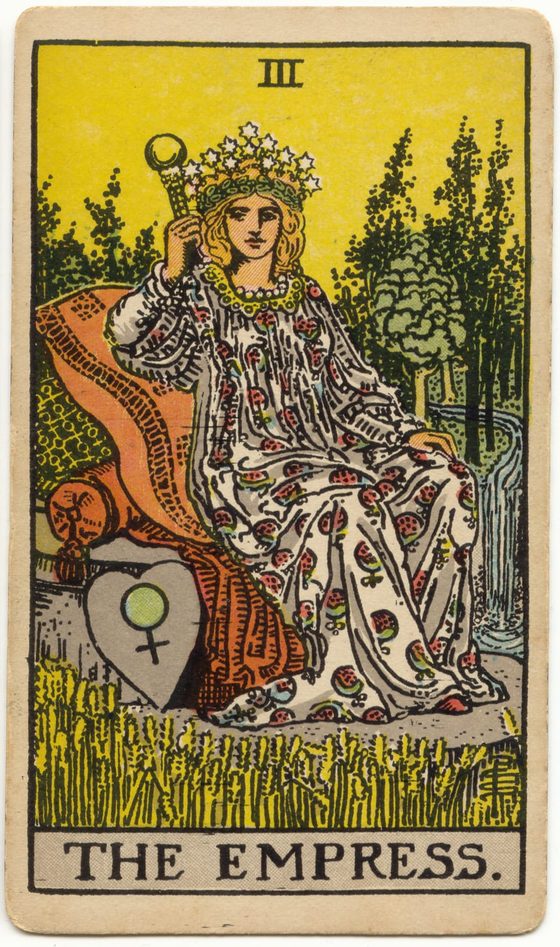
A woman reclines on a low couch heaped with cushions, set outdoors. She wears a loose robe patterned with pomegranates and a crown of twelve stars. In her right hand is a short sceptre topped with a globe. A heart-shaped shield leans against the couch beside her, marked with the symbol of Venus.
In front of her the ground is planted with wheat, drawn head-high and ready to cut. The wheat comes right up to the edge of the couch. Behind, a stand of dark trees and a stream falling over a small drop. The sky is plain gold. Nothing is happening in the picture: no one is working the field, and the figure is not looking at it.
Upright meaning
The Empress describes conditions rather than effort. Something in the situation is favourable and has been for a while: a body of work with momentum, a relationship with slack in it, a household that runs. The wheat in the picture is ready, and nobody is shown having planted it.
Upright, it usually reads as abundance, care, or creative fertility, and all three are the same idea at different scales: something is being sustained. The card is often glossed as motherhood, which is one instance of the pattern and not the pattern itself. Plenty of people draw this card about a project, a garden, or a friendship group they hold together.
What it does not describe is a decision. The Empress has no urgency in her; the picture has no deadline in it. Beside The Emperor, which follows it, the pair read as the difference between growing something and governing it. Beside cards of scarcity such as the Five of Pentacles it can mean resources exist that have not been recognised, and beside cards of pressure it often means someone is doing the sustaining and is not being counted.
Upright in love
In relationship readings The Empress is the card of a connection that is being fed. Attention, food, patience, physical presence, the ordinary maintenance that keeps something alive. It reads as warmth rather than intensity.
It is worth asking who is doing the feeding. The picture shows one person surrounded by growth, not two people sharing it. In a reading about a couple, this card frequently describes an arrangement where one person's care is the reason it works, and where that has stopped being visible to anyone including them. The card does not say whether that is fair. It says it is the case.
Upright in work
At work this is the card of things bearing fruit on their own schedule. A long project reaching the stage where it produces something. A team that has settled and now runs without constant correction. It is not a card of launches.
It also names a kind of labour that organisations are bad at seeing: the person who keeps morale up, who remembers the context, who does the work that only shows when it stops. The Empress upright says that work is happening and is effective. It does not say it is being paid for. Compare the Nine of Pentacles, where the same abundance is unambiguously the figure's own.
Upright in money
In money questions The Empress usually describes sufficiency rather than a windfall. Enough, arriving steadily, from something already established. The field is planted; the card is about the harvest, not the speculation.
It leans toward spending on maintenance and comfort rather than accumulation, and it often turns up around a home. That is a description of a tendency, not a recommendation. The card has no view on any particular arrangement and cannot assess one; anything with real money attached needs figures and a person qualified to read them.
Upright as feelings
As someone's feelings, The Empress is settled affection rather than excitement. Comfort in your presence, an inclination to look after you, a willingness to make room. It is generous and it is also slow; this is not a card of urgency. Where a querent is hoping for evidence of passion, this card describes something steadier and less flattering to read.
Upright as advice
Harvest one thing you have already grown instead of planting another. The Empress upright is not asking for effort; it is asking you to notice what is finished and take it. Name the piece of work, relationship or resource that is ready, and use it this month.
Reversed meaning
Reversed, The Empress reads two ways that pull against each other. The first is depletion: the sustaining has continued past the point where there was anything left to sustain it with. Care given automatically, out of habit or obligation, by someone who has stopped asking what it costs them. It often appears when a person is very tired and has not connected the two facts.
The second is care that has become control. Providing for people in a way that keeps them dependent, or holding a project so closely that nothing in it can develop without you. Both look like generosity from the inside, and that is what makes the reading uncomfortable.
A third and plainer version is simple stagnation: conditions that were favourable and no longer are, still being treated as though they were. Which of the three the reversal means is not in the card. It is in the question, and in what else is on the table. A reader who reaches for self-care every time is giving advice, not reading a spread.
Reversed in love
Either one person is carrying the relationship and running out, or the care has tipped into management and the other person is being handled rather than met. Both are usually invisible to the person doing them. The reversal can also describe a connection that was genuinely nourishing once and is now being maintained out of memory. Look at whether the surrounding cards describe exhaustion or resistance; that is the tell.
Reversed in work
Work that has stopped producing, or a person who has become the bottleneck by holding everything. The second is the more common and the harder to see: competence that nobody can route around, dressed up as being indispensable. The reversal also covers the invisible labour that has finally exhausted whoever was doing it, at which point the organisation discovers what it was getting for free. None of that is a prediction about your job.
Reversed in money
Spending that is doing emotional work, or provision that has become a way of keeping people close. The other reading is straightforward: income from something established that has quietly stopped producing while the outgoings assumed it would continue. The card describes a pattern of behaviour around money, not a fact about your accounts, and it has no opinion on what you should do next.
Reversed as feelings
Affection that has thinned into duty, or affection that has become possessive. In the first the person is still going through the motions and feels nothing much; in the second they feel a great deal and it has stopped being about you. The reversal does not tell you which one you are dealing with, and it is not a verdict on anyone's character.
Reversed as advice
Stop supplying one thing for a week and see whether it collapses. If it does not, you were not needed there and the effort is available for something else. If it does, you now have a specific fact to take to the people who benefit, instead of a general feeling of being taken for granted.
Symbolism in the 1909 image
The wheat. Grown to full height directly in front of the couch, ready to cut. It is the only element in the picture doing anything, and it is doing it without visible attention. Read as fertility and yield; read also as the fact that nobody in the frame is holding a scythe.
The Venus shield. A heart-shaped shield leaning against the couch, marked with the planetary sign of Venus. It is the clearest attribution in the deck and also, plainly, a shield: an object for defence, set down and not being held.
The crown of stars. Twelve of them, usually tied to the twelve signs of the zodiac or to the woman crowned with stars in Revelation. Waite does not settle it, and Smith drew the stars small enough that most readers never count them.
The pomegranates on the robe. The same fruit that appears on the veil of The High Priestess, here worn rather than hung. Read as fertility. The repetition across the two cards is deliberate and is one of the few places where Smith's patterning clearly links two trumps.
The waterfall. A small stream falling behind the trees, easy to miss. Usually read as emotion feeding the land. It is worth noticing that it is the only thing in the picture arriving from outside the frame; everything else is already there.
Where this meaning came from
The Empress is one of the oldest and least disturbed cards in the deck. She appears in the fifteenth-century Italian trumps as l'Imperatrice, paired with the Emperor, and unlike the Papess she caused nobody any trouble. In the trick-taking game she was simply a middling trump.
The divinatory layer arrives with the eighteenth-century French occultists, Court de Gebelin and Etteilla, who supplied the deck with Egyptian origins it never had. The association with Venus and with fertility is later still and comes largely through the Hermetic Order of the Golden Dawn in the 1880s and 1890s, which is where most of the astrological attributions readers now quote were fixed.
Waite was a member of that order, and the 1909 deck he directed carries its scheme. Pamela Colman Smith drew the Venus shield into the picture, which makes the attribution explicit in a way earlier decks never did. In The Pictorial Key to the Tarot (1910) Waite calls her the fruitful mother of thousands and the Garden of Venus, and says little else.
The modern reading of the card as motherhood in a domestic sense is twentieth-century, and it narrows what Waite meant considerably.
The common misreading
The most common misreading is treating The Empress as an announcement of pregnancy. It is the single most frequent question this card attracts and the one it is worst equipped to answer. A card cannot know that, and telling someone it does is a cruel thing to do in either direction: to a person hoping, and to a person who is not.
The second is reading abundance as money arriving. The picture contains no money. It contains a crop that is ready and a person who is comfortable, which describes a state rather than a transaction. Drawn about finances, the honest reading is that the resources already exist, not that more are coming.
The third is the softest and the most misleading. Because the card is warm, it gets used to close a difficult reading on a comfortable note. But an Empress in a spread about exhaustion is not reassurance; it is a description of who has been holding everything together, and it usually points at the person asking.
Questions to sit with
- What in your life is already ripe and has not been harvested?
- Who benefits from the care you provide, and do they know they are receiving it?
- If you stopped doing the maintenance for a month, what would fail first?
- Is the thing you are tending still growing, or are you tending it out of habit?
Pull this card in a real spread.