- Card number
- 1
- Arcana
- Minor Arcana
- Suit
- Wands
- Element
- Fire
- Rank
- Ace
- Yes or no reading
- Yes
Ace of Wands
The offer of something before anything has been done with it. The Ace of Wands is a card of available energy and unspent enthusiasm, and it says nothing about whether the thing gets built.
- spark
- initiative
- desire
- potential
- beginning
- false start
- dispersal
- delay
- flatness
- hesitation
What the card shows
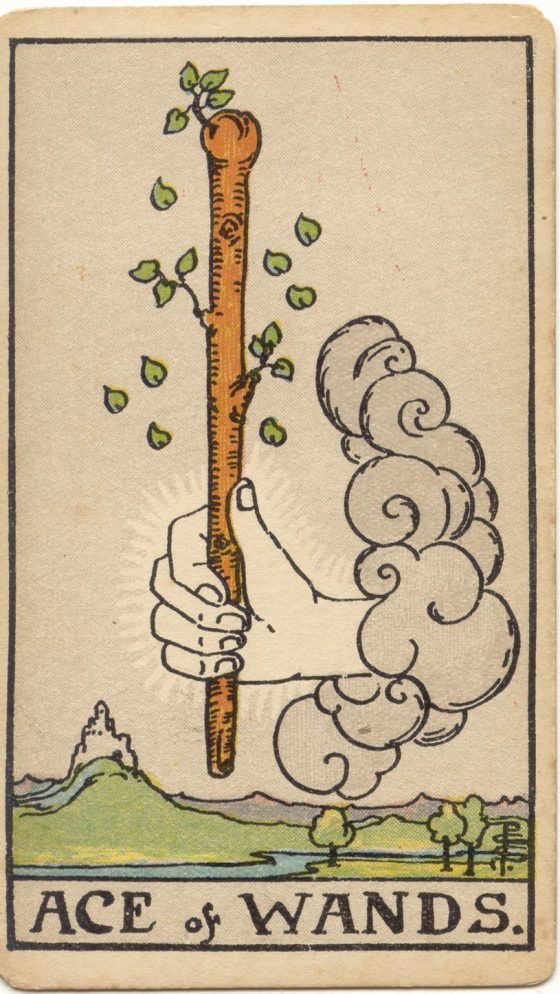
A white hand emerges from a grey cloud on the right side of the card, gripping a thick wooden club upright. The club is still living wood: green leaves sprout from it in several places, and eight loose leaves drift in the air around it. The bark is rough and the cut ends are visible at the top and bottom.
The lower fifth of the card shows a small landscape. A green hill on the left carries a turreted castle. A river runs across the middle distance with trees along the far bank, and low hills close the horizon. The rest of the card is empty pale background, with no sky drawn and no ground under the hand.
Upright meaning
The Aces are the suit in its unused form, and the Ace of Wands is fire before anything has been burned. It describes an impulse that has arrived intact: an idea, an attraction, a sudden appetite for doing something. Nothing has been committed and nothing has been tested. That is the whole of its content.
Drawn upright it usually marks the beginning of something the querent actually wants, which distinguishes it from obligations that arrive looking like opportunities. The energy in this card is genuine and it is also undirected. The hand offers the wand; nobody has taken it. The card marks the arrival of appetite, which is a real event and a small one. Everything it describes is still potential, and potential is not an achievement.
It is worth being plain about the limitation. The Ace says the impulse is real, not that it is wise, and not that it will be acted on. Most of what this card describes is never built. Beside Two of Wands, which follows it, the impulse gets a plan; beside cards of scattering it reads as another enthusiasm in a series.
Upright in love
In relationship readings the Ace of Wands is attraction in its early, physical, uncomplicated form. Interest that has arrived quickly and has not yet had to survive anything. It reads for new connections and for the return of desire in established ones, which is the version people mention less and value more.
It is a poor card for questions about durability. Nothing in it describes commitment, compatibility, or whether either person is available in any practical sense. Where a querent asks whether this is going somewhere, the Ace is describing the starting energy and not the direction. Read Two of Cups nearby for whether anything mutual has actually formed.
Upright in work
At work this is the new thing before it has a name: the idea in the meeting, the side project, the role that has been mentioned but not offered. It carries genuine momentum and no structure at all.
It reads well for starting, pitching, and for the point at which enthusiasm is the actual asset. It reads badly for anything requiring follow-through, because follow-through is the one thing the card does not depict. The practical value of the Ace of Wands at work is that it identifies which of the several things on your list you actually have energy for, which is worth knowing and is not the same as knowing which one you should do.
Upright in money
In money questions the Ace of Wands usually describes a possible source rather than an actual one: a piece of work that might be offered, a venture being considered, an idea that could earn.
It carries no figure and no timeline. Treating this card as income is an expensive mistake, because what it depicts is a hand holding out a stick that nobody has taken yet. If a decision to spend is being made on the strength of money this card seems to promise, the card is being asked to do something it cannot do. What it can confirm is that there is appetite here, and appetite is worth acting on with your own resources rather than borrowed ones.
Upright as feelings
Immediate, physical, uncomplicated wanting. As someone's feelings, the Ace of Wands describes desire that has arrived recently and has not been examined. It is not a card of depth and it is not a card of pretence. What it indicates is that the interest is real and current, with no information about whether it will still be there in three months.
Upright as advice
Do the smallest real version of it in the next three days. Not the plan, not the research, the thing itself at whatever scale you can manage without permission. The Ace of Wands decays quickly if it is only discussed, and the test of whether the impulse was worth anything is whether it survives contact with one afternoon of actual work.
Reversed meaning
Reversed, the Ace of Wands has two readings that are easy to collapse into each other and should not be.
The first is the impulse that did not arrive, or arrived and went. Enthusiasm that has drained out of something, a start that never happened, the flatness that follows a period of wanting things. This is the standard reading and it is straightforward.
The second is energy present but misdirected. The fire is there, and it is going into the wrong thing, or into starting a fourth project while three others sit unfinished. Reversed, this card is frequently drawn by people who are not short of drive at all and are short of a single thing they have stayed with. The problem looks like depletion and is actually dispersal.
Which applies is decided by the rest of the spread, and by a question the querent can answer: how many things have you begun in the last six months. If the answer is none, read the first. If it is several, the second is describing something real.
Reversed in love
Either attraction that has not materialised or has faded, or attraction that is real and is being spread across more than one situation. The second is worth naming plainly, because it is common and rarely volunteered. Reversed, the card can also describe a person whose interest is genuine and whose follow-through is not, which is a distinction that only becomes visible over a few weeks rather than in a reading.
Reversed in work
A start that stalled, or too many starts. The first is a project that lost its sponsor or its momentum. The second is a person whose reputation is becoming about beginnings rather than deliveries, which takes a while to notice and longer to correct. Reversed, this card is a reasonable prompt to count the unfinished items rather than to look for a new one.
Reversed in money
A prospect that did not convert, or money going into starting things rather than finishing them. The second pattern is the more costly and the less obvious: equipment for a hobby taken up twice, fees paid for courses not completed, small sums that only look small individually. Reversed, the card suggests adding those up before considering anything new. It is an uncomfortable total and a useful one.
Reversed as feelings
Interest that has cooled, or interest that is real and unfocused. Reversed, this position often describes someone who means what they say in the moment and does not carry it past the moment. That is not deceit, and treating it as deceit will produce a conversation about the wrong subject.
Reversed as advice
Finish one thing before starting anything else, and pick the one that is closest to done rather than the one you find most interesting. Reversed, this card's problem is almost never a shortage of ideas. It is that nothing has been carried far enough to find out whether it was any good.
Symbolism in the 1909 image
The sprouting wand. The club is cut wood and it is still producing leaves. That contradiction is the whole card: something has been taken from the tree and has not stopped growing. Read as vitality; note also that a cut branch producing leaves is running on stored energy and will eventually stop.
The hand from the cloud. All four Aces in this deck show the same device, a disembodied hand offering the suit's emblem, and Ace of Cups uses it identically. It has no body, no owner and no explanation. Whatever is being offered arrives from outside the querent, and the card gives no account of where from.
The falling leaves. Eight of them, drifting loose around the wand. Usually read as vitality overflowing. They are also, plainly, leaves that have come off, and a picture of energy shedding as fast as it is produced is at least as consistent with the drawing.
The castle. Small, distant, on a hill on the far left. It is the only structure in the card and it is a long way from the hand. Read as what could be built. Nothing connects the two, and nothing indicates the castle is the querent's.
The empty background. Most of the card is blank. There is no ground under the hand and no sky behind it, and the landscape occupies only the bottom strip. The composition puts an enormous amount of unused space around a single gesture, which is a fair picture of unspent potential.
Where this meaning came from
The Minor Arcana have a much thinner interpretive history than the trumps, and the Ace of Wands is a good example of why. In the Italian and Marseille decks the numbered suit cards carried no pictures at all: the ace of batons was a single decorated club on a plain field, and it meant whatever the game required, which was nothing.
Etteilla assigned divinatory meanings to the pips in the 1780s, and the Golden Dawn produced a systematic set in the 1880s, associating the suit of wands with fire and the aces with the root of each element. Those attributions are the source of nearly every keyword now attached to this card. They are about a century old, not ancient.
The scenic images that make the Minors readable at a glance are Pamela Colman Smith's own contribution to the 1909 deck. Waite's instructions for the Minors appear to have been sparse, and much of what a modern reader responds to in these cards is Smith's invention rather than Waite's doctrine. The Pictorial Key to the Tarot gives the Ace of Wands only a short entry: creation, invention, the beginning of enterprise. The picture is doing far more work than the text.
The common misreading
The Ace of Wands is read as a guarantee that the new thing will work. It is not. The card depicts an offer that has not been accepted and a wand that nobody is holding except a hand with no body attached. Everything about execution, timing and outcome is absent from the picture, and a reading that supplies those has invented them.
The second misreading is treating enthusiasm as evidence. Because the card feels good to draw, it gets used to confirm that a plan is sound. Wanting to do something is not information about whether it is a good idea, and the Ace is a card about wanting. Querents who have already decided tend to read this card as permission, which is exactly the use it cannot bear.
The third is specific to the Minors and worth stating plainly. Because Smith's pictures are vivid, readers treat the suit cards as though they carried the same weight as the trumps. In practice the Ace of Wands describes something small and early: an idea, a spark of interest, a first conversation. Reading it as a major life event inflates it well past what the card, or its hundred-year-old keyword list, can support. Compare The Magician, which describes the same energy with someone actually holding it.
Questions to sit with
- What have you wanted to start recently, and what have you actually done about it?
- How many things are currently unfinished on your list?
- If this impulse is still here in a month, what will you have to change to act on it?
- Is this something you want, or something you want to have wanted?
Pull this card in a real spread.