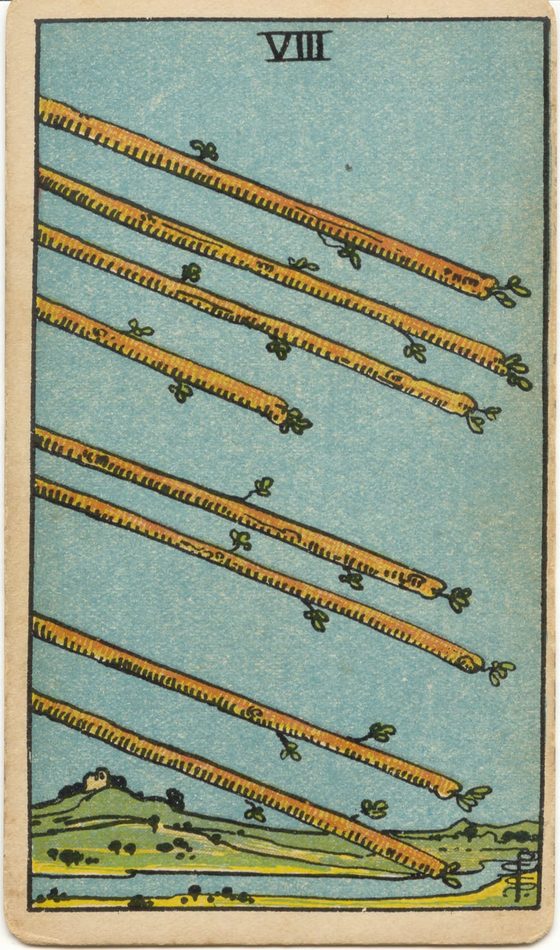
- Card number
- 8
- Arcana
- Minor Arcana
- Suit
- Wands
- Element
- Fire
- Rank
- Eight
- Yes or no reading
- Yes
Eight of Wands
Eight staves in flight, nobody holding them. The Eight of Wands is speed and things already in motion. It describes movement that has left your hands, not the destination it is heading toward.
- speed
- momentum
- news
- movement
- acceleration
- delay
- haste
- scattered
- stalled
- miscommunication
What the card shows
Eight staves fly through a clear sky, arranged in parallel and angled downward from upper left toward lower right. Each one has small green shoots along its length. Nothing holds them and nothing launches them; they are simply in the air, caught mid-flight.
Below is an open landscape: green fields, a river running across the lower part of the frame, a low hill with a small building on it in the far distance. The sky is a flat pale blue with no cloud. It is one of the very few cards in the deck that shows no human figure at all. There is no ground shown directly beneath the staves and no indication of where they will land.
Upright meaning
The Eight of Wands is the card of things moving faster than the people involved. Eight staves in the air, all travelling the same way, none of them under anyone's control any more. Whatever was set in motion is now in motion, and the moment for adjusting it has passed. The staves are drawn with fresh shoots on them, so whatever is travelling is still alive.
Upright it usually reads as speed, news arriving, messages, travel, a situation that has suddenly accelerated after a period of nothing. It is the most kinetic card in the suit and one of the few that describes pure momentum with no person attached. Read positively, it means the delay is over. Read carefully, it means events have outrun deliberation.
The card is silent on direction. The staves are angled down, which suggests arrival, but where they land is outside the frame. Beside Seven of Wands it can read as pressure arriving faster than it can be defended against. Beside a card of preparation it reads as a plan finally in flight. What it never describes is whether the speed is a good thing, and Nine of Wands is where the suit lands after it.
Upright in love
In a relationship reading this is a situation that has picked up speed. Messages that have started coming quickly, a meeting arranged sooner than expected, a connection that went from nothing to daily contact inside a fortnight.
Speed is not the same as depth, and this card is specifically about the first. Things moving fast can be exciting and can also mean that neither person has had time to see the other clearly. If the question is about someone's intentions, the honest answer is that the card describes tempo rather than intent. Fast contact and serious interest are different things and they look identical for the first month.
Upright in work
At work this is the week everything lands at once. Approvals come through, replies arrive, a project that sat still for a month suddenly needs everything done by Friday. It often follows a stalled period and it usually arrives without warning.
The practical reading is about sequencing rather than effort. When eight things are in the air, the failure mode is not laziness, it is trying to catch all of them. The card describes conditions you did not choose. It says nothing about whether the acceleration is good for the work, and a fast yes is not automatically better than a slow one.
Upright in money
In money questions this tends to describe movement: payments clearing, a transaction going through, several financial things resolving in the same short window after a long wait.
What the card marks is pace, not amount and not direction. Money moving quickly can be money arriving or money leaving, and the picture does not distinguish them. If several commitments are landing at once, the useful response is a list and a calendar rather than an interpretation. The card cannot tell you what anything costs, and it is not a reason to commit to something faster than you would have otherwise.
Upright as feelings
As feelings this is infatuation rather than settled attachment: quick, warm, and moving before it has been examined. Someone thinking about you a lot, right now. The card describes intensity and speed, and it deliberately says nothing about duration. Feelings that arrive this fast can last and can also be gone by the time the staves land.
Upright as advice
Pick the one thing that has to land first and handle it before anything else. Eight things in the air cannot all be caught, and trying is how people drop the important one. Write the order down, then work it. The speed is not yours to control; the sequence is.
Reversed meaning
Reversed, the Eight of Wands most often reads as delay. The staves have not launched, or they have stalled in the air. Messages unanswered, a decision that was supposed to have come through, a project that has stopped moving without anyone announcing that it stopped. This is the standard reading and it is frequently right.
The second reading is the opposite: not too slow but too fast. Movement without direction, everything happening at once and nothing being aimed, a rush that has scattered rather than arrived. On this reading the reversal is not about waiting; it is about haste that has cost accuracy. Both readings describe a mismatch between pace and purpose.
There is a third, which is misdirected motion: the staves flying, but not where anyone intended. Effort going somewhere nobody chose. The spread decides. Near cards of stagnation, read delay. Near cards of confusion, read scatter. A reader who says delay every time this card is upside down has stopped reading and started retrieving.
Reversed in love
Either contact that has slowed to nothing after a fast start, or a connection moving so quickly that neither person has looked at it properly. Both are standard here and they ask for opposite responses: one for patience, one for brakes. If the question is why someone has gone quiet, the card marks the change in tempo and nothing else. It does not know their reasons and neither, yet, do you.
Reversed in work
Projects stalled, replies not coming, approvals sitting with someone who has not looked at them. Equally, it can describe a team moving fast in no particular direction, generating activity that does not add up to progress. The two look different on a calendar and identical in a status meeting. Check whether the problem is that nothing is moving or that nothing is aimed, because the fix for one makes the other worse.
Reversed in money
A payment that has not arrived, a transaction held up somewhere in a process nobody can see into, or spending that has accelerated past the point where anyone is tracking it. Reversed, the card is often a prompt to find out where something actually is rather than to wait another week for it. That is an administrative question with an administrative answer, and no card will supply it.
Reversed as feelings
Interest that has cooled, or interest that never settled into anything because it moved too quickly to take hold. Someone whose attention has moved elsewhere, or someone still keen but scattered. The card registers a change of pace in how somebody is behaving, which is not the same as knowing what they feel.
Reversed as advice
Find out where the thing actually is. Not guess, not wait: ask the specific person, by name, what the current status is and when it changes. Most reversed Eight of Wands situations run on the assumption that silence means something, and silence almost never means what people assume.
Symbolism in the 1909 image
The eight staves in parallel. Evenly spaced, all at the same angle. Read as coordinated movement. What is notable is the parallel arrangement: these are not scattered, they are travelling together, which is unusual in a suit that otherwise draws staves crossing.
The absence of any figure. No hands, no launcher, no target. This is the card's most important feature. Whatever set this in motion is off the card, and readings that assign the motion to the querent are supplying an actor Smith deliberately left out. Only Three of Swords is as empty of people.
The downward angle. The staves are descending, not rising. Usually read as arrival, news landing, the end of a journey rather than the start. The ground they are heading for is not in the frame.
The green shoots. Small leaves along the shafts, the same detail that appears throughout the suit. It marks the staves as living wood rather than weapons, which is a quiet argument against reading this card as attack.
The river and the distant house. A settled landscape below the flight path. Read as the destination, though nothing in the drawing connects the staves to it. The house is very small and very far away.
Where this meaning came from
As with the rest of the minor arcana, the eight of batons began life as a playing card in fifteenth-century Italy, with a rank, a suit and no meaning. Nothing in the game required it to mean anything.
Meanings were supplied in France from the late eighteenth century, and Etteilla's nineteenth-century lists are where most of them were fixed. His entries for this card centre on the countryside, on arrows or darts, and on things sent. The association with messages is one of the older and more stable elements in the card's history.
Pamela Colman Smith's 1909 drawing kept the suit-emblem arrangement rather than inventing a scene, which makes this card unusual among her minors. Waite's note in The Pictorial Key to the Tarot (1910) reads it as the arrows of love, and as that which is on the move, adding that the card signifies motion through the immovable. It is one of his more opaque glosses and it has been quietly simplified into speed by everyone since.
The modern shorthand of swift action and news is therefore a genuine descendant of the older tradition rather than a Victorian invention, which is not true of every card in the deck.
The common misreading
The Eight of Wands is regularly read as good news on the way. The card contains no news and no direction. It shows movement, and movement is neutral. A reader who turns speed into a promise of a favourable outcome has added the outcome themselves, and it is the kind of addition people remember when it does not happen.
The second misreading is treating fast as good. In a culture that treats speed as a virtue, this card gets handed over as encouragement. But acceleration is often the point at which mistakes become expensive, and the honest version of this card includes the possibility that things are moving too quickly to be steered. Compare The Tower, where nobody thinks speed is a compliment.
The third is the one about the querent. Because there is no figure in the picture, readers instinctively cast themselves as the thrower. Nothing supports that. The staves may as well be coming at you as from you, and a reading that assumes agency where the drawing shows none is telling someone they are in control of something they may simply be standing under.
Questions to sit with
- What did you set in motion, and can it still be stopped?
- Which of the things currently moving actually needs your attention first?
- Are you moving quickly because it is the right pace, or because stopping feels like losing ground?
- If this arrives sooner than you expected, what are you not ready for?
Pull this card in a real spread.