- Card number
- 9
- Arcana
- Minor Arcana
- Suit
- Wands
- Element
- Fire
- Rank
- Nine
- Yes or no reading
- It depends
Nine of Wands
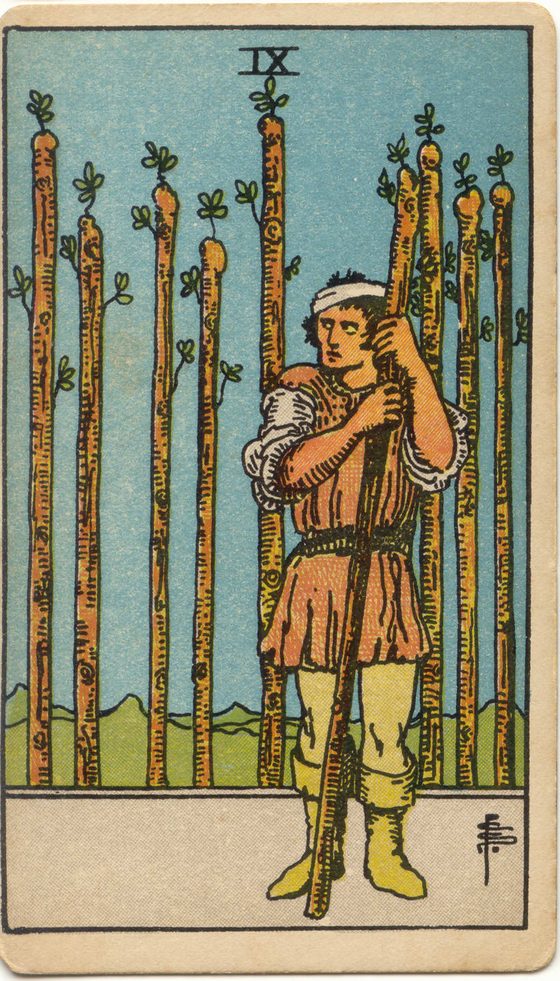
A bandaged man leaning on a staff, eight more standing behind him. The Nine of Wands is what endurance looks like from the inside: still standing, still watching, and tired enough that it shows.
- resilience
- persistence
- guarded
- last stand
- endurance
- burnout
- depletion
- over-guarded
- worn down
- surrender
What the card shows
A man stands leaning on a staff held upright in both hands. A white bandage is wrapped around his head. His weight is on one leg, his shoulders are hunched slightly forward, and he is looking sideways out of the frame rather than ahead. His expression is watchful rather than frightened.
Behind him, eight more staves stand in an upright row, evenly spaced and planted, forming something between a fence and a stockade. They are taller than he is. The ground is bare and pale, with low hills in the distance and a plain sky. Nothing else is happening in the picture. There is no opponent, no weapon raised, and no sign of what caused the injury.
Upright meaning
The Nine of Wands is the card of the last stretch. Something has already cost this person something, the bandage says so, and they are still upright, still holding the staff, still looking for the next thing coming. It is resilience drawn without any glamour attached. Nobody is coming to help.
Upright it usually describes persistence under accumulated strain: a project near the end of a long haul, a person who has been managing something difficult for months, someone who has been let down enough times to expect it. The eight staves behind him are usually read as what he has already built or already survived. They are also a wall between him and everything else.
The card's honesty is in the exhaustion. It does not say the effort was worth it and it does not promise the end is close. Beside Eight of Wands it reads as someone bracing for the next arrival. Beside Ten of Wands it reads as the point just before carrying becomes the whole life. The wariness is earned. Whether it is still useful is a separate question.
Upright in love
In a relationship reading this often describes someone who has been hurt before and is still here, guarded but not gone. The bandage matters: the wariness comes from experience, not from nothing. That makes it reasonable and it also makes it hard to be close to.
It can describe a relationship that has survived something and is still standing, tired. It can equally describe one person doing all the holding while the other has stopped noticing. The card says the guard is up. It does not say whether the current relationship is what the guard is for, and that distinction is usually the whole conversation.
Upright in work
At work this is the long project in its worst month, or the person who has been holding a function together after everyone else left. Competence built out of setbacks. It reads as someone who knows what goes wrong because it has gone wrong before, which is genuinely valuable and is not the same as being well.
The risk the card describes is defensiveness hardening into a working style. Someone who expects to be undermined starts building fences, and fences slow down the people trying to help. If this card turns up for a team question, the useful thing to ask is what happened here before that nobody talks about.
Upright in money
In money questions this describes a position held through difficulty: debt being worked down, a business that has survived a bad stretch, reserves that exist because something once went wrong. There is more resilience here than comfort.
The caution attached to it is real and can also become expensive. Someone who has been burned once often holds too much back, and money kept purely out of fear has a cost that does not appear on any statement. Whether your caution is proportionate is a question about your circumstances, not about the card, and it is worth asking someone who can see the actual numbers.
Upright as feelings
As someone's feelings, this is guarded interest. They are still here and they are braced. Often it describes a person who wants to trust you and has decided not to yet, based on something that happened before you. The card shows the defence and gives no account of what is behind it, which is frustrating and accurate.
Upright as advice
Rest before you decide anything. Not later, and not after this last push: the Nine of Wands is specifically the state in which people make bad calls because they are too tired to see straight. Take one full day away from it, then look at the situation again and see whether it is the same size. Four of Swords is the card that describes what you actually need.
Reversed meaning
Reversed, the Nine of Wands splits along a line most books only walk half of. The first reading is depletion: the defence has finally failed. The reserves are gone, the guard is down, and what was endurance has become simply being worn out. Read this way the reversal is about a person who cannot do it again.
The second is the opposite and it is the more useful one. The guard has become the problem. The fence is up against threats that stopped existing some time ago, and the wariness that once protected something is now the main thing keeping the person alone. Paranoia is too strong a word. Vigilance that outlived its cause is closer.
There is also a genuinely positive version: putting the staff down on purpose, because the fight is over and the person has noticed. Which of the three is in play is decided by what surrounds the card, not by the card. Near cards of pressure, read depletion. Near cards of isolation, read the fence. Near cards of resolution, read release.
Reversed in love
Either someone whose defences have finally come down, which can be intimacy or can be collapse, or someone whose guard has hardened past the point where anyone can reach them. The two are opposite situations and they need opposite responses. If the question is why a person is holding back, the honest answer is that the card shows the holding back and not the reason, and the reason usually predates you.
Reversed in work
Burnout that has arrived rather than been anticipated, or an entrenched defensiveness that is now doing more damage than whatever caused it. Reversed, this card often describes the person everyone finds difficult who is difficult for reasons the organisation created and forgot. It can also mark a decision to stop fighting a battle that ended. Look at whether the cards around it describe load or isolation, because those point in different directions.
Reversed in money
Defences that have run out, or caution that has calcified. Reversed, this card can describe a position that has finally given way after being held too long, and it can equally describe hoarding driven by an old fright rather than a current risk. Telling the two apart requires looking at what has actually happened in the last year rather than at what once happened. That is a records question, not a card question.
Reversed as feelings
Someone worn past the point of defending anything, or someone so defended that the feeling underneath has become inaccessible even to them. Both are exhaustion of a kind. The card marks that the usual guard is not working as it was, without saying whether that is a thaw or a collapse.
Reversed as advice
Ask for help from one specific person, and be concrete about what you want them to do. The reversed Nine of Wands runs on the belief that nobody will come, which is a belief formed at a time when it may have been true. Test it once, on something small, and see what actually happens.
Symbolism in the 1909 image
The bandage. Wrapped around the head, white, clearly fresh. It is the only injury drawn anywhere in the suit. Read as past damage, and it is the detail that makes the wariness reasonable rather than neurotic. Smith gives no account of how it happened.
The staff held upright. Not across the body as in Seven of Wands, and not raised. He is leaning on it. The same object that was a weapon two cards ago is now a support, which is most of what the card has to say.
The eight staves behind. A row, planted, taller than the man. Read as accumulated experience or as defences already built. They are also drawn between him and the background, so whatever is behind them is not visible to him either.
The sideways glance. He is not looking at the staves and not looking ahead. His attention is off the edge of the card, at something the viewer cannot see. Whether anything is there is the card's central open question.
The bare ground. Nothing growing, nothing built, no shelter. The scene is stripped of everything except the man, the fence and the distance.
Where this meaning came from
The nine of batons spent its first three centuries as an ordinary playing card in Italian tarot decks, where the suits existed for trick-taking and carried no meaning at all.
The interpretive tradition was built in France between the late eighteenth and the mid nineteenth century. Etteilla's lists, the practical source for most later attributions, associated this card with delay, suspension and waiting, with expectation rather than with endurance. The modern reading of battle-scarred resilience is not in the older sources in that form.
It comes from Pamela Colman Smith's 1909 drawing, which supplied the bandage. Waite's commentary in The Pictorial Key to the Tarot (1910) reads the figure as a man leaning on his staff with an expectant look, as if awaiting an enemy, and glosses the card as strength in opposition. The bandaged head is Smith's contribution to a card Waite described mainly in terms of posture.
That single detail carries almost the whole modern meaning. Without it the card is a man waiting; with it, he is a man who has already lost something. Smith was paid a flat fee, signed with a monogram, and is not in the deck's usual name.
The common misreading
The Nine of Wands is handed out as encouragement: nearly there, keep going, one more push. That is a reading of the fence, not of the man. Nothing in the picture says the end is close. He is watching an edge of the frame we cannot see, and there is no evidence in the drawing that anything is coming or that anything has stopped.
The second misreading treats the wariness as a flaw to be corrected. It is not obviously a flaw. He has a head wound. Vigilance after injury is a proportionate response, and telling someone in this position that they are being defensive is a way of describing the symptom as the problem. The useful question is whether the danger is still current, and only the querent can answer that.
The third is quieter and worse. Because the card looks heroic, it gets used to make a bad situation sound noble. Endurance is not automatically virtuous, and sometimes it is just the absence of anyone offering to take over. A reading that admires the standing and never asks what it costs has flattered someone instead of helping them.
Questions to sit with
- What actually happened that made you this careful, and when was it?
- Is the thing you are guarding against still capable of happening?
- Who could take some of this off you if you asked, and why have you not asked?
- What would you do differently if you were rested?
Pull this card in a real spread.