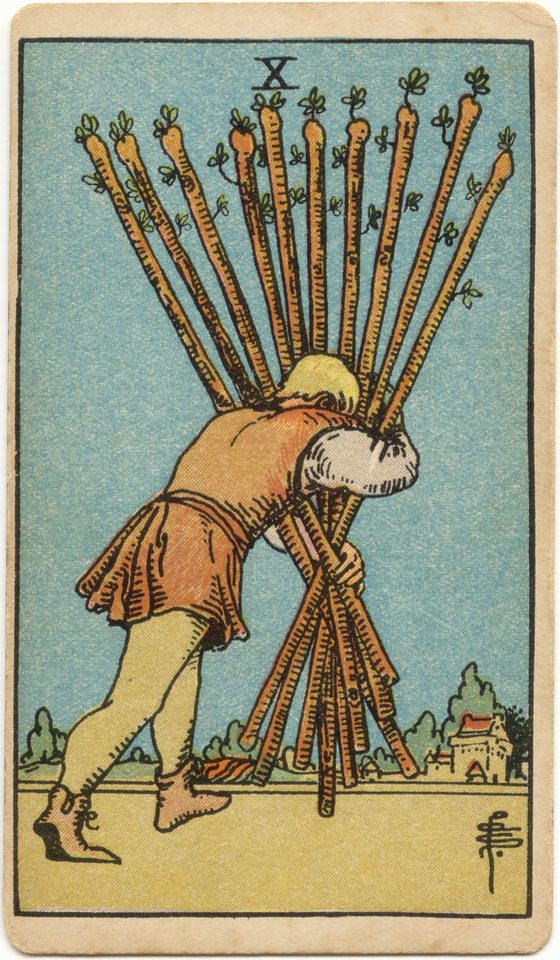
- Card number
- 10
- Arcana
- Minor Arcana
- Suit
- Wands
- Element
- Fire
- Rank
- Ten
- Yes or no reading
- No
Ten of Wands
A man bent under ten staves he is carrying all at once. The Ten of Wands is overload: the end of a long effort, arrived at by taking on everything and putting nothing down.
- burden
- overload
- responsibility
- hard work
- obligation
- release
- delegation
- collapse
- unloading
- handover
What the card shows
A man walks bent almost double under a bundle of ten staves. He holds them gathered in both arms across his chest, and they fan out above and in front of him so that they block his face entirely. His head is down; the viewer cannot see his expression.
He is moving across open ground toward a cluster of buildings in the middle distance, close enough to be reached. The field is bare, the trees behind him are small, and the sky is a plain yellow. Nothing in the picture is pursuing him and nothing is blocking the way. The only obstacle drawn is the load itself, and he is carrying it in a way that makes it heavier than it needs to be.
Upright meaning
The Ten of Wands is the last card of the suit and it is not a triumph. Everything the suit started, the spark of Ace of Wands, the plan, the contest, the win, the defence, has ended up in one person's arms at once. The load is the accumulated result of a series of things each of which seemed reasonable on its own.
Upright it describes burden, responsibility that has grown past what one person can hold, and the specific exhaustion of being nearly finished. The buildings ahead are close. That is the card's cruelty: it is not a picture of failure, it is a picture of someone almost home and unable to see it, because the load is in front of his face.
The card is very clear about one thing. Nobody put the staves on him. He gathered them. That is not a moral judgement, since most overload accumulates from commitments that were individually sensible, but it does mean the situation is more within reach than it feels. Beside Nine of Wands it reads as a load carried past the point of usefulness. Beside The Hermit it reads as a person who needs to put something down and stop.
Upright in love
In a relationship reading this is a partnership where one person is carrying most of the practical weight: the logistics, the emotional management, the remembering. It can be entirely unresented and still be unsustainable.
It also describes a relationship that has become another obligation on a long list. Nothing is wrong with it and there is no room left for it. If the question is why closeness has thinned out, this card points at capacity rather than feeling. The person carrying is often the last to notice, because the load is in front of their face, and the honest response is a conversation about who does what rather than about how anyone feels. The card to contrast it with is Two of Cups, where the weight is shared.
Upright in work
At work this is the clearest card in the deck. Too much, held by one person, usually because they are competent and it was easier to give it to them. Scope that grew, a role that absorbed three other roles, the person who cannot take leave because nothing is documented.
What makes it a Ten rather than a complaint is that the work is nearly done. This is the end of something, not the middle. The card asks what would actually happen if some of it were dropped or handed over, and the answer is usually less dramatic than the person carrying it believes. Nothing here predicts your workload next quarter.
Upright in money
In money questions this is commitments that have stacked up: several obligations, each small when it was taken on, now arriving in the same month. Subscriptions, loans, family expectations, a business carrying costs it agreed to one at a time.
The card describes the weight rather than the danger. Being overcommitted is not the same as being in trouble, and the picture shows a man who is still walking. What it asks is whether every one of the ten is still yours to carry. Working out which can be set down is a matter of looking at the actual list, which is a task and not an interpretation.
Upright as feelings
As someone's feelings, this is a person with no capacity left rather than a person who has cooled toward you. Overwhelmed, heads-down, running on obligation. It rarely means indifference, and it very often gets read as indifference, because from outside they look the same. What the card does not tell you is whether they know you have noticed.
Upright as advice
Put one thing down this week. Not restructure everything, not learn to say no in general: pick a single specific commitment, name it, and end it. The Ten of Wands does not resolve through better carrying. It resolves through the load getting smaller, and that only happens one item at a time.
Reversed meaning
Reversed, the Ten of Wands most often reads as release. Something has been put down, delegated, or given up, and the relief is the point. This is one of the reversals that is straightforwardly better than the upright, which is unusual enough to be worth saying.
The second reading runs the other way. The load has not been released; it has collapsed. The person carried until they could not, and things have been dropped rather than set down, including things that mattered. Both readings involve the staves leaving the arms, and only the surrounding cards say whether that was a decision or a failure.
There is a third that is worth watching for: the burden being shifted onto somebody else and reframed as delegation. Reversed cards about relief are the easiest place in a reading to flatter the querent. Near cards of rest, read release. Near cards of loss, read collapse. Near cards involving other people, ask who is holding the staves now.
Reversed in love
Either a fair share finally being negotiated, which is the good version, or one person quietly withdrawing from the work of the relationship and calling it boundaries. The two look similar for a while and diverge sharply. If the question is about a partner who has stepped back, the card marks the change in load and not the reason for it. Ask what specifically has moved and to whom, because that is answerable and feelings are not.
Reversed in work
Work handed over, a role finally split, or a resignation. Equally, it can describe someone who has stopped carrying without telling anyone, so the work is not being done and nobody has noticed yet. Reversed, this card is worth reading alongside whatever describes the team, because burdens rarely disappear; they move. If something has come off your desk, the useful question is whose desk it landed on.
Reversed in money
Commitments cleared, a debt closed, an obligation that has finally come off the list. It can also mean the opposite: things dropped rather than settled, payments missed, a load released in the disorderly way. Reversed, this card says the weight has changed. It does not say the change was managed, and finding out which it was means looking at the record rather than at the card.
Reversed as feelings
Someone with room again, or someone who has disengaged. Relief and withdrawal produce the same lightness from outside. If a person who was overloaded has suddenly become available, that is worth welcoming and worth asking about, because the card does not distinguish having capacity from having stopped caring.
Reversed as advice
Write down everything you are currently carrying, then mark who else could hold each item. Do it on paper, in one sitting. The reversed Ten of Wands only becomes real relief when the list exists outside your head, because a load you cannot see the edges of is one you will keep picking back up.
Symbolism in the 1909 image
The ten staves. Held all at once, in both arms, rather than dragged or carried in stages. Read as burden. The arrangement is the argument: he has chosen the least efficient possible method, and the card is about that choice as much as about the weight.
The obscured face. The staves fan across where his head would be. Books read this as being unable to see the way forward. It also means the viewer is denied his expression, so we cannot tell whether he is suffering or simply working.
The buildings ahead. Small, clear, close. Usually read as the destination or home. Their proximity is the sharpest detail in the card: the effort is nearly over and he cannot see that either.
The bent back. The posture is doing the work that a facial expression normally does. Everything about the reading of exhaustion comes from the angle of his spine.
The empty field. No pursuit, no obstacle, no bad weather. Whatever is difficult here is not coming from the environment, which is what separates this card from the ordinary misfortune readings people attach to it.
Where this meaning came from
Like the rest of the pips, the ten of batons was originally a rank in a suit in an Italian card game, with no assigned meaning of any kind. The pips were counters, not symbols. That remained true for around three hundred years.
French occultists supplied the meanings. Etteilla's nineteenth-century lists, which standardised most of what later English writers repeated, associated this card with treachery, obstacles and difficulties, a reading closer to being deceived than to being overloaded. The modern meaning of burden is a later shift.
It arrives with Pamela Colman Smith's 1909 image. Waite's note in The Pictorial Key to the Tarot (1910) describes a man oppressed by the weight of the staves he carries, and adds a striking qualification: the card, he says, may signify that the person has succeeded, and that the burden is the cost of success. That ambivalence is usually dropped in modern summaries.
It is worth keeping. Waite's version of this card is not a picture of failure, it is a picture of what winning costs, and reading it purely as misfortune loses the more interesting half.
The common misreading
The Ten of Wands is read as a card about being victimised by circumstance. Nothing in the drawing supports it. There is no pursuer, no storm, no obstacle in the path. He is carrying ten staves because he picked up ten staves. Saying so is uncomfortable, and it is also the only reading that leads anywhere useful.
The second misreading is the reverse error: treating the load as a personal failing, a matter of poor boundaries or weak character. That is equally wrong and considerably crueller. Loads accumulate because each individual commitment was reasonable, and because competent people get given more. The card describes a mechanism, not a defect.
The third is about the ending. Because this is the last card of the suit, readers treat it as a verdict on everything that came before, the whole enterprise reduced to exhaustion. Waite himself allowed that the burden might be the cost of having succeeded. A reading that skips that possibility is telling someone their effort came to nothing, on evidence that does not say so.
Questions to sit with
- Which of the things you are carrying did you actually agree to take on?
- What would genuinely happen if you put one of them down this month?
- Who benefits from you carrying all of this, and have they noticed?
- How close is the end of this, and when did you last check?
Pull this card in a real spread.