- Card number
- 8
- Arcana
- Minor Arcana
- Suit
- Pentacles
- Element
- Earth
- Rank
- Eight
- Yes or no reading
- Yes
Eight of Pentacles
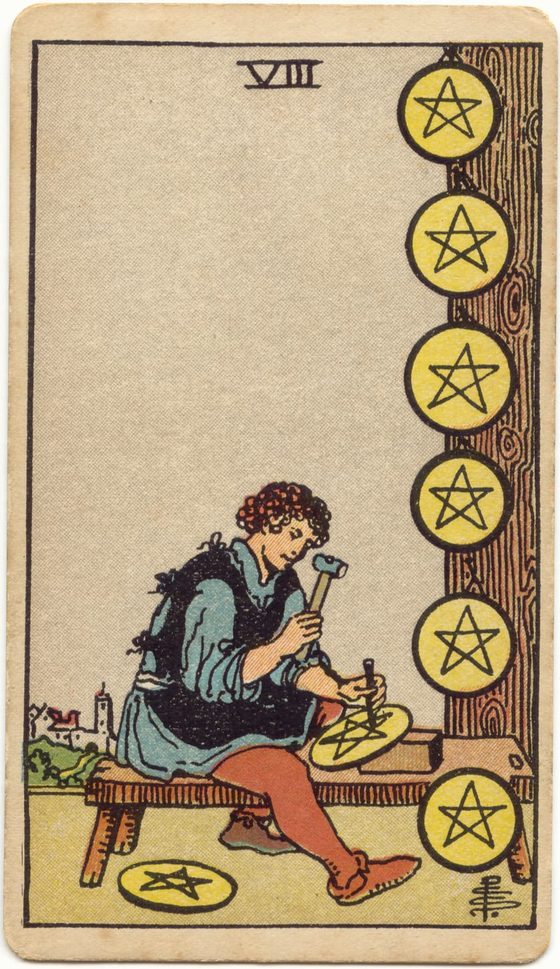
A craftsman cuts the same disc again while six finished ones hang on the post beside him. The Eight of Pentacles describes repetition as a method, and says nothing about whether the work is worth doing.
- craftsmanship
- repetition
- apprenticeship
- diligence
- focus
- carelessness
- perfectionism
- stagnation
- busywork
- no progress
What the card shows
A man sits on a low wooden bench, bent forward over his work. In one hand he holds a hammer; with the other he steadies a chisel against a pentacle propped on a block in front of him. He wears a blue tunic under a dark sleeveless overgarment, with red hose and brown shoes. His face is turned down to the disc and his shoulders are rounded over it.
To his right an upright wooden post runs the full height of the card, carrying six finished pentacles fixed flat against the grain in a single column. An eighth lies flat on the ground at the lower left, under the end of the bench. Away to the left, past the bench, a small town with a tower and red roofs sits on a green rise in the distance. The rest of the background is blank. He is the only person in the picture.
Upright meaning
The Eight of Pentacles describes work done by repetition. Not a project, not a breakthrough: the same operation performed again, and then again, with the quality improving because of the count rather than because of any insight. Waite's list for it is short and practical, work and employment and commission and craftsmanship.
What the drawing adds is the cost. He is alone, bent over, and the town is off behind him. Getting good at something requires a period in which you are not doing anything else and not visible to anyone. The card is honest that this is a trade, and it does not pretend the trade is always worth making.
It also has nothing to say about whether the thing being made is any good. Six identical discs on a post is a picture of consistency, which is not the same as value. Beside Three of Pentacles the work has other people in it and someone is checking it. Beside The Hermit the isolation becomes deliberate rather than incidental. Beside Seven of Pentacles the question of what all this is producing has finally arrived.
Upright in love
In a relationship reading this card is about effort applied steadily rather than feeling expressed strongly. Someone is doing the work: turning up, remembering things, repairing small damage before it accumulates. That is real and it is undramatic, and it often goes unnoticed by the person it is being done for.
The card carries a caution as well. The man in the picture is facing away from the town. Applied to a relationship, that describes a person whose absorption in something, work, study, a craft, has become the reason they are not present. Whether that absorption is temporary or has become the arrangement is what the rest of the spread is for. It is a card about attention, and attention is finite.
Upright in work
The plainest career card in the deck. Training, apprenticeship, a skill being built by doing the thing repeatedly. It also covers the unglamorous middle of a competent career: the years where nothing is being learnt and the work simply gets done well.
Two things the card does not say. It does not say the skill is in demand, and it does not say anyone has noticed. Both are common gaps between how this card feels and what it actually depicts. If the question is about advancement, look at whether other people appear in the spread; the Eight of Pentacles on its own describes someone getting better in a room nobody is looking into. Compare Page of Pentacles, which is the same energy at the beginning rather than in the grind.
Upright in money
Money earned by the hour or by the piece. Not a windfall, not an investment: the direct exchange of skilled time for payment, and a rate that improves slowly as the skill does.
The card is useful in money spreads because it locates the variable. If income is the question, this card points at capability rather than at markets or luck. That is worth knowing, and it is not the same as encouragement, because a person can become very good at something that does not pay. Nothing here is financial advice. What the card offers is a fair description of the mechanism: this money comes from work done repeatedly, so it stops when the work stops.
Upright as feelings
As someone's feelings, this is care expressed as effort. They will fix your bike, learn your family's names, read the thing you wrote twice. What they will probably not do is say anything about it. If you are trying to work out whether they care, look at the count of small acts rather than at the conversation.
Upright as advice
Do the next repetition today, badly if necessary, and do not review the whole run. The Eight of Pentacles works by accumulation, and the single most common way people break it is by stopping to judge the pile before it is tall enough to judge.
Reversed meaning
Reversed, this card divides in two and the halves point opposite ways. The first is the work going wrong: attention slipping, standards dropping, repetition without care, the same disc cut badly six times. Waite's reversed list runs to vanity and exaction, which is one flavour of it.
The second is the work going on too long. Nothing is wrong with the craftsmanship. What has gone wrong is that the person has kept refining something that was finished, or has stayed in the apprentice position past the point where anyone was going to promote them. Perfectionism and being stuck look identical from the inside, and both are this reversal.
There is a practical way to tell them apart. Look at whether the recent output is worse than the older output or simply the same. Worse is the first reading. Identical for years is the second. And do not assume the reversal is a criticism of effort; more often it is a criticism of the target the effort has been pointed at.
Reversed in love
Effort that has become mechanical, or effort in the wrong currency. Someone is still doing all the things and none of them are landing, usually because they are the things that were needed three years ago. The other reversal is a person so absorbed in work that the relationship has become one more repetition on the list. Neither is a failure of feeling. Both are a failure of aim, and aim is easier to correct than feeling if anyone will say what is actually wanted.
Reversed in work
Sloppiness that has crept in unnoticed, or competence that has stopped being developed. The second is the common one in long careers: a person doing a job perfectly well for the eighth year running, with no new operation in the repertoire. It is not a crisis and it will not announce itself. The card also covers busywork, effort that is genuinely careful and pointed at something nobody needs. Ask what the last new thing you learnt was, and when.
Reversed in money
Income that has flattened, or work that is being paid at the rate it was three years ago. Reversed, this card often marks the moment where more hours stop producing more money, which is the structural limit of earning by repetition. Waite's reversed keywords include usury and exaction, which read now as a note about work paid badly rather than a moral judgement on the worker. This page cannot tell you what to charge. It can point out that the card describes the mechanism reaching its ceiling.
Reversed as feelings
Going through the motions, or a person whose attention is entirely elsewhere and has been for months. Reversed, the card describes involvement that has lost its edge. It is worth distinguishing from indifference: the difference is that the effort is still being made, which is a fact you can check without asking anyone what they feel.
Reversed as advice
Change one variable in the routine rather than working harder at all of them. A different tool, a different hour, a different person to show it to. Reversed, this card is not fixed by more effort, because more effort is what produced the problem in both of its versions.
Symbolism in the 1909 image
The hammer and chisel. One in each hand, the chisel held against the disc on the block. The only card in the suit where a tool is being used rather than leant on or held. Smith drew the moment as work rather than contemplation.
The post with six discs. Fixed flat to the upright at his right, identical, in a single column running the height of the card. Waite calls them trophies, and that word is doing a lot: they are simultaneously a record of skill and a display of it. Nobody is there to see the display.
The disc on the ground. Lying flat at the lower left, under the end of the bench, well away from the finished column. A small detail, and the one that makes the picture a sequence rather than a still: there is an order to these, and the order is still running.
The dark overgarment. Sleeveless, worn over the blue tunic. It marks the difference between a person who works and a person dressed as one, which is a distinction Smith drew carefully across the whole suit.
The town. Small, off to his left on a green rise, a tower and a few red roofs. He has his back half-turned to it and there is no road drawn between him and it. Whether he left it or has not gone yet is not shown, and the ambiguity is the most interesting thing on the card: the price of the skill and the reason for it are the same distance away.
Where this meaning came from
The eight of coins was a pip in the fifteenth-century Italian tarot, unillustrated and meaningless, part of a game rather than a system. Divinatory readings were attached in eighteenth-century France by Court de Gebelin and Etteilla, along with an Egyptian pedigree that has since been shown to be invention.
Waite's line for the card in The Pictorial Key to the Tarot (1910) is one of his shortest: an artist in stone at his work, which he exhibits in the form of trophies. His divinatory meanings are work, employment, commission, craftsmanship, skill in craft and business. Reversed: voided ambition, vanity, cupidity, exaction, usury.
The Golden Dawn title is Lord of Prudence, Sun in Virgo. That attribution explains the card's association with method and care better than Waite's text does, and most modern readings of it are closer to the Golden Dawn than to the Pictorial Key.
The picture itself is Pamela Colman Smith's invention. She drew all seventy-eight cards in about six months in 1909, working from Waite's directions for the twenty-two trumps and with considerably more freedom on the fifty-six minors, which is why the pip cards look like scenes from a play and the trumps look like diagrams. She signed them with a small monogram and received a flat fee.
The common misreading
The Eight of Pentacles is the card readers use to tell people that hard work pays off. It does not say that. It says work is being done. The picture contains no customer, no payment, no audience and no evidence that the discs are wanted by anyone. Effort is depicted; return is not.
The second misreading is treating it as unambiguous praise. Being the person who is very good at one operation is a position with a ceiling, and the drawing shows that ceiling clearly: he is sitting down, facing away from the town, doing the same thing. Read next to a card about other people, it can describe someone who has been left to it because leaving them to it is convenient.
The third is confusing repetition with progress. Six identical pentacles is a picture of consistency. Whether the seventh is better than the first is not shown, and in a lot of real cases it is not. The honest version of this card asks what has actually changed in the work over the last year, which is a question with an answer. Compare Nine of Pentacles, which shows what it looks like when the work is behind someone.
Questions to sit with
- What has changed in how you do this over the last twelve months?
- Who, if anyone, is waiting for what you are making?
- What are you not doing while you do this, and did you choose that?
- If the skill stopped improving tomorrow, would you still want the job?
Pull this card in a real spread.