- Card number
- 7
- Arcana
- Minor Arcana
- Suit
- Pentacles
- Element
- Earth
- Rank
- Seven
- Yes or no reading
- It depends
Seven of Pentacles
A man leans on his staff and looks at what he has grown. The Seven of Pentacles is the pause in the middle of a long piece of work, when the only useful question is whether to keep going.
- patience
- assessment
- slow growth
- investment
- pause
- impatience
- sunk cost
- abandoned early
- stalling
- poor timing
What the card shows
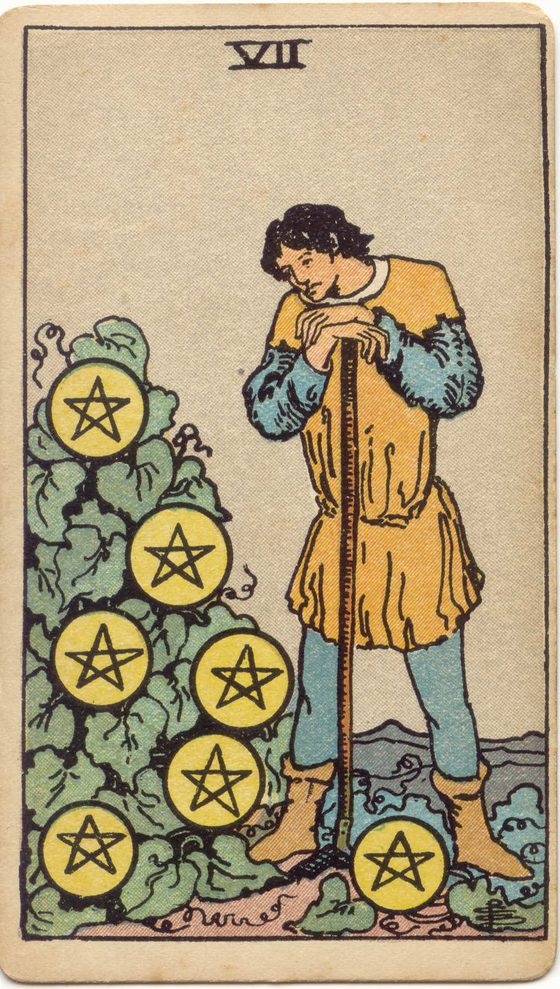
A young man stands with both hands folded over the top of a long staff, his weight resting on it and his chin close to his knuckles. His head is bent forward and turned down to the left. He wears a yellow tunic with full blue sleeves, blue hose and tan boots. The background behind him is plain cream.
To his left a tall bush fills the side of the card, drawn with broad, heavily veined green leaves and curling tendrils. Six pentacles are set among the foliage, spread through the leaves at different heights rather than clustered. A seventh sits on the ground at the bottom right, near his foot, among low green growth that runs along the base of the picture. There is no house, no other person, and no tool except the one he is leaning on.
Upright meaning
The Seven of Pentacles is a card about the interval. Work has been done, results have started to appear, and none of it is finished. The man has stopped working in order to look, which is the only activity available at this stage and does not feel like an activity at all.
What the card describes accurately is the discomfort of that position. Effort no longer produces visible change day to day. The plant grows at its own rate and the tool cannot speed it up. People in this position tend to do one of two unhelpful things: dig it up to check, or walk away because nothing is happening. The card is a description of the moment before that choice.
It is not a card of reward. Waite's divinatory line for it is oddly mixed, money and business on one account, altercation on another, and the mixedness is honest. Beside Eight of Pentacles it reads as a break in sustained work rather than an ending. Beside Eight of Cups the pause tilts toward leaving. Beside Nine of Pentacles it reads as the stage before something that did work out.
Upright in love
In a relationship reading this card describes a stage rather than a feeling. Something has been built over time and it is at the point where the effort is invisible and the results are partial. Nothing is wrong and nothing is exciting.
That stage is where a lot of relationships are quietly decided. The card names the specific temptation: measuring, comparing, tallying what you have put in against what has come back. Doing the arithmetic is not the same as being unhappy, and it is not automatically a sign that something is finished. But it is worth noticing that you have started, and worth asking what you were expecting by now and where the expectation came from.
Upright in work
A project in its long middle. The initial work is done, some results exist, and the remaining distance is not obviously shorter than the distance already covered. The Seven of Pentacles is the card of the eighteen-month build, the second year of a business, the degree halfway through.
It often arrives with the question of whether to switch. That question is legitimate here in a way it is not at the start, because there is now real information: you can see six pentacles on the bush and count them. What the card refuses to do is tell you whether the yield justifies the remaining effort. That is an assessment, and assessments need numbers, not cards. What the card contributes is permission to make it deliberately instead of by drifting.
Upright in money
Money that is slow. Something has been put in and it has not come out, and the not-coming-out is the design rather than a fault: a long-term saving, a business that is not yet profitable, a qualification being paid for now for a return later.
The card describes patience as a condition, not a virtue. This page cannot tell you whether a particular commitment will pay, and the picture certainly cannot. What it does mark is the pressure of waiting on something you can see but not yet use, and the way that pressure makes people act early. If the spread is about whether to pull out, the card says the question is fair, not that the answer is yes.
Upright as feelings
As someone's feelings, this is investment without a decision. They have put real time into this and they are looking at it rather than at you. That is not withdrawal and it is not commitment. It is assessment, and the honest thing about the card is that assessment can go either way.
Upright as advice
Decide the date on which you will decide, and put it in the calendar. Between now and then, do the work without reviewing it. The Seven of Pentacles goes wrong when the assessing becomes continuous, because a thing checked daily never looks like it is growing.
Reversed meaning
Reversed, this card gives two readings that recommend opposite actions. The first is impatience: the assessment made too early, the work abandoned before it could produce, the plant dug up to see whether the roots were doing anything. Waite's reversed note is about anxiety over money, and anxiety is what produces this version.
The second is the opposite failure, and it is the one people recognise less. The pause has become permanent. The assessment was due a long time ago and has been deferred, because doing it might mean admitting that a great deal of effort has gone into something that is not going to work. Sunk cost keeps a person leaning on the staff for years.
Which one is in front of you is decided by how long the situation has been running, not by the card. If the work is young, read impatience. If it is old, read avoidance. And note that both look identical from outside: a person standing still next to something unfinished.
Reversed in love
Either someone has cut short a relationship that had not had time to become anything, or a relationship has been in assessment for so long that the assessing is now the relationship. The second is quieter and much more common. People stay in the pause because leaving would mean saying that the years counted for nothing, and staying does not require saying anything at all. Reversed, the card usually points at a decision that has been available for a long time.
Reversed in work
A project abandoned before it could show what it was, or a project that should have been stopped two years ago and has not been. The reversal also covers the ordinary case of a review that keeps being scheduled and moved. Look at the age of the thing. And look at who has the authority to stop it, because in a lot of workplaces the person leaning on the staff is not the person who decides whether the field gets planted again.
Reversed in money
Something cashed out early, or something left in long past the point where anyone was still paying attention to it. Waite's reversed line is specifically about anxiety over money that may be lent, which is narrower than the modern reading and worth keeping. This page gives no advice on investments, and the card gives none either. What the reversal does is name the emotional state that tends to produce the worst timing: watching something too closely, for too long, without a rule for when to act.
Reversed as feelings
Frustration with how slow something has been, or a quiet acceptance that it is never going to change and a decision to stop expecting it to. Reversed, the card describes someone who has finished waiting. Whether that means they are about to act or have already given up is not something the card can settle.
Reversed as advice
Write down the condition under which you would stop, in one sentence, and then check whether that condition has already been met. Reversed, this card is not asking you to be more patient or less patient. It is asking you to have a rule, because without one the decision gets made by exhaustion.
Symbolism in the 1909 image
The staff. Long, straight, with both hands folded over the top and his weight on it. Waite calls it a staff; most modern readers call it a hoe. Either way the tool has become furniture: the implement that did the work is now the thing holding him upright while he does not work.
The six on the plant. Attached among the leaves rather than growing from them. Smith drew them hanging in the foliage, which is not how anything grows, and the artificiality is part of it: the results are visible but not yet detachable.
The seventh on the ground. Sitting on the ground at the lower right, near his foot and away from the bush. Read as what has already been harvested, or as one that fell, or as the cost of the work so far. The drawing does not say, and readings that insist it is a loss are choosing.
The low growth. Green runners spread along the whole base of the picture, under his feet and around the seventh disc. He is standing in what he has been cultivating rather than beside it, which is easy to miss and is the reason the card is about being inside a process rather than reviewing it from outside.
The downward gaze. He is not looking at the horizon and not looking at the viewer. The whole card is one person looking at one thing very hard, which is exactly the posture that stops being useful after the first hour.
Where this meaning came from
As with every pip in the suit, the seven of coins carried no meaning in the fifteenth-century Italian decks. It was a low card in a trick-taking game called tarocchi, and the earliest surviving decks were painted for aristocratic households in Milan and Ferrara.
The divinatory apparatus arrives in eighteenth-century France with Court de Gebelin and Etteilla, together with an Egyptian origin story that has been comprehensively refuted.
Smith's picture dates from 1909. Waite's entry in The Pictorial Key to the Tarot (1910) describes a young man leaning on his staff, looking intently at seven pentacles attached to a clump of greenery on his right, and adds a sentence that is unusually psychological for him: one would say that these were his treasures and that his heart was there. His divinatory meanings are a scattered set, money and business and barter on one account, altercation and quarrels on another, innocence and ingenuity on a third, and reversed, cause for anxiety about money which it may be proposed to lend.
The Golden Dawn title is the sharpest gloss anyone has given the card: Lord of Success Unfulfilled, Saturn in Taurus. Not failure. Not success. The gap between the two, which is where the picture sits.
The common misreading
The Seven of Pentacles gets read as a promise that the waiting will be rewarded. That is the one thing it does not say. The Golden Dawn called it Success Unfulfilled, which is not a euphemism for success delayed; it is a description of a state that has not resolved and may not.
The second misreading is treating patience as the moral of the card. Readers say be patient, the harvest is coming, and hand back the querent's own hope with a picture attached. Sometimes the honest reading is that a person has spent three years on something with six pentacles to show for it, and the useful question is whether they would start it again today knowing what they now know.
The third is missing what the card is actually good at. It is not about the plant. It is about the man's posture, stopped, leaning, looking. What it describes is the psychological state of the interval, and states like that distort judgement in predictable ways. Anything decided from inside this posture is worth deciding twice. Compare The Hanged Man, which is the same suspension with none of the accounting.
Questions to sit with
- How long has this actually been running, in months?
- What would have to be true for you to stop, and is it true yet?
- Are you checking this because you need the information or because waiting is uncomfortable?
- If you had started today, with what you know now, would you have started at all?
Pull this card in a real spread.