- Card number
- 11
- Arcana
- Minor Arcana
- Suit
- Pentacles
- Element
- Earth
- Rank
- Page
- Yes or no reading
- It depends
Page of Pentacles
The student card. A person absorbed in something they do not yet understand, holding it up to the light. The Page of Pentacles is about the beginning of a practical undertaking, not its outcome. Absorption is not the same as ability.
- study
- apprenticeship
- new venture
- diligence
- curiosity
- procrastination
- distraction
- careless start
- unwelcome news
- wasted effort
What the card shows
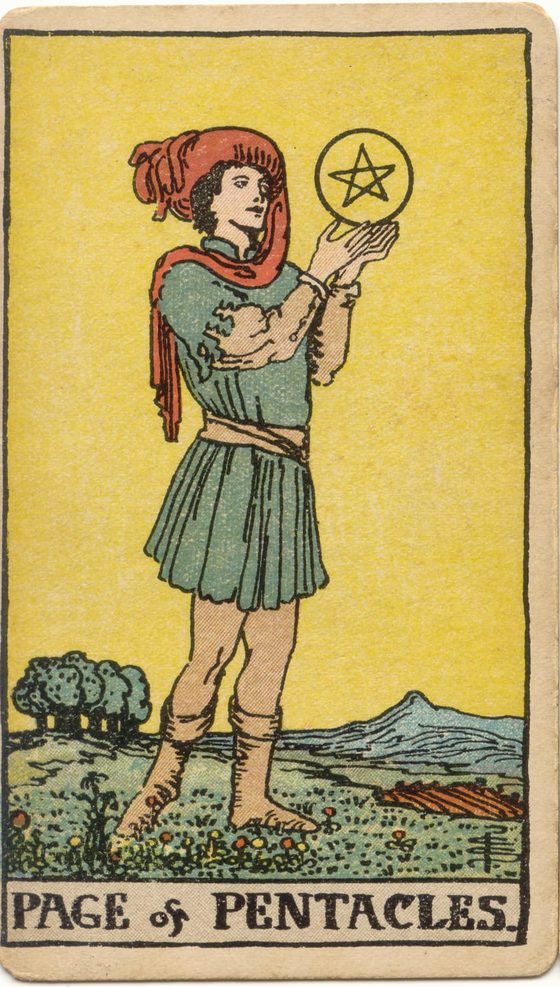
A young figure stands alone in a green meadow, holding a single large pentacle in both raised hands at eye level. Waite describes the disc as hovering above the hands rather than gripped in them, and Smith drew it that way: there is a visible gap. The figure is looking directly at it and at nothing else.
The clothing is careful rather than grand: a green tunic, a brown belt, and a red head-wrapping whose long tail falls down over one shoulder. To the left, on the horizon, stands a small clump of trees. To the right the land rises into a low blue range with a small patch of ploughed ground in front of it, the furrows drawn as a few fine lines. The sky is flat yellow. Nothing is happening. Nobody else is in the frame.
Upright meaning
The Page of Pentacles is the suit at its beginning: someone who has picked up something material and is trying to work out how it functions. A course, a trade, a first business, a skill being learned slowly and badly. Waite's list for it runs application, study, scholarship, reflection, which is close to what the picture shows.
What separates it from the Ace of Pentacles is that the Ace is an offer and the Page has already accepted. What separates it from the Eight of Pentacles is repetition: the Eight has done the thing four hundred times, and the Page is still turning it over. Absorption is not competence, and the card is careful about the difference.
In the older tradition pages are also messengers, which survives now as news about something practical: a result, an offer, a document arriving. Beside a card of movement this reads as a beginning that goes somewhere. Beside the Seven of Pentacles or another card of waiting, it reads as a long apprenticeship with the outcome still a long way off, and the card offers no opinion on whether that apprenticeship is worth serving.
Upright in love
In a relationship reading this is early and earnest. Someone taking the thing seriously, being deliberate about it, possibly deliberate in a way that is faintly awkward. There is more attention here than skill.
It often marks a relationship being treated as something to learn rather than something to perform, which is a good sign and a slow one. It can also describe a person who is genuinely interested and genuinely inexperienced, and those two facts together account for most of what goes wrong at this stage. The card does not promise the interest survives contact with difficulty. Nothing in the picture has been tested yet.
Upright in work
Entry-level work, a trainee position, a course, a qualification, the first project that is actually yours. The card favours the person willing to be visibly a beginner, which is harder than it sounds and is what the picture is really about.
It also carries the older messenger reading: news about work, an offer arriving, a document that changes the practical situation. Where the question is whether somebody is ready, this card says they are studying, not that they are ready. Compare the Knight of Pentacles, who has stopped studying and started grinding.
Upright in money
Money handled deliberately and for the first time. A budget written down, an account opened, the mechanics of tax or invoicing being learned rather than avoided. Small sums, given more attention than their size warrants, which is exactly how the attention gets built.
The card is about the habit rather than the amount. It says somebody is now reading the numbers, and that is worth having independently of what the numbers currently say. It does not say the plan is a good one, only that there is a plan and a person looking at it.
Upright as feelings
Close, sincere, slightly clumsy attention. Someone thinking about you carefully and probably too much, without much practice at what to do with the thought. It is not casual and it is not confident. As with all the pages, it describes an attitude rather than a decision, and no decision has been made yet.
Upright as advice
Pick one thing and study it on a schedule for a fixed period, then write down what you actually did rather than what you meant to do. The card's whole strength is sustained attention to something small. Its weakness is that attention feels like progress, and a written record is the only thing that tells the two apart.
Reversed meaning
Reversed, the Page of Pentacles goes two ways, and they are close to opposites.
The first is study that never becomes practice. The plan gets refined, the research continues, the course is bought and not started, the notes are beautiful. Preparation is a comfortable place to stand because nothing there can fail yet, and this reversal often describes somebody who has quietly noticed that and settled in for the duration.
The second is the reverse: beginning without learning anything. Impatience with detail, carelessness about money, a project started on enthusiasm and dropped when the first tedious part arrives. Waite's reversed list runs to prodigality and dissipation, which is that reading in older language.
There is also the messenger sense, where reversed marks practical news that is unwelcome, or a document that does not say what was hoped. Which of the three is operating is decided by the question and by the cards around it. A reader who always reaches for laziness is reading one card and calling it three.
Reversed in love
Either interest that stays permanently at the studying stage, examined and analysed and never acted on, or interest acted on with no attention at all. Reversed pages often describe someone whose behaviour and whose stated intentions have come apart. It can read as immaturity, though that is a word worth resisting: what the card actually shows is a mismatch between how seriously somebody takes a situation and how seriously they behave inside it.
Reversed in work
A beginner who will not begin, or a beginner who will not learn. Both stall in the same place and only look different up close. Reversed, this card can also mark a training or a role that is not delivering what it promised, or news about work arriving late or wrong. The useful question is whether the obstacle is the person's attention or the situation's design, and the surrounding cards usually answer it.
Reversed in money
Small sums leaking with nobody tracking them, or the opposite: so much time spent on the tracking that nothing is ever decided. Waite's reversed reading for this card is prodigality, spending outrunning attention. The modern version is usually less dramatic and more procedural, an account nobody has opened in a year and a subscription nobody remembers starting. Reversed here points at the habit, not the balance.
Reversed as feelings
Interest that is real but unexamined, or interest examined so thoroughly it has stopped being felt. Reversed pages often describe somebody who has not decided what they think and is behaving as though they have. Not deceit, usually. More often a person out of their depth and unwilling to say so out loud.
Reversed as advice
Convert one piece of preparation into one piece of practice this week, at whatever scale is embarrassing. Send the draft, book the first session, spend the small amount. If the other reversal applies and you have been moving without learning, stop and read the instructions you skipped the first time.
Symbolism in the 1909 image
The pentacle. Held up at eye level in both hands and, in Waite's own text, hovering above them rather than gripped. Smith drew the gap. Read as the object of study; note that the figure is holding it up to look at it, not putting it to any use.
The ploughed field. A small patch of worked ground in the middle distance on the right, easy to miss entirely. It is the only sign in the picture that anybody has done anything. The ground has been prepared and nothing has grown in it yet.
The head-wrapping. A red cloth whose long tail falls down over one shoulder. Books read the red as appetite or drive. It is also simply what a working person's headgear looked like in the medieval sources Smith drew from, and there is a real risk of reading too much into it.
The trees and hills. Placed well back, small, out of the way. Where other cards set the distance in tension with the figure, here it is only distance. Nothing is coming.
The feet. Flat in the grass, not moving. Waite writes that the figure moves slowly and is insensible of what is around it. In the drawing it is not moving at all.
Where this meaning came from
The coin suit is the oldest layer here. In the fifteenth-century Italian decks tarot was a card game, the denari were one of four suits, and each suit carried four court ranks, of which the page or knave was the lowest. The card had a function in play and no meaning outside it.
Divinatory readings were attached in eighteenth-century France by Antoine Court de Gebelin and then Etteilla, along with a set of claims about Egyptian origins that have not survived scrutiny.
The courts are worth separating from the pips here. Pamela Colman Smith's real innovation in 1909 was drawing full scenes on the numbered cards, which had been plain arrangements of coins for four centuries. Court cards had always been figures. What Smith changed about this one is what the figure is doing: she gave a static rank a specific action, looking at a single disc in an empty ploughed field.
Waite's list in The Pictorial Key to the Tarot (1910) is application, study, scholarship and reflection, plus news and the person who brings it. The study reading and the messenger reading have coexisted uneasily ever since.
The common misreading
The commonest misreading is the literal one: a young person in your life, usually described down to their hair colour. Court cards attract this because it feels like information. It is not. The courts describe postures, and a page can be a sixty-year-old retraining, a project, or the querent themselves. Reading it as a physical person gives a spread false precision about somebody's identity, and that precision is invented.
The second is reading absorption as aptitude. The figure is looking at the pentacle with complete attention, and complete attention is not the same as talent, progress or a good decision. Plenty of people study the wrong thing very hard. The card shows the looking and says nothing about whether the object deserves it.
The third is treating pages as minor because they are low-ranked. In a spread about work or study this is often the only card describing what the querent actually does all day, and it gets skipped in favour of whatever Major happens to sit beside it.
Questions to sit with
- What are you currently studying that you have not yet tried to use?
- How long have you been preparing, and what date did you last set for starting?
- If you had to teach what you have learned so far, what could you actually say?
- Is the thing holding your attention the thing you chose, or the thing that showed up?
Pull this card in a real spread.