- Card number
- 12
- Arcana
- Minor Arcana
- Suit
- Pentacles
- Element
- Earth
- Rank
- Knight
- Yes or no reading
- Yes
Knight of Pentacles
The slowest card in the deck. A knight on a horse that is not moving, holding out a single coin. The Knight of Pentacles is about persistence, routine and unglamorous reliability, and it says nothing about arrival.
- persistence
- routine
- reliability
- patience
- hard work
- stagnation
- inertia
- stubbornness
- boredom
- aimless effort
What the card shows
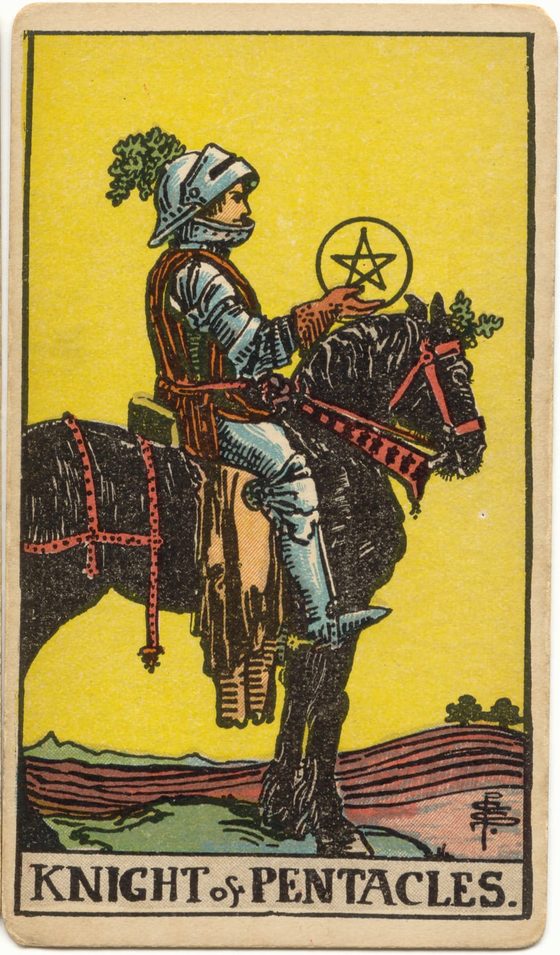
A knight sits on a heavy black horse. The horse is standing still, all four feet flat on the ground. Of the four knights in the 1909 deck this is the only mount not in motion. He wears pale plate armour under a red-brown surcoat, and his visor is raised, so his face shows in profile. His right arm is held out, gauntlet open, and a single pentacle stands clear of the fingers at about head height.
Sprigs of green foliage sit on his helmet and on the horse's brow, with red harness across the horse's chest and flank. Behind him on the right the ground is ploughed into long red-brown furrows, with one small tree at the field's edge. To the left the land is green and falls away to low hills. The sky is flat yellow, and there is no road and no destination in view.
Upright meaning
The Knight of Pentacles is the card of grind. Waite's list for it runs utility, serviceableness, responsibility, rectitude, four words nobody has ever used to describe an exciting day. That is the card. It marks work that gets done because somebody keeps doing it, at a pace that does not vary and does not impress anyone watching.
Put it beside the Knight of Wands and the point becomes obvious: one horse is rearing and this one is standing still. Where the Eight of Pentacles is practice at a bench, the Knight is the long campaign around it, the years rather than the hours. Its virtue is that it finishes things. Its cost is that it is slow enough to be mistaken for nothing happening at all.
Upright it usually says the querent's approach is sound and the timescale is longer than they want it to be. It does not say the destination is right. A methodical person going the wrong way arrives just as reliably as anyone else. Beside a card of direction it reads as steady progress; beside a card of stagnation, as a routine that has outlived its reason.
Upright in love
Dependability rather than romance. Somebody who turns up, remembers the thing you said in March, and does not create weather. In a relationship reading this card often describes the partner who is easy to rely on and difficult to read, because the feeling gets expressed in maintenance rather than in declaration.
It is slow to commit and equally slow to leave, which is a real virtue and occasionally a trap. Where the question is whether somebody cares, the card answers by pointing at what they do rather than what they say. Where the question is whether the relationship is still alive, it does not answer at all, and its neighbours have to.
Upright in work
The reliable operator. Long projects, maintenance, documentation, the part of the work nobody photographs. Upright, the card favours consistency over brilliance and usually describes somebody who is trusted precisely because they are unexciting.
This is promotion by attrition rather than by display, and it is genuinely how a great deal of career progress happens. It is also how people end up carrying load that never gets acknowledged. The King of Pentacles is what this becomes once the reliability has been converted into authority; the Knight is the stage before anybody has noticed.
Upright in money
Money handled by routine rather than by decision. Regular contributions, a standing order, a budget that has run unchanged for two years, debt cleared at a fixed rate. The card describes a habit rather than a product, and it has no opinion whatever about which product.
Its strength is that it works without motivation, which is the only kind of financial behaviour that survives a bad month. Its weakness is that a routine nobody reviews will happily keep running long after the reason for it has gone.
Upright as feelings
Settled, undemonstrative, and more serious than it looks from outside. Someone who has decided, has not said much about deciding, and is unlikely to say much later either. It is not coldness. It is a person whose way of showing regard is to keep showing up, which is easy to underrate and easy to miss entirely.
Upright as advice
Pick the smallest version of the task you could sustain on a bad week, and do exactly that on a fixed schedule for a set number of weeks. Write the end date down. This card's failure is not stopping too soon; it is continuing without ever checking whether the thing still needs doing.
Reversed meaning
Reversed, this card describes two failures that look nothing like each other.
The first is the one Waite named: inertia, idleness, stagnation. The horse never starts. Routine has hardened into an inability to move, and because the routine is respectable it is difficult to see as a problem. This is the reversal that hides inside a full calendar. Compare the Four of Pentacles, which holds on rather than stalls.
The second is the opposite: somebody who cannot stop. Persistence continued long past the point where it was serving anything, work carried on because stopping would require a decision. Same posture, opposite fault. Both refuse to change direction; one refuses to start and the other refuses to finish, and from the outside the two are almost impossible to tell apart.
The reversal itself does not tell you which one you are looking at. The question and the surrounding cards do, and a reader who always chooses laziness will misread half the spreads this card turns up in.
Reversed in love
Either a relationship settled so deeply into routine that nobody can remember choosing it, or a person grinding away at something that ended a while ago. Reversed, the dependability this card is known for stops being a gift and becomes a default. It can also mark somebody so slow to act that the window closed while they were being careful. Reliability and avoidance are hard to tell apart from the inside, and this reversal is usually about that difficulty.
Reversed in work
Work that continues without direction. A role unchanged in years, a project maintained past its usefulness, effort that is entirely real and pointed at nothing. Or the opposite failure: somebody who has stopped putting in the ordinary work and is coasting on the reputation the ordinary work built. Reversed, the question is not whether a person is trying. It is whether trying is still the useful thing for them to be doing.
Reversed in money
A financial routine nobody has reviewed. Payments that made sense when they were set up, a rate that has quietly become bad, an arrangement continuing because reviewing it is dull. Waite's reversed words for this card include carelessness, and the careless version here is passive rather than extravagant. Money is not being thrown away. It is being left where it was put, which is a different problem and a slower one.
Reversed as feelings
Habit doing the work that feeling used to do. Somebody still present, still dependable, and no longer certain what they are being dependable about. Reversed here rarely means the regard has gone. More often it means nobody has examined it in a long time and both people have stopped asking.
Reversed as advice
Set a review date and put it in the calendar. Then on that date ask the one question the routine has been protecting you from: is this still worth continuing? The point of the reversal is not to work harder and not to quit. It is to make a decision that has been deferred by being busy.
Symbolism in the 1909 image
The standing horse. Heavy, dark and completely still, the only one of the four knights' mounts not in motion. Waite calls it slow and enduring. Whether the picture shows patience or a refusal to start is not settled by the drawing, and both readings are in constant use.
The pentacle and the open hand. Held out at arm's length on an open gauntlet and not actually touched, the disc standing clear of the fingers. Waite writes that he exhibits his symbol but does not look into it. In Smith's drawing the visor is up and the face is turned toward it, and readers have been quietly choosing between the text and the picture ever since.
The ploughed field. Long ridges running behind him, worked and bare. The same field lies behind the Page of the suit. The work has been done and the result is not visible yet, which is close to the entire suit in one image.
The green sprigs. Foliage on the helmet and on the horse's brow. Usually read as growth, or as the reward waiting at the end. They are also the only living things in a picture otherwise made of metal and soil.
The armour. Full plate under a surcoat, visor raised, and more than the situation requires. Nothing in the frame is threatening him. Books read it as protection; it reads just as easily as a man who cannot quickly change what he is doing.
Where this meaning came from
The knight is a rank from the game. In the fifteenth-century Italian tarot each suit carried four courts, and the cavallo sat between the knave and the queen. Coins were simply one of the four suits, and the card meant nothing beyond its value in play.
Divinatory meanings were attached in eighteenth-century France, first by Antoine Court de Gebelin and then more systematically by Etteilla, along with claims about Egyptian ancestry that later scholarship has not supported.
The 1909 deck is where this card acquired its stillness. Court cards had always shown figures, so Smith's innovation on the numbered pips does not apply here. What she supplied was posture. She gave three knights moving horses and gave this one a horse standing flat on the ground, and that single decision is responsible for most of how the card is read today.
Waite's own list in The Pictorial Key to the Tarot (1910) runs utility, serviceableness, responsibility and rectitude, with inertia, idleness and stagnation reversed. It is a notably unromantic entry for a court card, and a century of popular tarot writing has not managed to soften it very much.
The common misreading
This card gets skipped. It arrives in a spread, somebody says hard work and patience, and attention moves on to whatever is more interesting beside it. That is a misreading by omission: in a question about work or money the Knight is frequently the card describing what is actually happening, and the dramatic card next to it is describing a mood.
The second misreading is treating persistence as a guarantee of arrival. The horse is not moving. Nothing in the picture indicates a destination, a road, or a distance already covered. The card commends the method and stays silent on whether the method is pointed anywhere useful, and people travelling the wrong way steadily are a real category.
The third is using it as a compliment. Read as praise for the querent's work ethic it is flattering and frequently false. It is at least as often describing somebody who has substituted effort for a decision, or somebody the people around them have quietly learned they can lean on past the point of fairness.
Questions to sit with
- What have you been doing consistently for long enough that you no longer ask why?
- If this pace continued unchanged for two years, where would it have taken you?
- What are you carrying that nobody has thanked you for, and did you volunteer for it?
- What date will you next review whether this is still worth doing?
Pull this card in a real spread.