- Card number
- 14
- Arcana
- Minor Arcana
- Suit
- Pentacles
- Element
- Earth
- Rank
- King
- Yes or no reading
- Yes
King of Pentacles
A man in a robe covered with grapes, holding a coin he no longer bothers to look at. The King of Pentacles is the card of settled material authority, of somebody who has built the thing and now maintains it.
- stewardship
- material authority
- business sense
- reliability
- provision
- stubbornness
- control
- overextension
- strain
- misused authority
What the card shows
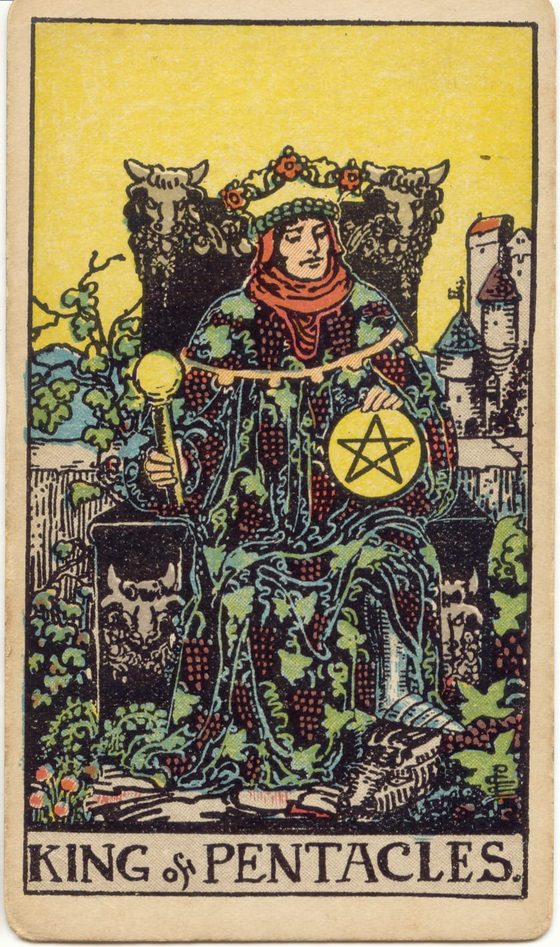
A crowned king sits on a stone throne in a robe embroidered from shoulder to hem with bunches of grapes and vine leaves. He holds a short sceptre upright in one hand and steadies a large pentacle on his knee with the other. His head is tilted slightly down, and the drawing does not settle whether he is looking at the disc or past it. Plate armour shows at his foot, below the hem of the robe.
The throne carries two large carved bulls' heads at its top corners and further carved faces low down at each side. Vines and grapes grow thickly around its base and up into the frame on both sides, so that the figure is very nearly enclosed. On the right of the frame, behind him, a walled castle with several towers rises above the greenery. His crown is a wreath set with red flowers.
Upright meaning
The King of Pentacles is the suit at its most settled: material authority already established and now mostly needing maintenance. Waite gives him valour, realising intelligence, business aptitude and, unusually for a court card, mathematical gifts. It is a card about somebody who is good with actual numbers and actual things.
The tell is what he does with the pentacle. The Page of Pentacles studies it, the Knight exhibits it, the Queen of Pentacles looks into it. The King rests it on his knee and is barely attending to it. He is past the stage of finding it interesting. What the card describes is stewardship rather than acquisition, and stewardship is a great deal less exciting than the imagery of wealth around it suggests.
Upright it usually says competence is available, either the querent's or somebody else's, and that the practical problem in front of them is solvable by ordinary means. It says nothing about generosity. Beside the Ten of Pentacles it reads as a structure with a person in charge of it; beside a card of restriction, as authority that has become the obstacle.
Upright in love
In a relationship reading this is provision and steadiness. Somebody established and unhurried, who offers security rather than romance and is often better at the first than the second. The card frequently marks a partner who expresses commitment by making the practical conditions of a life reliable.
That is worth a great deal and it is not the same as intimacy. This card can also describe a relationship in which one person's material position quietly does most of the deciding, without anybody naming it. Where the question is whether somebody is dependable, the answer here is usually yes. Where the question is whether the two people are equals, the card does not say.
Upright in work
The owner, the director, the person whose name is on the thing. Established business, long experience, decisions made from a position that is not currently under threat. Upright this is somebody who has done the work and now runs the shop, and it often turns up as a mentor, a backer or a boss rather than as the querent themselves.
It favours the practical and the proven over the novel. Where a spread asks about approaching somebody with authority, this card describes a person who will respond to a clear number and a working plan, and who is unlikely to be moved by enthusiasm on its own.
Upright in money
Established resources, and a person who understands how they work. The card describes competence with money at some scale: contracts, property, a business, arrangements that have been running long enough to be boring.
It is not advice about what to do with money and it names no product and no direction. What it usually points at in a reading is that expertise exists nearby and has not been asked for. That is a small, dull, useful thing for a spread to be saying, and it is more often the honest reading than a promise of wealth arriving.
Upright as feelings
Steady, faintly proprietary, and expressed through provision rather than through words. Somebody who has made a decision about you and considers the matter settled, quite possibly without having mentioned it. It can be deep and durable regard. It can also be a person who values you the way they value the rest of what they have built, and the card does not separate the two.
Upright as advice
Bring the numbers. Whatever you are trying to move forward, this card says the way through is a concrete plan with figures in it, put in front of somebody who can act on it. Ask the person with the experience directly, and ask for something specific rather than for advice in general.
Reversed meaning
Reversed, this card offers two readings that share a picture and share nothing else.
The first is authority that has curdled. Control exercised because it can be, money used as leverage, a person whose competence has become the reason nobody else is permitted to decide anything. Waite's reversed list is blunt about this: vice, weakness, ugliness, perversity, corruption, peril. Modern books soften it, and something real is lost in the softening.
The second is the opposite, and it is far more common in ordinary readings. Somebody solid who is no longer solid: a position undermined, a business under strain, an authority whose confidence has outgrown their actual situation. Stubbornness standing in for judgement, and pride making it difficult to admit. Compare the Four of Pentacles, which grips for much the same reason.
The reversal will not tell you which of these you have. The question and the neighbouring cards will, and treating every reversed King as corrupt is a quick way to be wrong about somebody's father.
Reversed in love
Either a partner whose material position has become a form of control, or a partner whose steadiness has stopped being real and is now being maintained as an appearance. Reversed, this card often marks a relationship where provision has replaced conversation altogether. Money and security are doing the work that talking used to do, and neither person is quite willing to be the one who says so first.
Reversed in work
A business or a boss under more strain than is being admitted. Reversed, this card can mark stubborn leadership, decisions defended long past the evidence, or somebody clinging to a position the situation has already moved past. It can also mark straightforward mismanagement. What it rarely means is incompetence from the beginning: the reversal usually describes a person who was genuinely good at this and has not adjusted.
Reversed in money
Money doing something other than being money: leverage, a way of keeping score, a way of keeping people close. Or the plainer reading, which is a solid-looking financial position considerably thinner than it appears from outside. Reversed here is a prompt to look at the actual figures rather than the reputation, and to notice that reputation is the thing this card is best at maintaining.
Reversed as feelings
Regard that has turned possessive, or steadiness being performed by somebody who no longer feels it. Reversed, this often describes a person unwilling to show that their position has changed. Pride is usually the mechanism rather than coldness, and pride is considerably harder to talk to.
Reversed as advice
Look at the underlying numbers rather than the surface of the situation, your own included. If you are the one holding the position, say the part you have been managing instead of mentioning. If somebody else is holding it, ask a direct question and accept that a straight answer may take a second attempt.
Symbolism in the 1909 image
The grapes on the robe. Bunches and vine leaves embroidered across the whole garment. Read as cultivated abundance rather than wild growth. He is wearing his own produce, which is either confidence or advertising depending on what sits beside it.
The bulls' heads. Carved into the throne. Usually read as Taurus and as fixed earth. They are also the only aggressive thing in a card that contains no visible conflict at all.
The pentacle on his knee. Held steady under one hand and at rest. Every other court in the suit attends to the disc in some obvious way. This one's gaze is downcast and unfixed, and whether that reads as mastery or as complacency is not settled by the drawing.
The armour under the robe. Visible only at the foot, where a plate greave and shoe show below the hem. He is dressed for peace over a readiness for something else. Nothing in the picture threatens him, which makes the choice worth noticing.
The castle behind him. A walled castle with several towers, on the right of the frame and closer than it first looks. The estate exists and is in plain view. He is sitting outside it, in the growth, with his back to it.
Where this meaning came from
In the fifteenth-century Italian decks the king was the highest court of a suit in a trick-taking game, and coins were simply one of the suits. Nothing about the card carried meaning outside play. The interpretive layer came later, in eighteenth-century France, through Antoine Court de Gebelin and then Etteilla, together with an Egyptian origin story that has not survived examination.
The 1909 deck fixed the modern reading. Court cards had always been figures, so what Pamela Colman Smith added here was specificity: the grapes, the bulls, the armour under the robe, the castle set just out of the way. None of that is in the older decks, and almost all modern interpretation of this card is interpretation of her choices.
Waite's list in The Pictorial Key to the Tarot (1910) runs valour, realising intelligence, business aptitude and, oddly, mathematical gifts. His reversed list is among the harshest in the book: vice, weakness, ugliness, perversity, corruption, peril. He is describing a failure of character rather than of circumstance, which is a strong claim for any card to make and one most contemporary writers decline to repeat.
The common misreading
The King of Pentacles is read as a rich man far more often than the picture supports. It is a card about authority over material things, and authority is not the same as a large balance. Somebody running a small operation competently is this card. So is a person in the spread who holds the expertise the querent needs and has not been asked for it.
The second misreading is treating him as the answer to a question about money. He describes a stance, not a sum. Asked whether funds will arrive, this card says there is competence in the situation, and competence has to be applied by somebody before it turns into an outcome. Nothing in the drawing depicts a transfer of anything.
The third is the reversal, and it does real damage. Waite's reversed language is vice and corruption, and readers reach for it about people the querent has to live with. Most reversed Kings of this suit describe somebody under strain who will not say so, not somebody dishonest. Reaching for corruption first tells a querent something about their father or their employer that the card did not say.
Questions to sit with
- What expertise is already available to you that you have not actually asked for?
- Where are you being deferred to, and is that deference earned or just habitual?
- If you had to show someone the real figures this week, what would they see?
- What are you maintaining that you no longer want to be responsible for?
Pull this card in a real spread.