- Card number
- 13
- Arcana
- Minor Arcana
- Suit
- Pentacles
- Element
- Earth
- Rank
- Queen
- Yes or no reading
- Yes
Queen of Pentacles
Practical care with a ledger behind it. The Queen of Pentacles makes a place where things can grow and knows exactly what that costs. It is a card about competence rather than about softness.
- practical care
- resourcefulness
- abundance
- competence
- generosity
- self-neglect
- smothering
- mistrust
- overextension
- withheld help
What the card shows
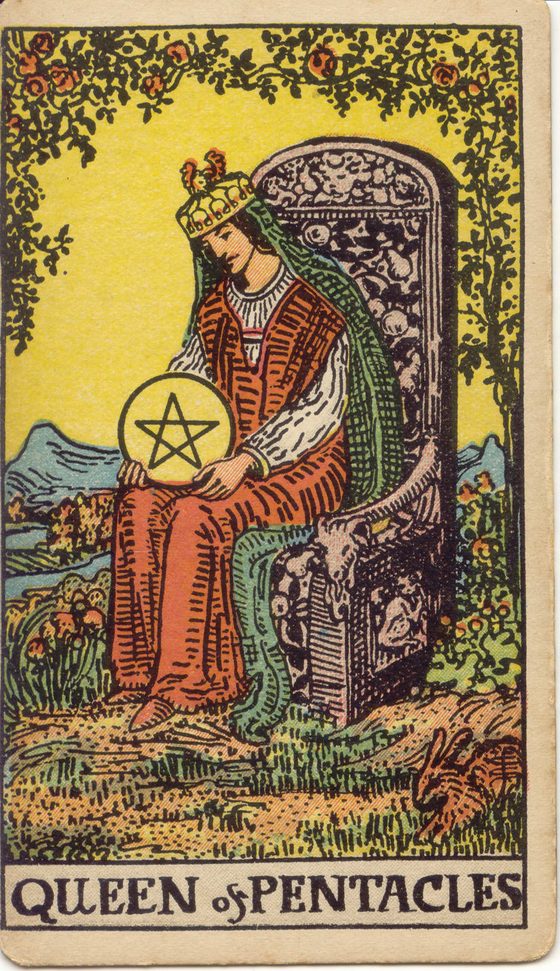
A crowned woman sits on a carved stone throne in the open air, holding a large pentacle in both hands on her lap and looking down into it. The throne is decorated with goat heads, fruit and a small winged face. An arch of roses grows over and behind her, and the ground around the throne is thick with leaves and flowers.
Her robe is red-orange with white undersleeves, and a green mantle falls from her shoulder across the throne. To the left of her the ground drops away to a green plain and a line of blue hills; to the right there are flowering shrubs. In the lower right corner a rabbit sits in the grass facing the throne. It is the only other creature in the frame.
Upright meaning
The Queen of Pentacles is the card of practical care: the person who keeps a household, an operation or a family functioning, and who knows to the penny what that takes. Waite gives her opulence, generosity, magnificence and security, and writes that she contemplates her pentacle and may see worlds in it. She is the only court figure in the suit looking into the symbol rather than at it.
The work she describes is usually invisible, and invisible by design. Meals, logistics, money stretched, the thing that got sorted out before anyone else noticed it was a problem, and the reason nobody noticed is that she handled it. It is the same competence the Nine of Pentacles turns inward, pointed outward at other people instead.
It is easy to confuse with The Empress, and the difference matters. The Empress is abundance without arithmetic. The Queen of Pentacles has done the arithmetic. Beside a card of scarcity she reads as somebody making a hard situation liveable; beside a card of exhaustion, as somebody doing that for too long without ever being asked whether she can.
Upright in love
Warmth expressed as attention to what somebody actually needs. This is the partner who notices you have not eaten, who handles the thing you were dreading, whose affection arrives as logistics rather than as language.
It usually reads well, and there is one question worth asking whenever it appears in a relationship spread: whether the care runs both ways. The card describes a person who is very good at looking after other people and often bad at being looked after. Where the question is whether somebody loves you, this is a strong card. Where the question is whether the arrangement is fair, it does not answer, and its neighbours have to.
Upright in work
Operations. The person who knows where everything is, keeps the schedule honest, and absorbs the problems before they reach anybody senior. This is competence of a kind that organisations depend on completely and describe vaguely, usually in the language of being helpful.
Upright, the card favours the practical fix over the ambitious plan. It also tends to turn up for people whose value is obvious to everyone they work with and invisible on paper. The King of Pentacles holds the same competence with the title attached; this card frequently does not have the title.
Upright in money
Resourcefulness. Making the amount available do more than it should: stretching, substituting, repairing, knowing the real price of things. The card describes skill with money rather than a quantity of it, and the skill is the part that transfers between situations.
It is not a card about markets or products and offers no guidance there. What it does describe is somebody who could tell you without looking roughly what this month costs and where the slack is. That knowledge is worth more than most advice and is unglamorous enough to be dismissed routinely.
Upright as feelings
Protective, warm and practical. Someone who has already thought about your circumstances and has probably done something about them without mentioning it. It is regard expressed by solving problems, which is easy to receive and difficult to reciprocate. The card describes steady care rather than intensity, and says nothing about whether any of it has been declared out loud.
Upright as advice
Write down everything you are currently carrying for other people, then pick one item and hand it back this week. The card's strength is capacity. Its characteristic failure is treating capacity as an obligation, and the list is almost always longer than the person writing it expected it to be.
Reversed meaning
Reversed, this card splits along a line most books smooth over.
One reading is care that has consumed the person giving it. Everything is being held together and nobody has asked at what cost, the querent included. Self-neglect presented as competence. This version is rarely a character flaw; it is usually a situation that grew and never got renegotiated.
The other is care withheld, or care turned into control. Generosity with conditions, help that creates obligation, suspicion where there used to be trust. Waite's reversed list for this card is unusually harsh, running to evil, suspicion, suspense, fear and mistrust, and modern books have quietly dropped most of it. Some of that instinct is sound and some of it loses a real reading. Compare the Six of Pentacles, where the question of strings attached is the whole card.
The reversal does not tell you which of the two is in play. The question does, and so do the cards around it, and choosing between them is the actual work of the reading.
Reversed in love
Either a person giving so much that the relationship has stopped being mutual, or a person whose care has acquired conditions. Both feel like devotion from the inside. Reversed, this card often marks the point where practical support has become the only currency in the relationship and nothing else is being exchanged. It can also describe somebody tired enough to have gone quiet, which reads as coldness from outside and is not.
Reversed in work
The person holding an organisation together while it declines to notice. Reversed, this card frequently marks unrecognised load rather than poor performance: somebody doing three jobs, absorbing the friction, and being described as reliable rather than paid as though they were. The other reading is control, competence used to keep others dependent and information held rather than shared. The surrounding cards decide which, and the two need completely different responses.
Reversed in money
Resourcefulness under strain. Stretching that has stopped being clever and become grinding, or an accounting so tight it has taken over the mood of the household. Reversed can also mark money used to manage other people, given with expectations attached and remembered later. The card is not making a judgement about the amount. It points at what the money is being asked to do besides being money.
Reversed as feelings
Care that has gone quiet from exhaustion, or care that has become watchful. Reversed here often describes somebody who still feels everything they felt and has stopped expressing it, because expressing it did not appear to change anything. Suspicion is the other reading, and it should be reached for last rather than first.
Reversed as advice
Ask one person for something specific this week and let them do it badly. The reversal describes capacity that has become a trap, and the trap closes by way of everything being quicker to do yourself. Accepting slightly worse help is the concrete way out of it, and it is genuinely uncomfortable.
Symbolism in the 1909 image
The pentacle in her lap. Held in both hands and looked into rather than displayed. Waite writes that she contemplates her symbol and may see worlds in it, which is the opposite of the Knight of the suit, who holds his out at arm's length and never touches it.
The rabbit. Bottom right, sitting in the grass and facing the throne. Usually read as fertility and abundance. It is also the only other living thing in the frame, and it is close enough to her to be plainly unafraid.
The rose bower. An arch of roses growing across the top of the whole card, not only over the throne. Cultivated rather than wild: somebody trained it there and somebody keeps it. Much of the card's argument sits in that one detail.
The goat heads on the throne. Carved into the stone along with fruit and a small winged face. The goats are usually read as Capricorn and as earth. They are also plainly decorative, and the books tend to be more certain about them than the drawing is.
The open ground. A green plain and blue hills opening out to the left of the throne, flowering shrubs to the right, grass and bare earth beneath her. She is seated in the middle of it and looking at none of it.
Where this meaning came from
Coins were one of four suits in the fifteenth-century Italian decks, where tarot was a trick-taking game and each suit carried four court ranks. The queen had a rank and no meaning at all. Divinatory readings arrived in eighteenth-century France with Antoine Court de Gebelin and then Etteilla, along with the Egyptian origin story that later scholarship dismantled.
The 1909 deck drawn by Pamela Colman Smith to Waite's direction is where the modern reading was fixed. Waite's list in The Pictorial Key to the Tarot (1910) gives opulence, generosity, magnificence, security and liberty. His reversed list is startling next to it: evil, suspicion, suspense, fear, mistrust.
Two features of that entry have aged badly and are worth naming. Waite saves his most moralising reversed language for the two senior courts of this suit, evil and mistrust for the Queen and vice and corruption for the King, where the Page gets prodigality and the Knight gets idleness. And the upright description opens by identifying her by complexion, which was ordinary practice in period tarot writing and is not used now. Most modern books have dropped both quietly, without ever saying why they were there.
The common misreading
The Queen of Pentacles is routinely flattened into the mother. She appears, somebody says nurturing, and the reading stops. It is a card about running something, whether a household, a budget or an operation, and reducing it to warmth removes the competence, which is the part the picture is actually about. That reduction also tends to be applied to women in the querent's life and not to the equivalent cards elsewhere in the deck.
The second is treating her generosity as unlimited. The roses are trained, the field is worked, the arithmetic has been done. This card includes the cost of what it provides, and a reading that takes the abundance and skips the labour has quietly swapped it for a different card.
The third is repeating Waite's reversed list at a person. Evil, suspicion, fear and mistrust, applied to somebody the querent actually knows, is an accusation dressed as a reading, and it lands hard. If the reversal is describing withheld care, say that instead. Do not hand somebody a verdict on their mother.
Questions to sit with
- What are you holding together that would fall apart within a week without you?
- Who last did something practical for you, and did you let them finish it?
- What does this month actually cost, and could you say the number out loud?
- Is the care you give being received, or only absorbed?
Pull this card in a real spread.