- Card number
- 12
- Arcana
- Minor Arcana
- Suit
- Wands
- Element
- Fire
- Rank
- Knight
- Yes or no reading
- Yes
Knight of Wands
Momentum with a person attached to it. The Knight of Wands describes someone moving fast toward something they want, with more confidence than information, and the card is silent on whether the destination is worth the ride.
- energy
- speed
- adventure
- impulse
- confidence
- haste
- temper
- stalling
- scattered
- unfinished
What the card shows
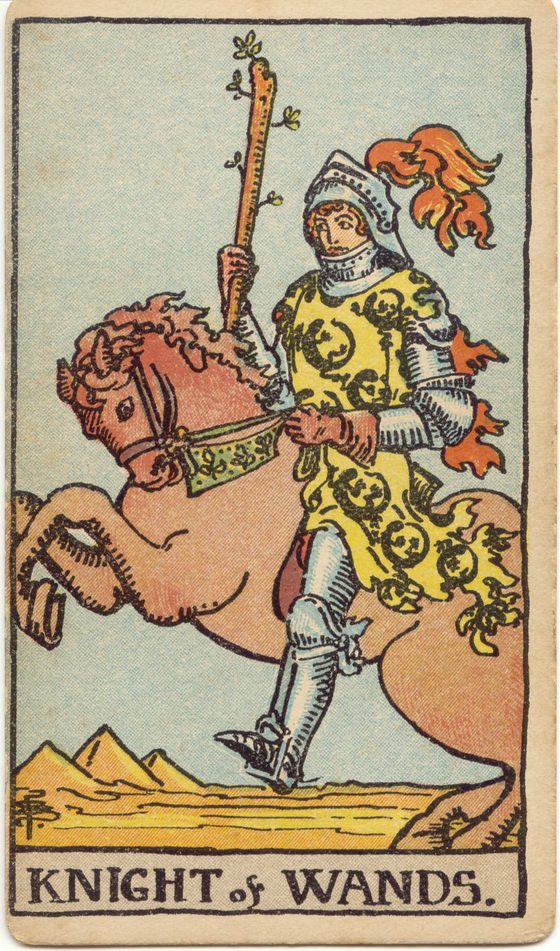
An armoured rider crosses the frame from right to left on a horse the colour of rust. The horse's forelegs are off the ground and its mane stands up in stiff flame-shaped points. The rider carries a wooden staff upright in the right hand; the staff is still sprouting green leaves at the top. A red plume rises from the helmet and a second length of red cloth trails behind the shoulder.
The surcoat is yellow and printed all over with black salamanders, some of them curled so the tail meets the mouth. Under it the armour is plate, articulated at the knee and elbow. The ground is flat yellow sand. Three small pyramids sit on the horizon at the left. The sky is pale and empty. Nothing is being ridden toward and nothing is being ridden from; the frame contains only the movement.
Upright meaning
The Knight of Wands is motion that has already started. Where the Page of Wands is an idea being turned over, the Knight has left the building. The card describes energy, direction and speed, and it says nothing about accuracy. This is the fastest of the four Wands court cards and the one least interested in being asked to explain itself.
As a person, it reads as someone charming, impatient and genuinely brave, who is better at beginning than at finishing. As a situation, it reads as a project already in flight: the commitments made, the announcement sent, the ticket booked. The useful question is not whether to move but whether the direction was chosen or merely taken.
Waite's own note on the card is short and physical, a departure or a change of residence, and later readers built the personality onto it. Neighbouring cards decide the tone. Next to Eight of Wands it reads as momentum that is actually going somewhere; next to Seven of Wands it reads as someone charging into a fight they picked; next to a settled card like Four of Wands it reads as arrival rather than flight.
Upright in love
In a relationship reading the Knight of Wands is heat and pace. It describes attention that arrives quickly and is not shy about it: the message sent the same night, the trip planned for next month, the declaration made early. That is genuinely attractive and it is genuinely real while it lasts.
What the card will not tell you is duration. The Knight is a court card about how someone moves, not about what they will still want in a year. If the question was whether this person is serious, the honest answer is that the card describes intensity, and intensity is not the same measurement. Look at what sits under it for that.
Upright in work
At work this is the card of the person who ships. They will take the unproven brief, present it before it is ready and carry a room on conviction. On a team that has been stuck, that is worth a great deal, and the Knight is usually the reason something finally moved.
The cost is in the follow-through. Wands courts are strong at ignition and weak at maintenance, and the Knight is the extreme case. If the reading is about a launch, a pitch, a move to a new city for a job, the card leans toward going. If it is about the eighteenth month of an existing project, it is describing restlessness rather than opportunity.
Upright in money
In money questions the Knight of Wands describes appetite rather than arithmetic. It is the card of the decision made at speed and defended afterwards: the deposit put down, the equipment bought for a business that does not exist yet, the notice given before the next thing is signed.
The card cannot tell you whether the number works. It can tell you that the reasoning was fast, and fast reasoning about money is worth checking against something slower. If the sum is small and the lesson is cheap, the Knight is a reasonable thing to be. If it is large, the card is describing your temperament, not the sum.
Upright as feelings
As feelings, the Knight of Wands is wanting, undisguised and in a hurry. It is not tenderness and it is not calculation. Somebody has decided they are interested and has not spent long deciding. Whether that interest holds under friction is a different card. The heat is real; it is also the easiest thing in the deck to mistake for depth.
Upright as advice
Go, but name the day you come back and check whether it is working. The Knight's failure is not the leap, it is the refusal to look back at it. Pick one measurable thing, a reply or a signed page or a number, and a day to look at it, before you start.
Reversed meaning
Reversed, the Knight of Wands splits, and the two halves point in opposite directions. The first is the horse running with nobody steering: haste, temper, a departure made to escape rather than to arrive, promises given faster than they can be kept. Read this way the card is not about the wrongness of moving but about the absence of a reason.
The second is the engine that will not start. Same rider, same fire, no ignition. Plans announced and not begun, enthusiasm that arrives in bursts and leaves before anything is finished, a person described as driven by everyone including themselves who has not shipped anything in a year. This half is quieter than the upright and harder to admit to.
The card does not choose between these. The spread does. If the surrounding cards describe pressure, conflict or speed, read the first. If they describe stalling, boredom or repetition, read the second. Picking the same half every time is a habit, not a reading.
Reversed in love
Either too much heat too fast, or heat that has gone out. In the first reading someone is pushing pace on a connection that has not agreed to it, or leaving abruptly because leaving is easier than the next conversation. In the second, the pursuit stopped once it succeeded and what is left is a person who was more interested in the chase.
Where the question is about somebody else, note that the card describes behaviour you can observe, not motive you cannot. Do not fill in the motive.
Reversed in work
A launch made before anyone checked the arithmetic, or a launch that has been imminent for two quarters. Both are the Knight reversed and they need opposite responses: the first needs a brake, the second needs a smaller first step.
There is a third version worth naming. Sometimes the reversal is a competent person in a job with no forward motion in it, and the restlessness the card describes is a fair reading of the job rather than a fault in the person.
Reversed in money
Money moved on impulse and regretted, or money held back so long that the thing it was for is gone. The reversal is a comment on the quality of the decision, not on the amount.
Practically, the reversed Knight is the card most likely to appear over a commitment made in a single evening. That does not make the commitment wrong. It makes it worth reading again in daylight, with someone who has no stake in it.
Reversed as feelings
Either feeling running ahead of anything that has actually happened between you, or feeling that has cooled and not been said out loud. Both look like silence from the outside, which is why this position is guessed at more often than it is read. The card describes temperature, not intention.
Reversed as advice
Find out which half you are in before you do anything. If you are moving, stop for one day and say out loud what you are moving toward. If you have not moved in months, do not plan again; do the smallest irreversible thing on the list today, and let the plan catch up.
Symbolism in the 1909 image
The horse. Rust-red, forelegs off the ground, mane drawn in stiff points like flame. It is the only thing in the picture with an opinion about the direction. One hand is on the reins, the other is full. Whether the rider could stop is not something the drawing settles.
The salamanders. Printed across the yellow surcoat and repeated on the horse's cloth. Several are closed into a loop, tail in mouth; several are not. The salamander was the standard emblem for fire in the period's occult writing, and the closed ones are usually read as fire mastered, the open ones as fire still loose. Smith drew both on the same garment.
The sprouting staff. Green leaves at the top of a cut piece of wood. Every Wands card carries this: the tool is still alive. It marks the thing being carried as unfinished.
The pyramids. Three of them, small, on the horizon at the left. They are the only permanent objects in the frame, and the rider is not looking at them. Waite says nothing about them. Later readers have offered Egypt, ambition and monument, and none of those comes from him.
The red plume. Rising from the helmet and repeated in a length of cloth behind the shoulder. It is the same red as the horse and it is drawn moving. It is the picture's only evidence of speed; without it the horse could be standing still.
Where this meaning came from
The knights of the tarot began as ordinary court cards. In the Italian trick-taking decks of the fifteenth century each suit ran page, knight, queen, king, and the knight was a rank in a game, not a temperament. Batons, the ancestor of Wands, were one of the four Latin suits still used on Italian and Spanish playing cards today.
The divinatory layer was added in eighteenth-century France, first by Antoine Court de Gebelin and then commercially by Etteilla, who assigned meanings to every card and attached an Egyptian origin story to the deck. The Egyptian claim was invented. It stuck anyway, and the pyramids Smith put on the horizon of this card are a late echo of it.
The version English readers actually use comes from the 1909 deck drawn by Pamela Colman Smith to Arthur Edward Waite's direction, and from Waite's The Pictorial Key to the Tarot in 1910. His entry for this card is unusually terse, a list of departure, absence, flight and emigration, and it says almost nothing about character. Nearly everything modern books say about the Knight of Wands as a person was written later, by other people, and is worth holding more loosely than the confidence of the books suggests.
Smith received a flat fee for the deck and was credited only by the initials in the corner of each card.
The common misreading
The most common misreading is treating this card as a promise that the thing will happen. It is a court card. Court cards describe a manner, and a manner is not an event. Drawn over a question about whether somebody is coming back, the Knight of Wands describes the way that person moves through the world, and someone who moves fast toward things can move fast away from them with exactly the same energy.
The second is the romance of the Knight himself. Read alone he is dashing. Read next to the cards he usually turns up with, he is frequently the reason something ended. That is not a judgement and it is not a warning; it is a note that the picture is flattering and the reading should not be.
The third is subtler. Because the reversal is usually taught as recklessness, readers reach for it automatically and miss the reading that comes up more often in practice: the person who has all the fire and none of the ignition. If nothing in the surrounding cards is moving, the reversed Knight is describing that, not haste.
Questions to sit with
- What are you moving toward, and when did you last say it out loud to someone else?
- Name the last three things you started this year. How many are still running?
- If this decision turns out wrong, what does it cost, and who else pays part of it?
- Is the restlessness about this situation, or does it follow you between situations?
Pull this card in a real spread.