- Card number
- 11
- Arcana
- Minor Arcana
- Suit
- Wands
- Element
- Fire
- Rank
- Page
- Yes or no reading
- Yes
Page of Wands
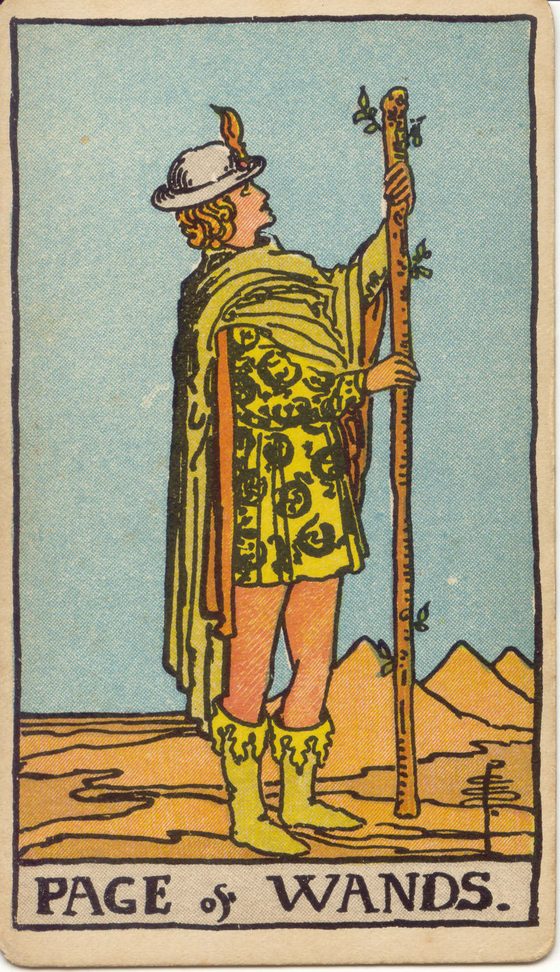
A young figure in the desert, looking up at a staff that has started to sprout. The Page of Wands is enthusiasm before experience: interest that is real, unproven, and not yet committed to anything.
- enthusiasm
- curiosity
- new interest
- exploration
- news
- scattered
- hesitation
- false start
- cooled interest
- bad news
What the card shows
A young figure stands in a desert landscape, holding a tall staff planted upright on the ground with both hands. The head is tipped back and turned to look up at the top of the staff, where small green shoots are sprouting. A wide-brimmed hat sits back on the head with a long red plume rising from it.
The tunic is patterned all over with salamanders, drawn in a repeating motif, some with their tails in their mouths. Behind, three low pyramids sit on the horizon. The ground is bare sand, the sky is flat yellow, and there is no path, no water and no other person. Nothing is happening. The figure has stopped and is looking.
Upright meaning
The Page of Wands is the beginning of an interest rather than the pursuit of one. Something has caught this person's attention and they have stopped to look at it. The staff is planted, not carried; nothing has been undertaken yet. What is drawn is the moment of being struck by an idea.
Upright it usually reads as enthusiasm, curiosity, a new venture in its earliest form, or news arriving about something you care about. In older systems the Pages also stood for messages and messengers, and that reading survives. The energy is genuine and it is untested. Nobody in the picture has done the work yet, and the desert around him means there is no evidence yet either.
Read as a person, this is someone young in a role rather than young in years: eager, unpolished, willing to try things that experienced people have learned to be careful about. That is a real asset and a real liability. Beside Ace of Wands it reads as an idea that has found a person. Beside The Fool it reads as someone about to start without a map, which the suit generally approves of and the spread may not.
Upright in love
In a relationship reading this is early interest with a lot of energy and very little history. Flirtation, a first stage that is exciting because nothing has been tested, someone who is enthusiastic and has not yet had to be reliable.
It is not a card about depth and it does not pretend to be. Read as a person, it can describe someone genuinely taken with you who has no track record with you, and those two facts sit together without contradiction. If the question is whether this lasts, the card cannot answer. It describes the temperature at the start, and starts do not predict the rest.
Upright in work
At work this is a new interest, a side project, a role someone has just started and is still excited by. It also covers the junior person with more enthusiasm than judgement, which is a description and not an insult; the enthusiasm is often the useful part.
As advice it points at the exploratory stage: learning something, trying an idea before it is justified, taking on work you are not yet qualified for. What the card does not supply is follow-through. The Page is looking at the staff, not using it, and a great many Page of Wands projects end at the looking. Knight of Wands is the card where somebody actually moves.
Upright in money
In money questions this is an early idea rather than a position: a venture being considered, a small first stake, income from something new and not yet proven. The amounts are usually modest and the interest is usually genuine.
The card marks enthusiasm, which is exactly the condition under which people skip the boring parts of a decision. It says nothing about whether the thing is sound, because it cannot: there is no evidence in the picture, only appetite. Anything that needs a number attached to it needs a spreadsheet and probably someone qualified, and this card is neither.
Upright as feelings
As someone's feelings, this is bright, immediate and not yet weighed. Excitement about you that has not been tested against anything difficult. It is warm and it is early. Whether it becomes anything is a question about time rather than about intensity, and the card is drawn at the point before that question has been asked.
Upright as advice
Try the thing at small scale this week. Not plan it, not research it further: do a small version of it and see what happens. The Page of Wands fails by staying in the looking stage, where an idea is still perfect because it has not met anything.
Reversed meaning
Reversed, the Page of Wands most often reads as enthusiasm that has not survived contact with anything. The idea has stalled, the new interest has gone quiet, or the person has moved on to the next thing before finishing this one. Scattered energy rather than absent energy.
The second reading is different and worth holding: hesitation. Not someone who has flitted away, but someone who has not started at all, because starting would make the idea real and a real idea can fail. The card in this position can describe a person still looking up at the staff months later.
There is also a plainer version, bad news or a message that does not arrive, carried over from the Pages' older role as messengers, which Eight of Wands handles more directly. Which applies is decided by the spread rather than by preference. Near cards of movement, read scatter. Near cards of stasis, read the unstarted idea. Near cards about other people, consider the message. The reversed Page is one of the easiest cards in the deck to reduce to immaturity, and that reading is almost always the least useful of the three.
Reversed in love
Either interest that has faded as quickly as it arrived, or interest that has never been acted on. Both are common in this position and they call for different responses: one for accepting it is over, one for saying something. If the question is about someone who went quiet, the card marks the stall and offers no reason. People stop for reasons that usually have nothing to do with the person waiting.
Reversed in work
A project abandoned at the interesting stage, a role someone has already cooled on, or news about a job that has not come. It can also describe a person with plenty of ideas and no delivery, which is a fair description and not a character verdict. The reversal points at the gap between starting and finishing. Whether that gap is the person's or the organisation's is a question the card leaves open.
Reversed in money
A venture that did not get past the idea, or money put into something on enthusiasm alone and then left unattended. Reversed, the card often marks the point where interest ran out before the admin did. If something was started and never properly closed, closing it is the practical reading. What anything is worth is not in this card and never was.
Reversed as feelings
Enthusiasm that has cooled, or enthusiasm that was never expressed. Someone who was keen and is now elsewhere, or someone who is still keen and has said nothing. The card registers that the feeling has not turned into anything visible, which is all anyone can honestly claim to know about it.
Reversed as advice
Finish one thing you already started before beginning anything else. Pick the oldest unfinished item, and either complete it or formally abandon it out loud. Both count. What does not work is leaving it open while starting the next one, which is how the reversed Page accumulates a shelf of half-built things.
Symbolism in the 1909 image
The salamanders on the tunic. Repeated across the fabric, and in several of them the tail meets the mouth. The salamander was a traditional emblem of fire, believed to live in flame. The closed-loop ones are usually read as completion and the open ones as potential, though whether Smith drew the distinction deliberately or simply varied a repeating pattern is not established.
The sprouting staff. Green shoots at the top of otherwise dead wood, the same motif that runs through the whole suit. It marks the idea as alive. It also means the staff is doing something without him.
The upward gaze. He is looking at the top of his own staff rather than at the landscape or the horizon. Read as inspiration. Read less generously, as attention fixed on the thing he is holding rather than on where he is.
The pyramids. Three of them, low on the horizon, small. They belong to the Egyptian layer that eighteenth-century French writers grafted onto tarot, and they are decorative rather than evidential.
The desert. Nothing grows, no path is marked, no destination is visible. The setting supplies no information at all, which is precisely the condition the card describes.
Where this meaning came from
The court cards are older than the divinatory tradition attached to them. In the Italian decks the four suits each carried a King, a Queen, a Knight and a Knave or Page, and the Page was simply the lowest of the four ranks in a card game.
The occult reading arrives in France. Court de Gebelin's speculation and Etteilla's practical lists gave the courts personalities and functions, and the Pages were widely treated as messengers or as young people connected to the querent. Etteilla's entries for this card lean toward a young man, a stranger, and news.
Waite kept both. His note in The Pictorial Key to the Tarot (1910) describes a young man in the act of proclamation, and offers a striking pair of readings: a faithful lover or an envoy, and also, he adds, a dangerous rival. That second possibility has largely fallen out of modern books, which prefer the enthusiastic beginner.
The salamanders and pyramids are Pamela Colman Smith's, drawn to Waite's Golden Dawn framework: salamanders for the element of fire, pyramids for the Egyptian pedigree the eighteenth century invented. The Egyptian claim was false. The picture is still the one everyone reads from.
The common misreading
The Page of Wands is most often flattened into a child. Pages are read as literal young people, and the card gets handed to someone as a prediction about a son, a nephew, a student. Waite's own text does not restrict it that way, and reading a court card as a person in the querent's life is a choice the reader is making, not information the card supplied.
The second misreading is treating enthusiasm as evidence. Because the card is warm and forward-leaning, it gets used to endorse whatever the querent is excited about. But the Page has done nothing yet. The picture contains appetite and no results, and using it to confirm that an untested idea is a good one is exactly backwards.
The third is the loss of Waite's other reading. He explicitly allowed that this card can indicate a dangerous rival, and modern summaries have quietly dropped it in favour of the bright beginner. Keeping only the flattering half of a source is how a tradition gets thinner over time, and it leaves the reader without the one interpretation that might have been useful.
Questions to sit with
- What have you been thinking about starting, and what would the smallest version of it look like?
- Is this interest new, or is it a returning one you have already abandoned once?
- What are you waiting to know before you begin, and is it actually knowable?
- Who would you have to tell in order to make this real?
Pull this card in a real spread.