- Card number
- 1
- Arcana
- Minor Arcana
- Suit
- Pentacles
- Element
- Earth
- Rank
- Ace
- Yes or no reading
- Yes
Ace of Pentacles
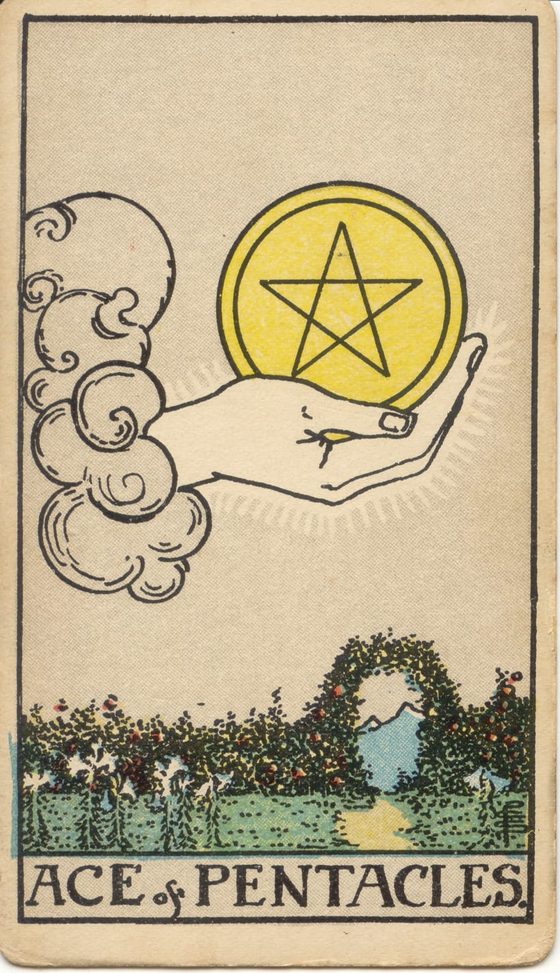
A hand out of a cloud offering a single coin above a walled garden, with a gate leading out to distant mountains. The card marks an opening in material life, not a delivery, and the gap between those is the whole card.
- opportunity
- new resources
- prosperity
- beginnings
- security
- missed chance
- delay
- poor planning
- hesitation
- scarcity
What the card shows
A hand comes out of a grey cloud in the upper part of the card, palm turned up and open, holding a large gold disc face-on. A five-pointed star is engraved on the disc. The cloud has no body attached to it, and the hand is not gripping.
Below is a garden. White lilies grow in a bed of green grass, and a trimmed hedge runs across the lower third of the picture, thick with small white flowers. An arched gap has been cut through the hedge, and beyond it a path runs away between the trees toward a range of tall mountains, blue-grey at the horizon. The sky is pale. Nobody is standing in the garden, and nobody is on the path.
Upright meaning
The Ace of Pentacles is an opening in the material world: a job offer, a piece of money, a house that becomes available, the start of something that will need work before it is anything.
Aces are potential rather than event, and this is the most concrete of the four. Where the Ace of Cups offers feeling and the Ace of Swords offers clarity, this one offers a thing you could hold. That makes it the easiest Ace to misread as a promise, because the object in the picture looks as though it has already arrived.
Nobody has taken it. The hand is open, the garden is empty, and the gate leads somewhere nobody is walking. The card describes an offer on the table. It says nothing about whether the offer is accepted, or whether accepting it works out.
Read the neighbours. Beside Eight of Pentacles the offer turns into a long apprenticeship. Beside The Empress it is fertile and likely to grow into something. Beside Four of Pentacles the question is whether the querent will hold it so tightly that it stops being useful.
Upright in love
In a relationship reading the Ace of Pentacles is unglamorous and usually good. It describes a practical beginning: keys exchanged, a shared account, a decision to build something rather than to feel something. This is the card of a relationship that is becoming a structure.
It is not a card of romance and does not pretend to be. Where a querent is asking whether somebody is in love with them, this Ace answers a different question, about whether the thing being built has foundations under it.
It also turns up for people who want stability and keep being handed intensity. The offer here is the other kind, and the card does not say whether it will be taken.
Upright in work
An opening at work. A role, a client, an offer, a piece of training that leads somewhere. The Ace of Pentacles is the most literal card in the deck about employment, and it still describes only the opening, never the career.
What it is good at is marking the difference between an opportunity and a plan. The disc in the picture is being offered, not built. Everything that would make it worth having is on the far side of the hedge and has not been done yet.
If the question is whether to take something, the card is describing the fact of the offer. The decision stays with the querent, and the card is not making it.
Upright in money
Money arriving or becoming possible: a payment, a raise, a new source of income, the beginning of a saving.
The most useful thing the card says is about timing. This is the moment before the money has done anything at all, when it is still entirely potential and could be spent, saved, invested or wasted with equal ease. Aces describe that moment and not the ones after it.
Nothing on this page is advice about what to do with money. The card notes an opening. What gets done with the opening is not in the picture.
Upright as feelings
As feelings, this is steady interest with something practical behind it. Someone who is thinking about whether this could work rather than about how it feels tonight. That is not a shortage of warmth. It is a person whose way of caring about somebody is to consider seriously what they would actually be offering them.
Upright as advice
Take the thing, or decline it clearly, and do it this week. Aces expire in practice, because offers are made by people and people move on. If you take it, write down the first physical step, the one involving a form, a call or a payment, and do that step before the enthusiasm wears off.
Reversed meaning
Reversed, the Ace of Pentacles reads two ways, and they are easy to confuse inside a spread.
The first is the offer that does not hold. A job that falls through, funding withdrawn, a scheme that looked solid and was not. This is the reading most books lead with, and it is usually stated too strongly: a reversed Ace need not mean the thing is fraudulent, only that what is on the table is thinner than it looked.
The second is the offer refused, or never noticed. The opening is real and the querent is not moving toward it, most often because taking it would commit them to something. Reversed, this card is very frequently about hesitation dressed up as prudence.
There is a third, narrower reading: the material offer taken at the cost of everything else, where the coin is accepted and the garden is never entered.
The card does not decide between them. Look at whether the surrounding cards describe an external failure or an internal stall.
Reversed in love
Either a practical beginning that did not take, or one that is being avoided. Reversed, this card sometimes marks the shared plan that quietly stopped being mentioned by either person. It just as often marks a querent who says they want security and keeps declining the unspectacular version of it every time it appears. The card describes the state of the offer, not anybody's motives.
Reversed in work
An opportunity that came to nothing, or one that is being sat on. Reversed, this can be the role that was withdrawn, the client who went quiet, or the querent who has had the offer for three weeks and still has not replied to it. Seven of Pentacles nearby argues that the wait is deliberate rather than avoidant. Look carefully at who is not moving.
Reversed in money
A financial opening that closed, or one that has not been acted on. Reversed, this card sometimes describes money counted before it arrived, and sometimes a straightforward chance to improve a position that the querent keeps deferring. It reports the status of an opportunity and nothing else. It is not advice about what to do with money, and no card can tell you whether an offer is sound.
Reversed as feelings
Interest that has never been converted into anything, or interest withdrawn once the practical cost of it became clear. Either way what shows is a gap between what somebody said they wanted and what they have actually done about it. That gap is the reversal, and it is not always deliberate.
Reversed as advice
Find out what the offer actually is before you decide anything about it. Ask the specific question, read the real document, check the number. Reversed Aces are usually resolved by information rather than by courage, and one direct question normally settles which of the two readings you are in.
Symbolism in the 1909 image
The hand from the cloud. All four Aces open the same way, with a disembodied hand offering the suit's object. Nothing in the deck says whose hand it is. Waite calls these hands the suit in its purest form, which is a polite way of saying the offer has no author anywhere in the picture.
The pentacle. A gold disc with a five-pointed star engraved on it, held flat and face-on so the whole design is visible. In this deck the pentacles carry money, work and physical life together, and the star is the older magical sign the suit took its modern name from.
The lilies. White, growing in the grass below the hand. Lilies carry purity in Christian symbolism, and their presence in a card about money is either a comment or a joke, depending on how generous you are feeling toward Waite.
The hedge and the arch. A trimmed garden hedge in flower, with a gap cut through it. This is the only Ace that includes an exit. The offer sits inside an enclosure, and a way out has been provided in the same frame.
The mountains beyond. Distant, blue and unreached. They belong to a different scale from the garden. What the arch frames is not the offer itself but everything the offer might eventually lead to, and that is a great deal further away than the coin makes it look.
Where this meaning came from
The suit now called Pentacles was originally coins. In the fifteenth-century Italian decks it was denari, one of the four suits of the ordinary playing pack of the period, alongside cups, swords and batons. An ace of coins was a card in a game, worth whatever the rules said it was worth.
The occult layer came from France in the eighteenth and nineteenth centuries. Antoine Court de Gebelin proposed an Egyptian origin for the tarot that has since been comprehensively disproved, and Etteilla built the first full set of divinatory keywords. The ace of coins in his system carried perfect contentment and material good fortune, which is close to the modern reading.
The name Pentacles, and the pentagram engraved on the disc, belong to the nineteenth-century occult revival and to the Golden Dawn in particular. Coins became pentacles because pentacles fitted the magical scheme better.
Pamela Colman Smith drew the 1909 card, and the garden, the lilies and the arch are hers. Waite's entry in The Pictorial Key to the Tarot (1910) is brief: perfect contentment, felicity, gold. He never explains the gate, which is the most interesting thing on the card.
The common misreading
The Ace of Pentacles is read as guaranteed money more often than any other card in the deck. Waite's own keyword for it is perfect contentment, which has not helped. A reader who tells a querent that money is coming has made a prediction the card cannot support, and people make real decisions on the strength of sentences like that.
The second misreading is treating the Ace as a completed event. It is an opening. Nobody in the picture has taken the coin, and every Ace describes the situation before anyone has acted, which is exactly the part that makes the card useful and exactly the part that gets skipped.
The third is scale. Because the disc is large and gold, the card gets read as a windfall. In practice it turns up for very small beginnings: a first client, a modest raise, an evening class. Reading it as a fortune sets up a disappointment the card never promised.
And a specific one: this card is used to encourage people into financial commitments. No spread can tell anybody whether an offer is sound, and a reading that implies otherwise is doing something worse than being wrong.
Questions to sit with
- What is actually being offered here, stated without the version you are hoping for?
- What would the first physical step be, and what has stopped you taking it?
- If you took this and it stayed exactly this size forever, would it still be worth having?
- Who is the hand attached to, and what do they get out of it?
Pull this card in a real spread.