- Card number
- 14
- Arcana
- Major Arcana
- Suit
- Major Arcana
- Element
- Fire
- Rank
- Trump
- Roman numeral
- XIV
- Zodiac attribution
- Sagittarius
- Yes or no reading
- Yes
Temperance
An angel standing with one foot in water and one on land, pouring liquid between two cups. Temperance is the card of proportion: the slow, unglamorous work of getting the mixture right and not spilling it.
- balance
- moderation
- patience
- proportion
- blending
- excess
- imbalance
- impatience
- overcorrection
- dispersal
What the card shows
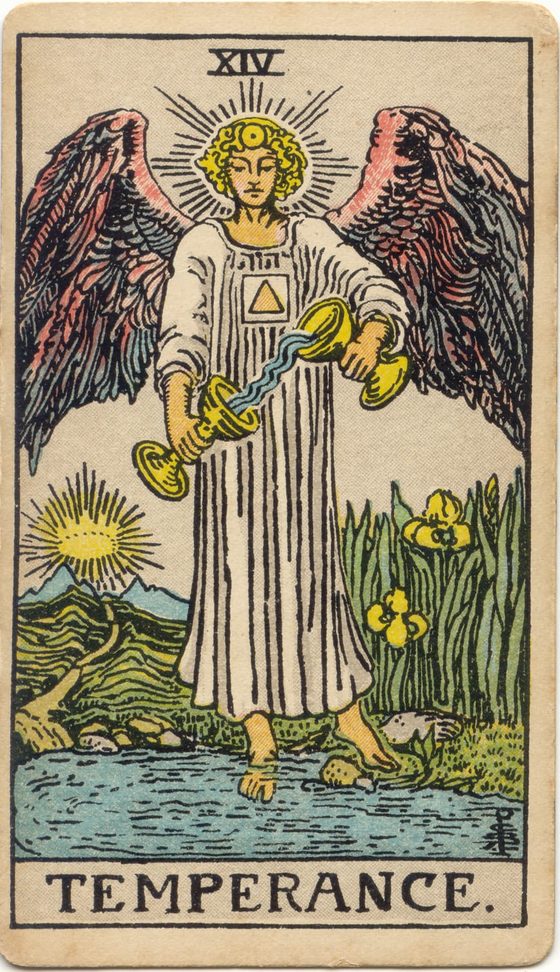
A winged figure in a long white robe stands at the edge of a pool, the right foot submerged in the water and the left resting on a stone at the bank. The wings are large, red above and dark blue-grey below. Rays of light stand out around the head, and on the breast of the robe is a white square with a triangle set inside it.
The figure holds a gold cup in each hand and pours a stream from the higher cup into the lower. The stream runs sideways rather than straight down, which no liquid does. On one side a clump of yellow irises grows at the water's edge. On the other, a path winds back through low green hills toward a radiant light sitting on the horizon between two peaks.
Upright meaning
Temperance is the card of proportion, and it is duller than the cards on either side of it, which is more or less the point. It sits directly after Death and directly before The Devil, between an ending and a trap, and what it describes is the ordinary work of getting a mixture right.
Upright, it usually marks a situation being handled well and slowly. Two things that do not naturally combine are being combined: two schedules, two temperaments, a new circumstance and an old habit. Nothing about it is dramatic. The figure has one foot in the water and one on the ground, which is an awkward stance to hold, and that awkwardness is why the card is about effort rather than about calm.
It gets read as peace, and peace is not quite it. What the picture shows is active moderation, something being adjusted continuously rather than a state that has been arrived at. Beside a card of open conflict it reads as somebody keeping a situation from tipping over. Beside The Hermit it reads as patience with a method behind it. Waite named the card for the virtue, not for the mood.
Upright in love
In a relationship reading Temperance is the ordinary competence of two people making something work: compromise that is actually happening rather than being discussed, and adjustment to each other's rhythms without either person disappearing into the other.
It is a quiet card and often a disappointing one to draw, because people asking about love usually want intensity and this is the opposite of intensity. What it says is that the mixture is being managed, that neither cup is being emptied into the other, and that the thing is going somewhere slowly. Where the question is about reconciliation, it favours a gradual one over a single decisive conversation.
Upright in work
At work this is integration: two teams merged, a new process bedding in, a person adapting a way of working to a situation that does not quite fit it. The card describes the middle of that, which is the unglamorous stretch nobody puts in a summary afterwards.
It also describes competence of a specific kind, which is knowing how much of something to apply. That is the difference between a skilled practitioner and a merely capable one, and it shows up in no metric anybody keeps. If the question is whether to push harder, this card says no, and it says so on grounds of proportion rather than of caution.
Upright in money
Balanced spending, a budget that is actually being kept, obligations and income brought into some workable relation with each other. Temperance is a card of arrangement rather than of amount, and it takes no interest at all in how much there is.
Nothing here is investment advice. What it does raise usefully is the question of proportion: what share of income, attention and risk is going where, and whether that share was chosen or simply accumulated. Most people's finances are a set of decisions made at different times that have never once been looked at together.
Upright as feelings
Steady, moderate, and warmer than it looks from outside. This is somebody who is not going to declare anything, whose feeling is real but is being kept in proportion with the rest of their life. That is not lukewarm. It usually describes a person who has been careless before and learned something from it.
Upright as advice
Change the proportions rather than the ingredients. Whatever you are doing, do less of one part and more of another before you conclude the whole thing needs replacing. The advice on this card is adjustment, and it works on the assumption that the elements are right and the ratio is not.
Reversed meaning
Reversed, Temperance divides into two readings, and they are not the same problem.
The first is excess. Something has gone out of proportion, one part of a life is taking everything, and the balancing effort has simply stopped. This is the reading most books lead with, and it covers overwork, overspending and the several other forms of too much.
The second is the moderation itself gone wrong: a person balancing so carefully that nothing is ever committed to. Everything gets a measured share and none of it gets enough. This is the quieter failure and much harder to see, because it looks responsible from every angle. Nobody stages an intervention for somebody who never over-commits.
The spread has to decide. A useful question is whether the querent is spilling, or pouring so slowly that nothing has filled. Both are described by the same picture upside down. Waite's reversal notes for this card are among the vaguest in the book, which has left the second reading badly underused.
Reversed in love
Either a relationship that has tipped, where one person's needs or work or family have taken the whole of it, or two people managing each other so carefully that nothing is being said. The second is the one worth naming, because it does not look like a problem from outside. Reversed, this card can describe a couple who compromised their way into a life neither of them chose, one reasonable decision at a time.
Reversed in work
Overwork, or a workload that has quietly become the entire allocation. Or the reverse: effort spread so thin across so many things that none of them got the amount they needed. The second is common and rarely diagnosed, because being busy on many fronts reads as commitment. Ask what would happen if one of the several things were dropped, and how long the querent has been avoiding that question.
Reversed in money
Spending or commitment out of proportion to income, or the opposite: money so carefully divided that none of it does anything. The reversal describes a ratio that has stopped being examined rather than any particular amount, and it is not advice about a specific decision. The question it supports is when the current allocation was last chosen on purpose. Most budgets are inherited from a situation that has since changed.
Reversed as feelings
Somebody whose feelings have gone out of proportion to what is actually happening between you, in either direction: too much for the situation, or so carefully rationed that they read as nothing at all. The reversal is about the ratio rather than the presence of feeling. Either way it is worth asking directly rather than trying to measure it.
Reversed as advice
Look at where your time and money actually went last month rather than where you meant them to go. Reversed, the advice on this card is an audit rather than a resolution. Fix the one ratio you find that is most obviously wrong, and do not attempt all of them at once, because that is the same mistake in a new direction.
Symbolism in the 1909 image
The two cups and the impossible pour. The stream runs sideways between the cups, at an angle no liquid takes. Smith drew it wrong deliberately. Whatever is being mixed is not water, and the drawing says so by breaking physics in the one place a viewer is certain to notice.
One foot in, one foot out. The right foot is in the pool, the left on stone. This is the most quoted detail on the card and the most over-read: it is usually glossed as balancing the conscious and the unconscious, when what it plainly shows is an uncomfortable stance somebody is choosing to hold.
The rays around the head. Light stands out from the head in straight lines. Waite says there is a solar disc on the brow, a circle with a dot at its centre, and the mark is faint in most printings. It sets this figure apart from the other angels in the deck, who are given no such sign.
The square with a triangle inside it. On the breast of the robe: a triangle within a square, spirit within matter in the usual alchemical shorthand. It is the card's clearest statement that the mixing is deliberate and technical rather than instinctive.
The path and the light on the horizon. A path winds back from the bank through low hills toward a radiance sitting between two peaks. Books describe it confidently as a crown. In this printing it reads at least as easily as a rising sun, and the drawing does not settle which.
Where this meaning came from
Temperance is one of the four cardinal virtues and, like Justice and Fortitude, it enters the deck through fifteenth-century Italian moral iconography rather than through anything occult. In the earliest versions it is a woman pouring water between two jugs: a picture of literal tempering, of thinning wine, which is what the word meant long before it meant abstinence.
The deck was equipment for a trick-taking game and the card had no divinatory function. The occult reading is added in eighteenth-century France by Antoine Court de Gebelin and Etteilla, and the Sagittarius attribution comes from the Golden Dawn in the 1890s.
Waite and Smith made two significant changes in 1909. The woman becomes a winged angel marked with the sign of the sun, and the jugs become cups with the stream running impossibly between them. Waite in The Pictorial Key to the Tarot (1910) is unusually forthcoming about the angel's mark and the path to the light, and unusually cagey about what is in the cups. He says the card concerns the economy and management of life, which is a plain description dressed up as a mystery.
The common misreading
Temperance is most often read as everything being fine. It is the card readers reach for when a spread is otherwise difficult and they want somewhere soft to land. That is a misuse of it. The figure is standing in cold water holding an awkward pose, and the card describes effort being spent to keep something from tipping over, not a situation that has resolved itself.
The second misreading is treating moderation as automatically correct. Some situations do not want a balanced response. A person being badly treated does not need a card telling them to find the middle, and a reader who supplies that has confused a virtue with advice. Temperance describes proportion. It does not say the current proportion is right, and it certainly does not promise that a compromise is available.
The third is boredom. Because the card is undramatic it gets passed over quickly in favour of whatever is more interesting in the spread, and that is usually a mistake. In readings about a long-running situation, Temperance is often the card carrying the actual answer, and the answer is that the thing is being managed rather than solved. That is worth saying plainly to somebody who is waiting for it to be over.
Questions to sit with
- What ratio in your life did you choose on purpose, and what did you simply end up with?
- Where are you spilling, and where are you pouring so slowly that nothing has filled?
- What would you have to do less of for the thing you say matters to get enough?
- Is this situation being managed or solved, and which one were you hoping for?
Pull this card in a real spread.