- Card number
- 17
- Arcana
- Major Arcana
- Suit
- Major Arcana
- Element
- Air
- Rank
- Trump
- Roman numeral
- XVII
- Zodiac attribution
- Aquarius
- Yes or no reading
- Yes
The Star
A card of replenishment after damage, drawn as a woman pouring water back into a pool she is kneeling beside. The Star describes a steady, unhurried return of hope, and says nothing about how long it lasts.
- hope
- renewal
- calm
- openness
- replenishment
- discouragement
- self-doubt
- waiting
- withdrawal
- complacency
What the card shows
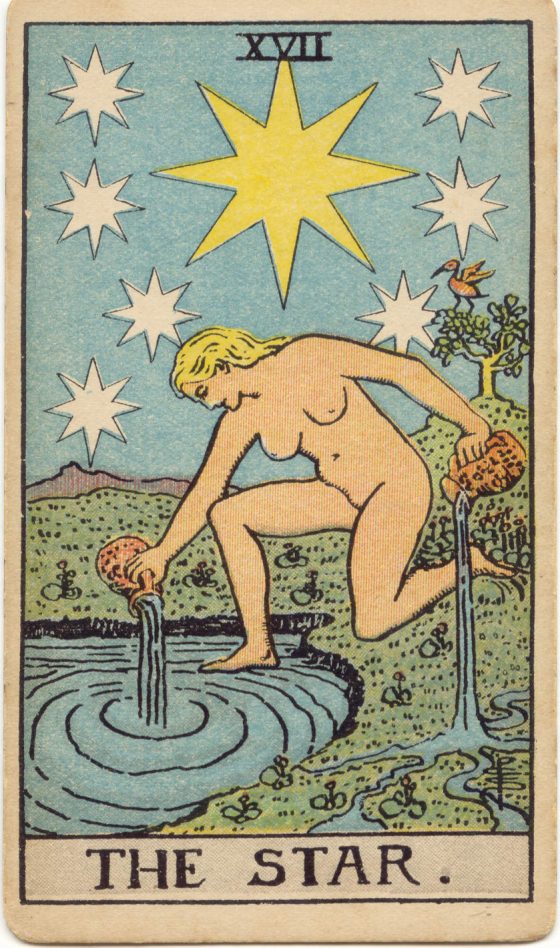
A naked woman kneels at the edge of a pool. Her right knee rests on the bank and her left foot is set on the surface of the water, taking no weight. She holds a terracotta vessel in each hand. The one in her left hand empties into the pool; the one in her right pours onto the grass, where it runs away in several small streams.
Above her, one large yellow star of eight points, and seven smaller white ones arranged around it. To the right, a tree with a red bird perched on the top branch. The ground is scattered with small plants. Low hills close the horizon on the left. Her hair is loose and yellow, and nothing in the scene is in shadow.
Upright meaning
The Star follows The Tower, and that order does most of the interpretive work. It is the card of what happens after the damage: not repair, not restoration to how things were, but the slow return of the capacity to want things again. The woman is not celebrating. She is doing quiet, repetitive work at the edge of a pool.
Drawn upright, it usually describes a period in which pressure has come off and something is being replenished. Confidence, health, attention, the willingness to be seen. The card is unhurried in a way that frustrates people who draw it hoping for movement. It is a recovery card, not a rescue card. Nothing here is fast, and nothing here is guaranteed to last, because the card describes a condition rather than an achievement.
It is also the deck's most exposed card. She is naked, in the open, with no shelter drawn anywhere in the frame. Read that as trust or as vulnerability depending on what surrounds it. Beside a card of loss it reads as genuine recovery; beside The Moon, which follows it, the calm looks more like a lull than a resolution.
Upright in love
In a relationship reading The Star usually describes a settling. Either a connection that has come through something difficult and is being slowly rebuilt, or a person who has stopped defending themselves and is willing to be known again. The openness here is real and it is also unprotected.
What the card does not do is describe the other person. It describes a climate, not an intention. If the question was whether someone is coming back, The Star does not answer it; it says the querent is in a state where they could receive an answer without being destroyed by it. That is a different and smaller claim than most books make for this card.
Upright in work
At work The Star tends to appear after a bad stretch rather than before a good one. A project that nearly failed and is being restarted, a reputation being rebuilt quietly, a return from burnout that is not yet a return to full capacity.
It reads well for work that depends on being seen: teaching, performance, anything where the willingness to stand exposed is the job. It reads less well for anything that needs speed. The card has no urgency in it at all, and where a decision is time-limited, The Star is describing the querent's state rather than recommending they wait. Read The Hermit nearby as confirmation that the slow pace is deliberate.
Upright in money
In money questions The Star usually marks the end of a shortage rather than the arrival of a surplus. Pressure easing, a debt becoming manageable, the first month in a while that did not require improvisation.
It is a poor card for scale. Nothing in the image suggests abundance; two small vessels are being emptied and refilled from the same pool. Read it as stabilising, not as gaining. If the question was whether to commit money to something, this card describes a person with the composure to decide well, which is not the same as a reason to decide yes.
Upright as feelings
Calm that has been earned rather than felt from the start. As someone's feelings, The Star is warmth without urgency: they are not anxious about you, and they are also not in a hurry. Where the querent wants intensity, this card will read as disappointing, which is a fact about the question rather than about the feeling.
Upright as advice
Pick the one thing you stopped doing when things were worst, and start doing it again this week, at a smaller scale than before. The Star is not asking for ambition. It is asking you to demonstrate to yourself that the capacity came back, which you cannot establish by thinking about it.
Reversed meaning
Reversed, The Star splits two ways, and they are not variations on each other. The reversal is one of the clearest cases in the deck where the card cannot decide for you.
The first is hope withdrawn. The replenishment described upright has stalled or been abandoned, often after a specific disappointment. This is the reading most books give, and it is the flatter of the two: discouragement, self-consciousness, the decision to stop being seen because being seen cost something.
The second is closer to the opposite. Hope that has become a substitute for action. The card upright is unhurried; reversed, that patience can curdle into waiting as a way of life, a querent who is very serene about a situation that needed a decision some months ago. Nothing is being replenished because nothing is being spent.
The spread decides which. If the surrounding cards describe pressure and loss, read the first. If they describe stasis, read the second. A reader who defaults to discouragement every time is reciting the card rather than reading it.
Reversed in love
Either a person who has closed up after being hurt and is now describing that closure as standards, or a person who is perfectly content to keep a relationship in its current undefined shape indefinitely. Both look like calm from the outside. Only one of them is. Where the question is about someone else's availability, the reversal often says the availability is real but the willingness to act on it is not.
Reversed in work
Confidence that has not come back, or a recovery that has quietly become the permanent arrangement. The reduced hours, the smaller role, the project kept deliberately unambitious. Neither is wrong on its own. The reversal asks whether the current shape of the work is still a recovery or has turned into an identity. Compare Four of Swords nearby, which describes rest with an end date.
Reversed in money
Either the shortage has not eased and the optimism is unsupported, or the pressure genuinely lifted and nothing changed in the habits that produced it. The second is the more common and the less comfortable. Reversed, the card is not describing a loss; it is asking whether the improvement was structural or a good month. That question has an answer, and it is in the numbers rather than in the cards.
Reversed as feelings
Guardedness presented as peace, or peace that has gone slack. Reversed, the feeling is harder to read from the outside than the upright, because both versions are quiet. What the card marks is a gap between how settled someone appears and how settled they are. Ask which one you are looking at before you interpret it.
Reversed as advice
Name a date. If you are waiting for confidence to arrive before you act, set a point at which you will act without it, and write it down. The reversal of this card is almost always fixed by introducing a deadline into a situation that has been allowed to run without one.
Symbolism in the 1909 image
The two vessels. One empties into the pool, the other onto the land. Read as the conscious and unconscious mind in most twentieth-century commentary, though the drawing supports something plainer: the same water is being moved from one place to another and will drain back. Nothing is added to the scene from outside it.
The eight stars. One large and yellow, seven small and white, all with eight points. The seven are usually identified with the classical planets. Smith drew them flat and evenly spaced, more like a decorative band than a sky, and they are the least naturalistic thing in the picture.
The foot on the water. Her left foot rests on the surface without breaking it. Books tend to pass over this quickly. It is the one openly impossible detail in the card, and it sits in an otherwise ordinary landscape.
The bird in the tree. Commonly named as an ibis, sacred to Thoth, on the authority of the Egyptian material Waite inherited rather than anything in the drawing. It is small, red, and could be almost any bird.
Her nakedness. Complete, unremarked, and drawn without eroticism. Several Major Arcana figures are unclothed; she is the one who is alone, unobserved, and occupied with a task. Whether that reads as trust or as having nothing left to protect is not settled by the image.
Where this meaning came from
The Star's earliest form has nothing to do with hope. In the fifteenth-century Italian trionfi decks the star trumps were part of a run of celestial cards, star then moon then sun, and functioned as ranks in a trick-taking game rather than as symbols. Some early versions show astronomers, or a figure holding a star aloft, not a woman at a pool.
The divinatory layer is French and eighteenth-century. Antoine Court de Gebelin read the trumps as surviving fragments of Egyptian priestly knowledge, a claim with no evidence behind it that nevertheless set the terms for everything after. Etteilla built the first commercial fortune-telling system on that foundation, and it is from this period that the card acquires its association with hope.
The image most English readers picture is from 1909, drawn by Pamela Colman Smith under Arthur Edward Waite's direction. Waite's The Pictorial Key to the Tarot followed in 1910 and gave the card a deliberately vague gloss, calling it a card of hope and bright prospects while declining to say much more. Most modern keyword lists for The Star trace back to that page, or to someone paraphrasing it. Smith was paid once, credited by her initials, and died in 1951 with no share in the deck's success.
The common misreading
The Star is the card people reach for when they want a spread to mean everything is going to be fine. It does not say that. Waite's own gloss is hope and bright prospects, which is a description of a mood, not a forecast, and the picture contains no event at all. A reading that turns this card into a promise has added the promise.
The second misreading is about timing. Because the card is calm, it gets read as saying the hard part is over. What it actually shows is someone doing maintenance work at the edge of a pool, having put no weight on the foot that rests on the water. If a spread contains real pressure elsewhere, The Star describes the querent's composure while under it, not the removal of it.
The third is the most common in practice and the least flattering. The Star is frequently drawn by people who have been waiting a long time for a situation to resolve itself, and read by them as confirmation that waiting is working. The card has no opinion about that. It shows a person replenishing something; it does not show anyone arriving, deciding, or being answered.
Questions to sit with
- What did you stop doing when things were at their worst, and have you started again?
- Is the calm you are feeling the result of something being resolved, or of something being avoided?
- Who has seen you since this happened, and who have you kept at a distance?
- If nothing external changes in the next six months, what will you have done differently?
Pull this card in a real spread.