- Card number
- 3
- Arcana
- Minor Arcana
- Suit
- Cups
- Element
- Water
- Rank
- Three
- Yes or no reading
- Yes
Three of Cups
Three people and a shared reason to raise a glass. The Three of Cups is the card of celebration that has other people in it, and it describes the gathering rather than what is being celebrated.
- friendship
- celebration
- community
- reunion
- joy
- excess
- gossip
- isolation
- crowded
- drifting
What the card shows
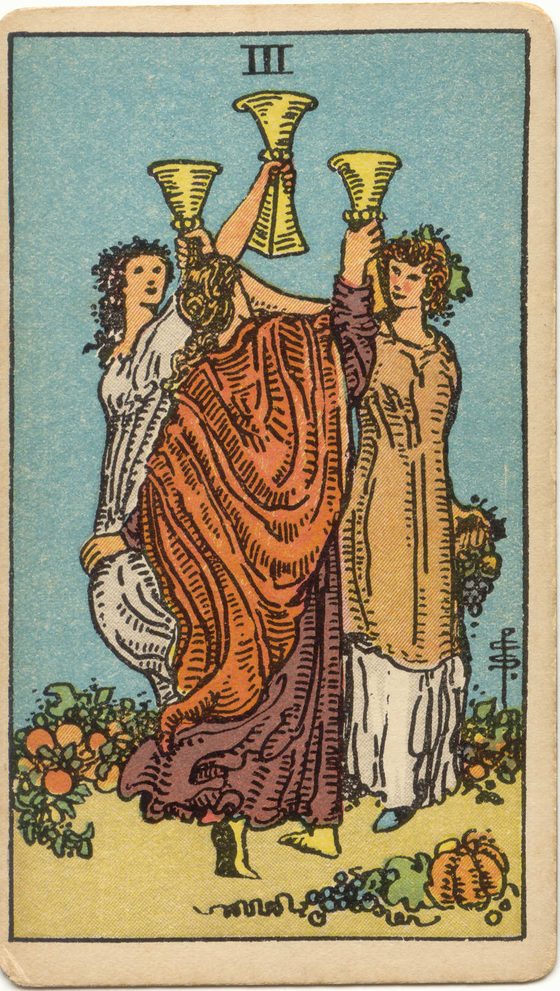
Three women stand together on green ground, close enough that their clothes overlap. Each raises a golden cup above her head, and the three cups meet near the top of the card. The figure in the middle is turned mostly away from the viewer and wears a red cloak over a long robe. The figure on the left is in white and pale yellow; the figure on the right is in a light gown.
All three wear leaves or vines in their hair. The one on the right holds a bunch of grapes in her lowered hand. The ground under them is scattered with fruit: a large pale gourd at the right, round orange fruits at the left, more grapes trailing between. The sky behind is plain and empty. The numeral III sits at the top.
Upright meaning
The Three of Cups is the deck's picture of good news shared. Where the Two of Cups is an exchange between two people, this adds a third, and the addition changes the card completely: what happens between two people is private, and what happens between three is a community.
It reads as celebration, and more precisely as the celebration of somebody else's good fortune. That is the useful distinction. Where Nine of Cups is satisfaction kept to oneself, this is satisfaction spent in company. Friendship, reunions, a birth, a wedding, the group that formed around a shared project and outlasted it. Waite's own gloss is the conclusion of a matter in plenty and merriment.
The card is warm and it is genuinely shallow, and that is not a criticism. It describes a moment rather than a structure. Neighbours decide how much weight to put on it: beside Four of Wands it reads as a lasting occasion, beside Five of Cups as the gathering before or after a loss, and beside a card of excess as the point where the celebration has started costing something.
Upright in love
In a relationship reading this card is usually not about the relationship. It describes the people around it: friends who approve, families that have met, the point at which something private becomes something other people know about.
Where it does speak to the couple, it is about ease rather than intensity. Nobody in this picture is negotiating anything. If the question is whether a relationship is serious, the Three of Cups is describing its social weather, and social weather is real evidence without being the whole climate. Read the cards that show only two people for the rest.
Upright in work
At work this is the card of a team that actually likes each other, and of the moment something finishes well enough to mark. A launch that landed, a contract signed, the end of a project people will still mention in two years.
It is also, less romantically, the card of the network. Work that arrives through people who already know you, and reputation that travels by conversation rather than by application. If the question is about finding something new, the Three of Cups is pointing at the people you already know rather than at the listings.
Upright in money
Money spent on other people, and money that arrives because of them. Parties, gifts, a round bought, a windfall shared out. The card has no interest in accumulation and does not pretend to.
What it describes well is the social cost of celebration, which is real and rarely budgeted. The Three of Cups is a generous card and generosity in company is easy to overshoot. If the reading is about whether something is affordable, this card is describing the pleasure rather than the price, and the two are being confused often enough that it is worth separating them on paper.
Upright as feelings
As feelings, this is affection that is comfortable being seen. Warmth without weight: someone glad you exist and not particularly anxious about it. It is a friendly card in a feelings position, and readers hoping for romance often find that disappointing. It is not less real for being easy. The card describes company, not longing.
Upright as advice
Tell someone. Whatever this is, it is meant to be shared, and you have been holding it. Pick the three people who would be genuinely glad and say it to them this week. If the good thing belongs to somebody else, turn up for it in person rather than by message.
Reversed meaning
Reversed, the Three of Cups splits along a line the upright hides. The first reading is excess: the celebration that has gone on past its reason, the social life being used to avoid something, a group where drinking or spending is the only thing still holding it together. Waite's reversal notes take this line.
The second is the opposite. Isolation, or a group that has closed and left somebody outside it. Friendships that faded without an argument, the gathering you were not told about, the slow discovery that a circle has continued without you. Nothing here is dramatic and that is what makes it hard to name.
There is a third that turns up in practice and belongs to neither: gossip. Three people talking is also three people talking about somebody, and the reversal sometimes marks the point where a group's warmth is being spent on a person who is not in the room. The spread decides which of the three, and the querent usually knows before the reader does.
Reversed in love
Either a relationship crowded by other people, or one with nobody around it at all. In the first, the couple is being managed by friends and family who have opinions and access. In the second, the relationship exists only in private, and the reason for that is worth looking at directly.
The reversal is also the standard position for a third person in the picture. That reading gets reached for quickly and it is an accusation. Do not make it unless something else in the spread supports it.
Reversed in work
A team that has become a clique, or a person who has ended up outside one. Both are common and neither is usually anyone's decision; groups close by drift rather than by vote.
The reversal also covers the celebration that was not earned, the launch party for something that has not shipped. If the reading concerns morale, this card is worth taking seriously: it describes a group's social health, and social health is the part of a team that fails silently.
Reversed in money
Spending that belongs to a social life rather than to a plan: rounds, gifts, trips agreed to because everyone else was going. None of it is large and the total usually is.
The other direction is withdrawal from all of that because it costs money, which is a reasonable decision that people rarely say out loud and then feel bad about. The card describes where the money goes, not whether it should. If this is a live question, the useful move is to count one month of it and look at the number.
Reversed as feelings
Warmth that has thinned out, or warmth that is being performed. Neither is coldness. The reversed Three of Cups more often describes someone who feels fond of you in a general way and has stopped thinking about you specifically, which is a smaller and more ordinary thing than most readings make it.
Reversed as advice
Work out whether you are surrounded or alone, because the corrections are opposites. If the social life has become the thing you are hiding in, take one week off it. If you have drifted out of a circle, do the unglamorous thing and be the one who sends the message first.
Symbolism in the 1909 image
The three raised cups. They meet at the top of the card, above all three heads. This is the only place in the suit where cups are held higher than the people holding them, and it is the visual reason the card reads as a toast rather than as a meeting.
The fruit on the ground. A pale gourd, round orange fruits, grapes on the vine. Autumn produce, and the standard reading is harvest and plenty. Note that none of it is being eaten or gathered; it is lying where it fell, which is either abundance or waste depending on how generous you are feeling.
The grapes. Held by the figure on the right and repeated underfoot. Wine is the obvious implication and Smith did not draw any. The card is read as a party by almost everybody and contains no drink at all.
The middle figure's back. She is turned away from the viewer, the only one of the three whose face is hidden. Waite says nothing about it. It has the effect of putting the viewer outside the circle, looking in.
The wreaths. Leaves and vines in all three sets of hair, of the kind associated with Dionysian celebration. Smith used the same device on the Two of Cups, where the two wreaths differ; here they are broadly the same, and the three figures read as a group rather than as individuals.
Where this meaning came from
The Three of Cups began as a pip card. In the fifteenth-century Italian decks it showed three cups arranged on a plain ground, and its only job was to lose to a four. Divination came later and from elsewhere.
The eighteenth-century French occultists supplied the meanings. Court de Gebelin's Egyptian theory, published in the 1780s, was invented; Etteilla's card-by-card system, which followed, is the direct ancestor of every keyword list in print. The Golden Dawn added its own titles in the 1890s, calling this card the Lord of Abundance.
The scene is Smith's. No earlier deck shows three dancing women, and the fruit, the wreaths and the gesture of the toast are all hers. Waite's entry in The Pictorial Key to the Tarot in 1910 is brief and cheerful: the conclusion of a matter in plenty, perfection and merriment. His reversed reading turns to excess and sensual pleasure, which is where the modern warning about overindulgence comes from.
The card is one of the clearest examples of how much of modern tarot is Smith's picture rather than Waite's text. Almost everything readers say about friendship here comes from what she drew, not from what he wrote.
The common misreading
The Three of Cups is most often misread as a promise of a good time coming. It is a picture of a moment, not a schedule, and it says nothing about when or whether. Drawn on a question about a future event, it describes the character of the thing being asked about, social and shared and warm, and leaves the timing entirely open.
The second misreading is in love spreads, where the three figures get counted. A third person in the picture is read as a third person in the relationship, and that reading is delivered with far more confidence than the drawing supports. The card is about a group, and most groups around a couple are friends.
The third is the assumption that celebration means everything is fine. People throw parties in the middle of difficult years. If the Three of Cups turns up alongside cards about loss or pressure, the honest reading is that a gathering is happening and the difficulty has not gone anywhere, not that the difficulty has been resolved because the picture is cheerful.
Questions to sit with
- Who would you tell first, and have you told them?
- When did you last turn up for someone else's good news without being asked?
- Is this circle still one you choose, or one you have simply not left?
- What are you celebrating, and what is it standing in for?
Pull this card in a real spread.