- Card number
- 14
- Arcana
- Minor Arcana
- Suit
- Swords
- Element
- Air
- Rank
- King
- Yes or no reading
- Yes
King of Swords
A king facing forward with the sword upright and slightly tilted, seated in completely still air. The card describes authority exercised through judgement, and the lean of that blade is its most honest detail.
- judgement
- authority
- principle
- clear thinking
- objectivity
- manipulation
- cold logic
- abuse of power
- indecision
- rigidity
What the card shows
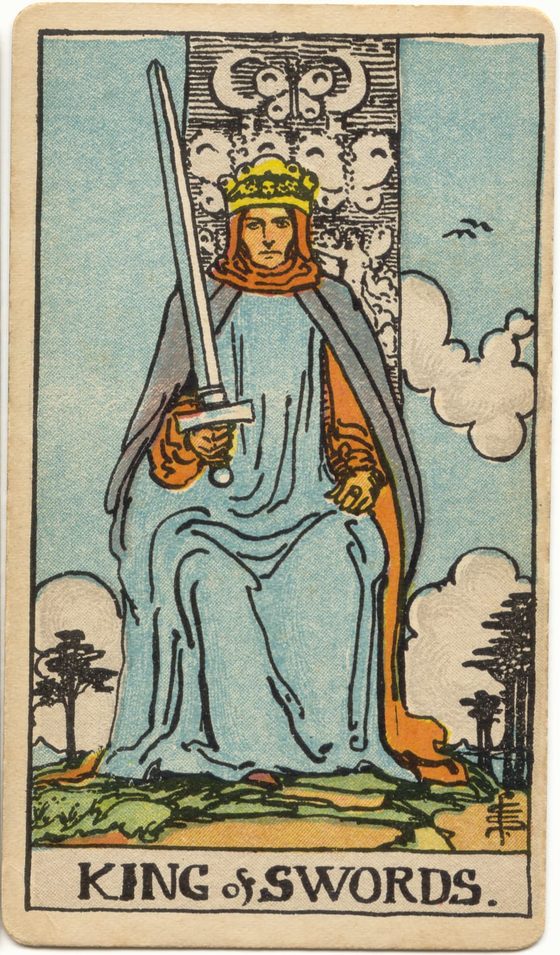
A crowned king sits facing almost directly out of the card on a heavy stone throne. He holds a sword upright in his right hand, the blade leaning slightly to one side rather than standing straight. His left hand rests on his thigh. He wears a blue tunic under a red-purple cloak, and his beard is trimmed short.
The back of the throne is carved with two butterflies and a crescent moon, and small winged figures are worked into the stone at the upper corners. Behind him the sky is pale, with a few clouds high up and birds in flight. A line of trees stands on the horizon, upright and barely moving. The ground is not visible. Nothing in the picture is in motion.
Upright meaning
The King of Swords is authority derived from judgement rather than from force. Where the Emperor rules because he holds the position, this King rules because he is usually right, and because he can explain why he is right.
In practice the card describes decisions made on principle. Rules applied consistently, arguments assessed on their merits, an outcome that does not bend according to who is asking. That is a real virtue and the card treats it as one. It is also the card of everybody who has ever managed to be correct and useless at the same time.
The sword is worth looking at. It stands upright but not vertical, tilted a few degrees off true, in a picture where every other element is settled and symmetrical. Smith drew a blade that leans, and it is the only thing here that does.
Read the neighbours. Beside Justice the judgement is being applied to something that genuinely requires it. Beside The Emperor the question is whether the authority is earned or merely held. Beside Queen of Swords the spread is showing two kinds of clarity and asking which one is actually in the room.
Upright in love
In a relationship reading this describes somebody who handles closeness through principle. Commitments are kept because they were made, disagreements are conducted with reasons, and feelings tend to arrive already processed into positions.
That can be extremely steady to be with. It can also be exhausting, because a person who argues well is difficult to be upset with, and being right is not the same as being fair to whoever you are being right at.
If the question is about somebody's feelings, this card answers a different question. It tells you how they think, and how they think is often what they offer instead of telling you how they feel.
Upright in work
At work this is the senior figure whose judgement is trusted: the person who reads the contract, chairs the difficult meeting, and gives an answer that still holds up a month later. In a question about a decision, the card argues for the version that can be defended on the record.
It also describes an environment run on rules rather than relationships. That is frequently the fairer arrangement and it is rarely the warmer one.
If the question is about a conflict with a manager, look at whether the card is describing a person or a standard. The two require very different responses, and spreads confuse them constantly.
Upright in money
Money handled by policy. Terms read, decisions made on the numbers, no room left for the version of the story that feels good to tell.
That discipline is genuinely useful, and it has a failure mode: a decision can be entirely rational and still be about the wrong thing, because the reasoning never once questioned the goal it was serving.
Nothing here is advice about what to do with money. What the card describes is a way of arriving at decisions, and it does not report whether the decision was any good.
Upright as feelings
As feelings, this is considered rather than warm on the surface. Someone who has thought about the situation carefully and will give you their conclusions rather than their feelings. That is not an absence of feeling. It is a person for whom saying what they have decided is easier and safer than saying what they want.
Upright as advice
Decide on the principle rather than on the personalities, and then say plainly what the principle is. Write the reasoning down before you deliver the answer, so you find out whether it survives being written. If it does not survive, you have your answer, and it is not the one you were going to give.
Reversed meaning
Reversed, the King of Swords reads two ways and both are recognisable on sight.
The first is judgement turned into control. Reason used to override rather than to reach anybody, rules applied selectively while sounding principled, an argument that cannot be won because the terms keep moving. This is the reading for manipulation dressed as logic, and it is the more dangerous of the two because it looks respectable from outside.
The second is authority collapsed. Someone who knows what should be decided and will not decide it. Reversed, this card can describe endless deliberation, a person hiding behind process, or a decision deferred until the situation makes it on their behalf.
There is also a plain reading for the querent's own thinking: clever reasoning in the service of something they already wanted, which is the failure this entire suit is prone to.
The spread decides. Cards about power and other people point to the first. Cards about stalling point to the second.
Reversed in love
Either principle used as leverage, or principle abandoned. Reversed, this card sometimes describes someone who wins every argument and has stopped noticing that winning was never the point of the conversation. It sometimes describes someone who will not take a position at all, leaving the other person to make every decision and then carry it. Both arrangements leave one party doing all of the work.
Reversed in work
Authority misused, or authority not exercised at all. Reversed, this can be the manager whose fairness applies unevenly depending on the person, or the one who will not make the call and describes that as consultation. Seven of Swords nearby leans toward the first, where the reasoning is cover for something already decided elsewhere. Look at whether the stated principle is applied to everybody.
Reversed in money
Reasoning that has stopped being honest, or decisions that are not being made. Reversed, this card sometimes describes a financial argument constructed backwards from the conclusion somebody wanted to reach. It sometimes describes a necessary decision deferred so long that the options narrowed on their own. The card comments on the quality of the thinking, and it is not advice about money.
Reversed as feelings
Feeling reasoned into something more manageable, or feeling deliberately withheld as a way of keeping the upper hand. Neither of those is coldness exactly. Both look the same from outside: a person carefully explaining their position when what they were actually asked was how they are.
Reversed as advice
Check your argument for the conclusion you started with. If you already knew the answer before you built the reasoning, you have not been thinking, you have been drafting. Then go and say the one thing you have been finding sophisticated ways not to say.
Symbolism in the 1909 image
The tilted sword. Upright but not vertical, leaning a few degrees off true. Every other element in the card is symmetrical and settled, and the blade is not. Most books read the sword here as pure intellect. The tilt is the drawing's own note that judgement is never quite level.
The butterflies on the throne. The same motif as the Queen's, carved into the stone behind him. Transformation and the soul, worked into furniture, which is more or less what happens to feeling in this card.
The crescent moon. Cut into the throne back above the butterflies. The moon belongs to the deck's cards of instinct and of what is not fully known, and its presence directly behind the head of the most rational figure in the pack is either a joke or a warning.
The winged figures. Small sylphs worked into the upper corners of the throne, associated with the element of air. They are the only living things in the frame apart from the birds and the King himself.
The still trees and pale sky. The Page's wind and the Knight's storm are gone. The air is completely calm, and the suit's whole energy has arrived somewhere and stopped. Whether that is mastery or stagnation the drawing leaves to the reader.
Where this meaning came from
The King is the oldest thing on the card. Fifteenth-century Italian tarot decks had a king in every suit because they were playing decks and the king took the trick. No meaning was attached to him, because none was needed.
Divinatory readings came later, from the French occult writers of the eighteenth and nineteenth centuries. Etteilla's lists gave the king of this suit associations with a lawyer, a judge, a man of the professions, and with the law itself. That professional flavour has stayed attached to the card ever since.
The picture is Pamela Colman Smith's, drawn in 1909 under Arthur Edward Waite's direction. Waite's entry in The Pictorial Key to the Tarot (1910) calls the figure a man of judgement and lists power, command, authority and the militant intellect, along with law and the offices of the court. He also, characteristically, allows that the card may be read as whatever arises from that power, for good or otherwise.
The Golden Dawn attributions that modern books cite for the Kings date from the 1890s. They are useful, and they are not ancient, and the difference between those two things is worth stating plainly.
The common misreading
The King of Swords is most often misread as a specific man, usually a lawyer, a doctor or a father. That reading comes straight from Etteilla's professional keyword lists and has been repeated so long that it now sounds like tradition. A card cannot tell you anybody's occupation.
The second misreading is treating intellect as proof of being right. This card describes a way of deciding, not the correctness of the decision. A person can reason immaculately from a premise they never examined, and this King is the card that most often flatters that error rather than catching it.
The third is the assumption that the reversal means a bad man. It just as often means a decent one who will not act, and that stalled reading is both commoner and harder to deliver, because there is nobody in it to blame.
And a broader one: this card gets used to justify treating a difficult situation as an argument to be won. Some situations are arguments. Most of the ones people bring to a tarot reading are not.
Questions to sit with
- What is the principle you are actually applying here, stated in one sentence?
- Would you apply it the same way if the person on the other side of it were someone else?
- Did you reach this conclusion by reasoning, or reason your way to one you already had?
- What are you explaining instead of saying?
Pull this card in a real spread.