- Card number
- 12
- Arcana
- Minor Arcana
- Suit
- Cups
- Element
- Water
- Rank
- Knight
- Yes or no reading
- Yes
Knight of Cups
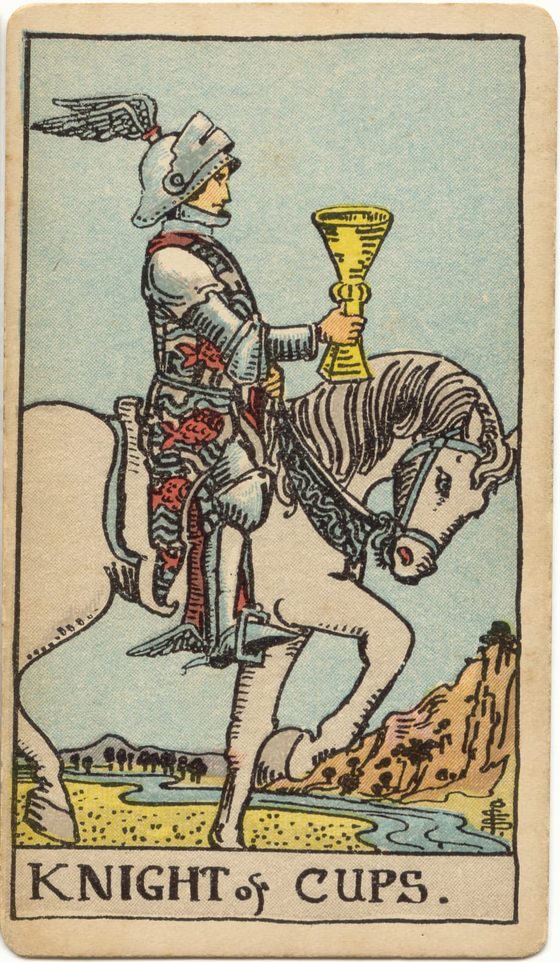
An armoured rider carries a cup forward on a slowly walking horse, wings at his helmet and at his heels. The Knight of Cups is an approach being made, and the card says nothing about what is behind it.
- approach
- invitation
- romance
- charm
- proposal
- unreliability
- stalling
- artifice
- empty charm
- moodiness
What the card shows
A knight in full armour rides a grey-white horse from left to right across the card. He holds a golden cup out in front of him at chest height, level and steady. The horse is walking, head lowered, one foreleg lifted. It is not charging.
Small wings are fixed to the sides of his helmet and to the backs of his heels. Over the armour he wears a surcoat patterned with red fish. Behind him the ground is dry and pale, with a river crossing the middle distance and low hills and a few trees beyond it. The sky is plain. Nothing in the landscape is in his way and nothing is following him.
Upright meaning
The Knight of Cups describes an approach. Waite's divinatory list for it is unusually concrete, running arrival, approach, sometimes that of a messenger, advances, proposition, invitation, and that is very nearly the whole card. Something or someone is coming toward the situation with an offer in hand.
The manner matters more than the content here. Waite calls the figure graceful but not warlike, and the horse is walking. This is not the Knight of Swords, who arrives at speed and takes the consequences. The Cups knight arrives well, and arriving well is a skill with no necessary relationship to what is being brought.
Upright the card is usually read as romance, an invitation, a proposal, good news carried by hand. All of those are fair. What it cannot do is tell you whether the offer is any good, and the picture is careful on the point: the cup is held out with its contents turned away from the viewer. Beside the Page of Cups it reads as feeling that has gathered enough shape to move. Beside The Chariot it reads as motion without the same discipline behind it.
Upright in love
In a relationship reading this is the card of the approach itself: an invitation, a declaration, a return after silence, the gesture that changes the register between two people. It is often genuinely romantic and often genuinely meant.
The limit is worth stating plainly. The card describes the arrival, not the character of the person arriving and not what follows it. A reader who takes it as evidence that somebody is sincere is adding something the picture does not contain, and Waite's reversed list for this card is severe enough that the tradition itself clearly had doubts. Read it as a movement toward you. What that movement is worth is a question only time and behaviour can answer.
Upright in work
At work the Knight of Cups is the offer, the pitch, the approach from outside. A message from a recruiter, a proposal from another team, an invitation to collaborate. It is a card of things coming toward you rather than of work being done.
It also describes a way of operating: persuasive, personable, better at the approach than at the follow-through. That is a real professional profile and not an insult, but it is worth naming when the question is about delivery. If a spread asks whether something will get finished, this card is describing how it started rather than how it ends.
Upright in money
In money questions the Knight of Cups is a proposition arriving. An introduction, an approach, an offer that is attractive in the way it has been presented. The card describes the arrival and the manner of it.
What it does not describe is the substance, and this is the one place in the suit where that gap matters practically. An approach made well tells you about the approach. Nothing here is guidance about what to do with money, and the useful response is simply to separate how something was offered from what is actually on offer.
Upright as feelings
As someone's feelings, the Knight of Cups is romantic feeling in motion: idealised, warm, aimed at you and expressed rather than held back. It tends to be sincere in the moment. Whether it is durable is a separate question the card does not answer, and a reader who claims it does is guessing about somebody they have never met.
Upright as advice
Make the approach. Say the thing in person or in your own voice, not through a channel that lets you edit it into safety. Then let the other person answer in their own time. The card is about the offering, and turning an offer into pressure is how this knight loses whatever grace he has.
Reversed meaning
Reversed, the Knight of Cups gives a reader an unusually stark choice.
The mild version is the approach that never lands. Charm without follow-through, a proposal made with real feeling and not acted on, somebody better at beginning things than at continuing them. This is the common modern reading and it fits most spreads.
Waite's reversed list is not mild at all. It runs trickery, artifice, subtlety, swindling, duplicity, fraud. Six words, every one of them an accusation, and the harshest reversal he gives any court card in the deck.
Both readings live in this position and the card does not choose between them. What a reader can honestly do is notice that the second makes a claim about a person's intentions, which no card can support. Raise it as a question about what is being asked for and on what timescale. Do not report it as a finding about who somebody is.
Reversed in love
Reversed in love, either enthusiasm that fades once it has been accepted, with the approach turning out to have been the interesting part, or an approach made for a reason that has not been said out loud. The first is far more common and far less dramatic. The second is in the tradition and is a possibility to hold rather than an accusation to make. What the reversal marks reliably is a gesture and a follow-through that do not match.
Reversed in work
At work, either a proposal that arrives beautifully and then stalls in delivery, which is the ordinary reading and usually the correct one, or an offer whose presentation is doing work its substance cannot. The reversal is a prompt to ask for detail. Look at whether the surrounding cards describe disorganisation, which points at the first, or concealment, which is the only condition under which the second is worth raising at all.
Reversed in money
Reversed, either an opportunity that is genuine and badly followed up, or one presented more attractively than it deserves. Waite's reversed list for this card includes swindling, which is the tradition speaking and not a diagnosis of anybody's arrangement. The plain and useful reading is that the manner of an offer and the terms of it are separate things and should be examined separately. None of this is advice about money.
Reversed as feelings
Either warm feeling that will not be sustained past the point where it costs something, or warmth with an aim attached. The reversal marks a distance between the expression and what stands behind it. It does not say the feeling is false, and the ordinary explanation is usually the correct one.
Reversed as advice
Follow through on the last thing you offered, exactly as offered, before making any new offer. If you are on the receiving end, ask for the specifics in writing and notice how the request is received. Neither of those is dramatic and both are decisive.
Symbolism in the 1909 image
The winged helmet and heels. Small wings at the head and at the feet. The reference is to Mercury, the classical messenger, and it is the clearest single piece of evidence for Waite's reading of the card as an arrival. Smith used the device nowhere else in the deck.
The walking horse. Head down, one foreleg raised, moving at a walk. Every other knight in the deck is at a canter or a gallop. This one is deliberately slow, which either means composure or means the arrival is taking its time, and the drawing does not say.
The cup. Held out in front, level, at arm's length. The contents are turned away from the viewer, so what is being carried is never shown. That is the whole ambiguity of the card in one object.
The fish on the surcoat. Red fish on a pale ground, the same creature that appears in the Page's cup. It ties the two cards together, and it is also a very old emblem for what moves unseen beneath a surface.
The dry ground. The land the horse crosses is pale and bare, with the river some way off. A knight of Water riding over dry country is either bringing something to it or leaving it behind, and Smith drew no clue which.
Where this meaning came from
The knight was a rank before it was a meaning. In the fifteenth-century Italian decks each suit ran king, queen, knight and knave, and a knight of cups was a card that beat some cards and lost to others. There was nothing in it to interpret.
The eighteenth-century French occultists supplied the meanings, and with them the practice of matching court cards to real people by age and appearance. That practice, more than anything else in tarot, is responsible for readings that sound like descriptions of strangers.
Smith's 1909 drawing gave this knight the winged helmet and the walking horse. Waite's commentary in The Pictorial Key to the Tarot (1910) calls him graceful but not warlike, notes the winged helmet as a mark of the higher graces of the imagination, and adds that he too is a dreamer, but that the images of the side of sense haunt him in his vision. His divinatory list is arrival, approach, advances, proposition, invitation. His reversed list is trickery, artifice, subtlety, swindling, duplicity, fraud.
The distance between those two lists is among the widest in the book, and nothing in the book explains it.
The common misreading
The Knight of Cups is most often read as a person arriving to improve a situation. The tradition invites it: Waite's meanings include advances and invitation, and readers extend those into a specific someone with specific intentions. The picture supports the movement and none of the rest. A rider is approaching with a cup, and what is in the cup is drawn facing away.
The second misreading is the opposite, and it has become fashionable: treating the card as a warning about an unreliable romantic on the strength of Waite's reversed list. That list is severe, but it belongs to the reversal. Importing it into the upright card means reading a warning into a picture of somebody arriving politely.
The third is the one to watch for. Because this card turns up so often in relationship questions, it gets used to make claims about another person's honesty. No card can do that. The most a reader can honestly say is that an approach is being made, and that the manner of an approach is not evidence about its contents. Where the Queen of Cups reads a situation, the Knight moves through one.
Questions to sit with
- What has been offered to you, and what exactly was in the offer?
- Are you drawn to the proposal, or to the way it was made?
- What did the last approach from this direction turn into?
- If you are the one approaching, what are you prepared to do after the answer?
Pull this card in a real spread.