- Card number
- 12
- Arcana
- Minor Arcana
- Suit
- Swords
- Element
- Air
- Rank
- Knight
- Yes or no reading
- Yes
Knight of Swords
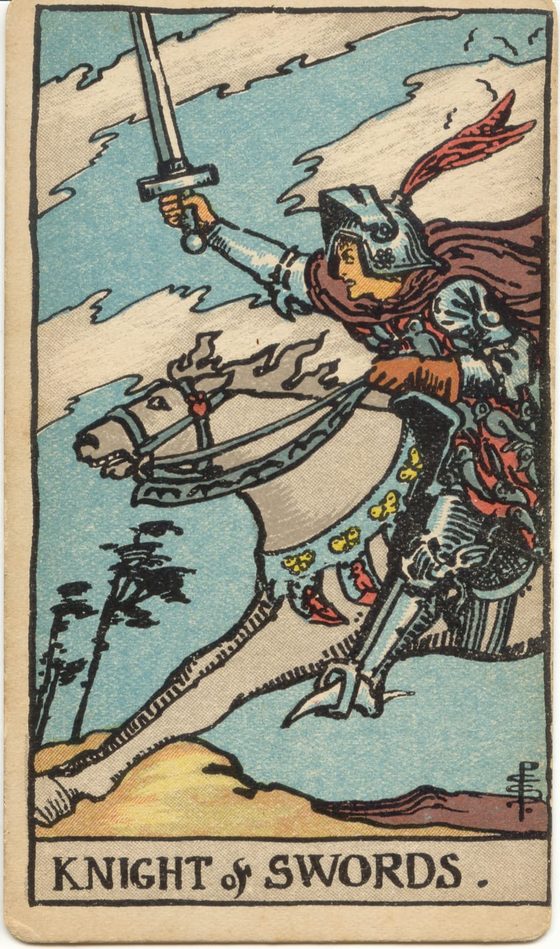
An armoured rider at full gallop with the sword already raised, into a wind that is bending the trees. The card describes momentum and conviction, and says nothing about whether the charge is aimed at anything.
- speed
- conviction
- directness
- momentum
- impatience
- recklessness
- aggression
- stalling
- burnout
- no follow-through
What the card shows
A knight in full plate armour rides a white horse at full gallop across the card. The sword is held high above the head with the arm fully extended, and the visor of the helmet is open. A red plume streams backwards from the helmet, and a short cloak flies out behind.
The horse is at full stretch with all four legs off the ground, mane and tail blown by its own speed. Its harness is decorated with small birds and butterflies. The sky is filled with driven clouds, the trees on the horizon lean hard in one direction, and birds are scattered across the upper part of the frame. The ground below is flat and featureless. There is nothing in front of the horse.
Upright meaning
The Knight of Swords is the fastest card in the deck. It describes action taken at the speed of the decision that produced it: no interval, no second look, no waiting for the rest of the information to arrive.
Read well, this is exactly what some situations need. Conviction has its own value, and there are moments when the person who moves first is right for that reason alone. The Knight is not a fool. The armour is real, the horse is trained, and the sword is up before anybody else has drawn.
Read badly, it is a charge with nothing in front of it. That is the detail worth holding on to: Smith drew no opponent, no target and no destination. Everything in the picture is moving and nothing in the picture is being reached.
The neighbours decide which. Beside The Chariot the speed is under control and pointed somewhere. Beside Five of Swords the argument is being won at a cost nobody is counting. Beside Page of Swords the thinking has only just started and is already being acted on.
Upright in love
In a relationship reading this is intensity arriving fast. Declarations early, plans made in the first month, a directness that is either thrilling or alarming depending on who is receiving it. There is nothing calculated here. The Knight means it at the time.
The difficulty is duration. This card describes a charge, and a charge is not a way of living somewhere. Relationships that begin at this speed often raise a question the card cannot answer, which is what happens when the momentum runs out.
It can also describe someone whose honesty has no brakes on it: truth delivered at speed, with very little attention paid to what it lands on.
Upright in work
At work the Knight of Swords is the person who pushes a decision through. Meetings shortened, objections overruled, a project moved in a week after a year of discussion. In an organisation that has stalled, this is often the most useful card in the spread.
The cost lands on other people. Speed of this kind leaves detail behind and colleagues bruised, and the Knight is usually the last person in the room to notice either.
If the question is about a conflict at work, look carefully at whether the querent is the rider or the ground being ridden over. The card describes the charge. It does not say who is right.
Upright in money
Money moving quickly and on conviction. A decision made in a day, a position taken because the argument for it seemed obvious at the time.
The Knight is not reckless in the way the reversal is. It is decisive. But decisiveness and correctness are different properties, and this card carries only the first of them.
Where it is genuinely useful is in describing tempo. If a money question has been sitting unresolved for months, this card is a fair picture of what breaking the deadlock would feel like. None of that is advice about what to do with money.
Upright as feelings
As feelings, this is direct and unhesitating. Someone who has decided how they feel and is not planning to sit on it. Expect it stated plainly and probably sooner than is comfortable. What the card does not describe is depth or duration. Strength of feeling in the moment is the only thing it reports.
Upright as advice
Move, but pick the target first. Write down in one sentence what you are actually charging at, and if you cannot finish the sentence, that is your answer for today. This card's failure is never hesitation. It is arriving somewhere at speed and finding it was the wrong field.
Reversed meaning
Reversed, the Knight of Swords reads two ways, and both are common.
The first is the charge going wrong. Speed without direction, aggression that has lost its object, words used as weapons because they are the nearest thing to hand. Reversed, this card covers the argument that stopped being about its subject some time ago and is now being fought for its own sake.
The second is the horse stopped. The conviction has gone, or was never converted into anything. This is the reading for plans announced with total certainty and then abandoned, for energy that stalls the moment it meets friction, and for a person waiting to feel sure again before doing anything at all.
Which one applies is not decided by the card. Look at whether the surrounding cards describe conflict or stagnation. If there is another person in the spread, the first reading is more likely. If the spread is mostly about the querent's own stalling, read the second.
Reversed in love
Either intensity that has turned harsh, or intensity that has simply stopped. Reversed, this card sometimes describes somebody whose directness has become bluntness with an edge on it. It just as often describes the opposite: the person who arrived at speed and then went quiet, leaving the other party to work out on their own what happened. The card does not say which, and it says nothing at all about their reasons.
Reversed in work
A decision pushed through badly, or a push that never came. Reversed, this can be the colleague who steamrolls a project and leaves the wreckage for other people to sort out, or the initiative announced loudly and dropped quietly a month later. Eight of Wands nearby favours the second reading, where the movement went somewhere else entirely. Look at whether anything actually changed.
Reversed in money
Money committed impulsively, or a decision that stalled at the last moment. Reversed, this card sometimes marks the point where speed cost something that patience would not have. It sometimes marks the opposite: a plan made with great conviction and never executed at all. The card describes the tempo of the decision rather than its merits, and it is not advice about money.
Reversed as feelings
Feeling expressed too fast and too hard, or feeling that has run out of momentum. If the first, expect something said in temper that will be regretted later. If the second, expect an interest that arrived at full speed and has quietly stopped, without a conversation anywhere to mark it.
Reversed as advice
Slow down far enough to name what you actually want out of this, then either commit to it or stop. The reversal punishes the middle: charging on without a target, or standing still and calling it thinking. Pick one, and be honest with yourself about which one you picked.
Symbolism in the 1909 image
The raised sword. Up and back before there is anything to strike. The blade is ready ahead of the situation, which is the whole temperament of the card compressed into one gesture.
The white horse. At full gallop with all four feet off the ground, a convention for speed rather than an observation of how horses actually move. White horses in this deck usually carry purity or clarity of purpose. Here the purpose is exactly the part the picture withholds.
The birds and butterflies on the harness. Small and easy to miss. Birds belong to the element of air, butterflies to change and, in older symbolism, to the soul. They are the only delicate things in an otherwise armoured picture.
The bent trees and driven clouds. The wind is running the same way the rider is. Whether he is driving it or being driven by it is not settled in the drawing, and that ambiguity is more useful than either answer would be.
The empty ground ahead. No opponent, no castle, no road. Smith left the space in front of the horse blank. Every reading that treats this card as a battle is supplying the enemy itself.
Where this meaning came from
Knights are original equipment. The four courts of the fifteenth-century Italian decks, king, queen, knight and page, existed because the cards were made for a trick-taking game, and the ranks were needed for play rather than for meaning.
Divinatory readings for the courts arrived with the French occult revival. Etteilla's lists and their nineteenth-century successors gave the knight of this suit associations with a soldier, an enemy, and sudden hostile action. The now-standard idea that the card is about speed is largely a modern refinement of that.
The image is Pamela Colman Smith's, drawn in 1909 to Arthur Edward Waite's direction. Waite's entry in The Pictorial Key to the Tarot (1910) calls the figure a hero of romantic chivalry riding in haste, and lists bravery, skill and enmity together without deciding between them. He also allowed a reading of destruction.
The Golden Dawn material Waite knew placed each knight in a fixed astrological range, and modern books repeat those attributions as though they were ancient. They date from the 1890s, which does not make them useless, only far more recent than the language around them suggests.
The common misreading
The Knight of Swords is routinely read as a person arriving. A man on a white horse, coming into the querent's life, usually in a love reading. Waite treated the courts as temperaments at least as much as people, and nothing in a spread can tell you that somebody is on their way.
The second misreading is heroism. The picture is stirring, and readers tend to receive it as encouragement: be bold, charge in, trust yourself. Look at the ground in front of the horse. It is empty. This is a card about the quality of a movement, not about whether the movement is warranted, and reading it as permission is how people get talked into arguments they did not need to have.
The third is treating the reversal as automatically worse than the upright. Both reversal readings are unpleasant, and the stalled one is often the more accurate and much less exciting to deliver.
There is also a habit of reading the card as aggression coming from somebody else. It describes a posture, and the person holding that posture is the querent more often than most spreads admit.
Questions to sit with
- What exactly are you charging at, in one sentence?
- What would you have to slow down to notice, and are you willing to?
- Who is absorbing the cost of the speed you are moving at?
- Is this conviction, or is it impatience wearing conviction's clothes?
Pull this card in a real spread.