- Card number
- 11
- Arcana
- Minor Arcana
- Suit
- Swords
- Element
- Air
- Rank
- Page
- Yes or no reading
- It depends
Page of Swords
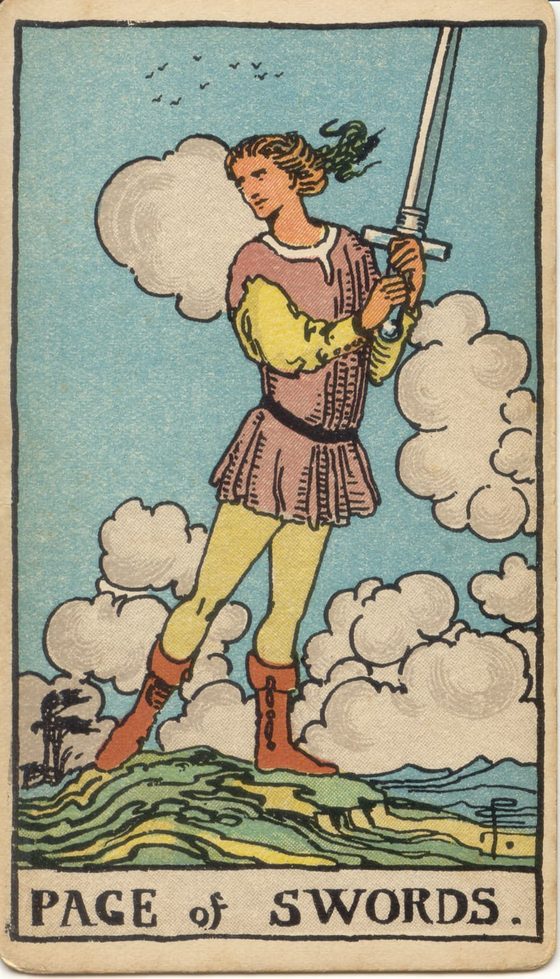
A young figure on windy high ground, sword raised in both hands, looking back over one shoulder. The card describes curiosity and watchfulness that have not yet separated from each other.
- curiosity
- vigilance
- new ideas
- questioning
- restlessness
- prying
- gossip
- scattered
- all talk
- lost interest
What the card shows
A young figure stands on a green rise, holding a sword upright in both hands with the blade tilted away from the body. The feet are planted wide. The head and shoulders are turned back and to one side, so the face looks in a different direction from the sword.
The wind is doing a great deal of work in this picture. The hair is blown, the short cloak lifts, and the clumps of trees along the ridge behind all lean the same way. The clouds are drawn as fast horizontal streaks against a pale sky. Ten small birds fly in loose formation above the ridge. The ground rises and falls in low green hills with no path across it. Nobody else is in the frame.
Upright meaning
The Page of Swords is the suit's beginner. Sharp, alert, and not yet certain what the sharpness is for. In practice the card usually describes a person or an attitude that is gathering information: asking questions, reading everything, watching a situation closely and forming opinions quickly.
The posture is the interesting part. The sword is up and ready, but the face is turned away from where the blade points. This is vigilance without a target, someone braced for a conflict that has not been identified. Read generously, that is curiosity and nerve. Read less charitably, it is suspicion looking for somewhere to land.
Court cards can describe a person, a stage of a situation, or the querent's own posture, and this one is among the harder to place, because the energy is unmistakable and the aim is not fixed. Beside Ace of Swords the questioning is productive and pointed at something true. Beside Knight of Swords it is about to become momentum whether or not the thinking is finished. Beside Seven of Swords, read the watching as surveillance rather than study.
Upright in love
In a relationship reading, the Page of Swords often describes the early stage where two people are still finding out about each other, and one of them is doing it by asking a great many questions. There is real interest here and very little established trust yet.
Less flatteringly, it can describe the person who has started checking. Rereading messages, noticing inconsistencies, keeping a mental file. That behaviour usually begins as curiosity and does not always stay there.
The card cannot tell you whether the suspicion is warranted. It describes somebody in a watchful posture, which is a fact about them and not evidence about anyone else.
Upright in work
At work this is the newcomer, the trainee, the person asking the questions everybody else stopped asking two years ago. The Page of Swords is genuinely useful in this mode, because a fresh eye finds things a settled team no longer sees.
It can also describe the early stages of learning something demanding, where enthusiasm is high and judgement is thin. Opinions form fast here, and get expressed faster.
In a workplace context the card sometimes points at gossip, or at information being collected before anyone has decided what it is for. If the surrounding cards are about other people, look hard at whether the watching is fair.
Upright in money
Money questions with this card usually involve research rather than transactions. Reading about a thing, comparing options, learning how something works. The Page is in the finding-out phase and has committed to nothing yet.
That is a reasonable place to be. It becomes a problem only when the research starts substituting for the decision, which is a failure mode this suit is prone to across all four of its courts.
Nothing here is advice about what to do with money. What the card describes is the state of the querent's information, and specifically that it is new.
Upright as feelings
As feelings, this is interest with an edge of caution on it. Someone who finds the querent genuinely intriguing and is watching a while before committing to anything. Expect questions rather than declarations. It is not coolness, though it can easily look like coolness from outside. The attention is real and it is still assessing.
Upright as advice
Ask the question you have been circling. Not the diplomatic version of it, the actual one, out loud, to the person who can answer it. Then stop gathering. The Page's failure is not asking too much, it is collecting indefinitely because collecting is easier than acting on what you find.
Reversed meaning
Reversed, the Page of Swords goes two ways, with a third available in some spreads.
The first is the sharpness turning unkind. Curiosity becomes prying, questioning becomes cross-examination, and the observations that were useful start being used. This is the reading that covers gossip, tale-carrying, and the person who has worked out that information is leverage.
The second is the opposite: the energy collapsing. The questions stop, the interest goes, and what is left is somebody all talk and no follow-through, or somebody who has decided that finding out is more trouble than it is worth. Reversed, this Page can be scattered rather than sharp, opening five lines of enquiry and closing none of them.
The third is plainer: an immature response to a situation that needed an adult one.
Which applies depends on the question. If the surrounding cards involve other people and communication, read the first. If they are about the querent's own divided attention, read the second.
Reversed in love
Either watchfulness that has curdled into checking, or interest that has quietly evaporated. Reversed, this card sometimes describes someone who has stopped asking questions because they have stopped wondering about the answers. It just as often describes someone whose questions have turned into an interrogation conducted in a friendly voice. Both read as tension from the outside, and the surrounding cards are what separate them.
Reversed in work
Information used badly at work: a confidence repeated, a half-understood fact stated with certainty, a junior opinion delivered as a verdict nobody asked for. Reversed, this card can also mark scattered effort, where several things have been started and nothing has been carried through to the point of being useful. Eight of Pentacles nearby argues for finishing one thing before beginning another.
Reversed in money
Decisions made on thin information, or research that has stopped producing anything. Reversed, this card sometimes points at acting on something half-read, and sometimes at the opposite, where months of comparing have quietly replaced any actual decision. The card describes the quality of the querent's attention to the subject. It says nothing about the subject, and it is not advice about money.
Reversed as feelings
Interest that has gone sour or gone quiet. If sour, expect a critical edge to it: small remarks, attention that no longer feels friendly to be under. If quiet, the questions have simply stopped, which is usually the clearer signal of the two and by far the easier one to miss.
Reversed as advice
Stop repeating what is not yours to repeat. If a piece of information has been sitting with you for a week, decide today whether to act on it or drop it, and then go and do that one thing. Half-held knowledge is this card's worst habit.
Symbolism in the 1909 image
The sword held in both hands. Upright, blade tilted, gripped with the whole body rather than one easy hand. It is the grip of somebody who has not used the weapon much. Waite calls this figure a vigilant one, and the hands are where that vigilance actually shows.
The turned head. The face looks one way and the blade points another. Almost every book reads this as watchfulness. It is equally a picture of divided attention, and the drawing declines to choose between them.
The wind. Trees bent, hair blown, clouds streaked across the sky. Air is the suit's element, and Smith made it visible here more than in any other card of the four. Nothing in the picture is still.
The ten birds. Loose formation, high above the ridge. Usually read as thoughts, or as the activity of the mind. Waite does not mention them at all. They may simply be birds, which is worth remembering before a whole reading gets built on them.
The uneven ground. Green hills rising and falling, with no path across them. The figure has taken high ground without a road to it, which fits a card about someone holding a strong position and no clear direction.
Where this meaning came from
The Page is a court card, and the courts are the part of the tarot with the least invented history. Fifteenth-century Italian decks had four courts in each suit, king, queen, knight and knave or page, because the deck was made for playing with, and a game needs ranks.
The knave carried no divinatory meaning until French occultists supplied one. Etteilla and his successors assigned readings to the courts along with everything else, and the page of this suit was generally given associations with a spy, a messenger, or unwelcome news brought by someone young.
The 1909 deck kept the rank and gave it a scene. Pamela Colman Smith drew a figure on a windswept ridge holding a sword slightly too large for comfort. Waite's note in The Pictorial Key to the Tarot (1910) describes an active and alert person, and mentions vigilance and spying almost in the same breath, which is why the card has always read two ways at once.
The modern habit of reading Pages as literal young people, or as students, is later than Waite and much more rigid than anything he wrote. He treated the courts as postures at least as often as persons.
The common misreading
The most common misreading of the Page of Swords is age. Readers see a young figure and tell the querent to expect news from a child, a student, or someone in their twenties. Waite did not read the courts that literally, and no card can tell you how old anybody is.
The second is treating the vigilance as proof. This card comes up constantly in questions about whether a partner is hiding something, and readers oblige by saying the Page confirms it. It does not. The card describes a watchful posture in the person asking. That is information about them and not evidence about anybody else, and presenting it as evidence is one of the ways tarot does real damage to real relationships.
The third is the sunny version, in which the Page is reduced to curiosity and fresh ideas and the sharper reading is quietly dropped. Waite's own text puts spying next to vigilance. A reading that keeps only the flattering half is not being kind, it is being incomplete.
And a smaller one: the birds get treated as certain symbols of thought. Waite never mentions them.
Questions to sit with
- What is the question you keep almost asking, and who is it actually for?
- Is the information you are collecting changing what you would do, or only how you feel?
- Where are you watching a person rather than watching a situation?
- What would you have to admit you do not know in order to move?
Pull this card in a real spread.