- Card number
- 11
- Arcana
- Minor Arcana
- Suit
- Cups
- Element
- Water
- Rank
- Page
- Yes or no reading
- Yes
Page of Cups
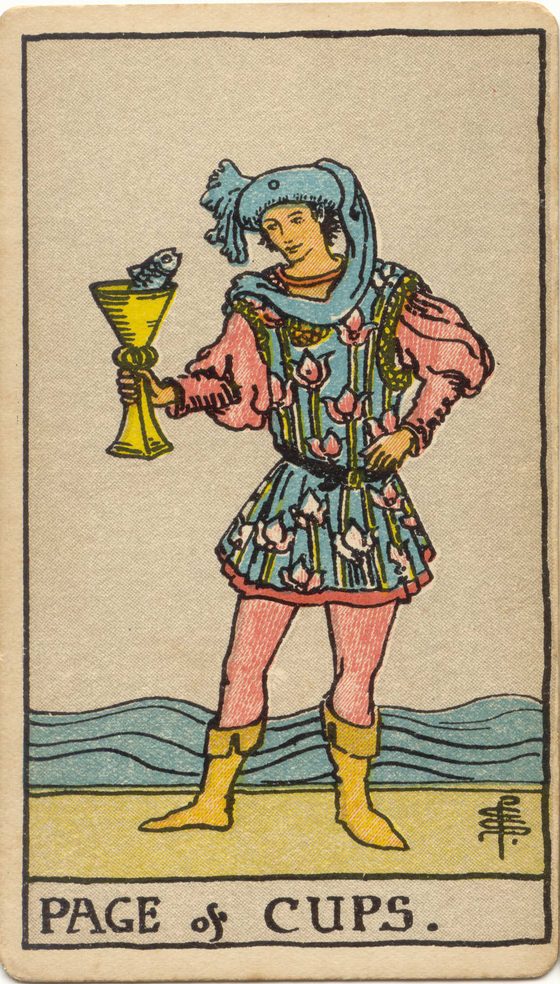
A young figure on a shoreline holds up a cup with a fish looking out of it. The Page of Cups is a small, surprising feeling arriving before anyone has decided what to do with it.
- curiosity
- new feeling
- message
- creativity
- openness
- withheld
- immaturity
- guardedness
- flattery
- self-doubt
What the card shows
A young figure stands facing left on a narrow strip of ground, holding a golden cup at chest height in one hand. A fish has risen out of the cup and is turned back to look at them. The other hand rests on the belt. Neither figure nor fish is doing anything about the other.
The tunic is blue and covered in pink flowers. Over it sits a wide sash, and a soft cap with a long scarf falling from it and doubling back across the shoulder. Behind, the sea runs across the whole width of the card in stylised curling waves, with no horizon beyond it and no vessel on it. The figure's expression is mild and slightly puzzled.
Upright meaning
The Page of Cups describes something small and unexpected arriving from the emotional side of life. Waite calls it the pictures of the mind taking form, which is a better description than most: an idea, a feeling or a piece of news that has surfaced without being summoned.
Upright it is usually gentle and usually early. Nothing has been committed to. The figure is holding the cup rather than drinking from it, and the fish has not been dealt with in any way at all. In practice the card marks curiosity, a first draft, an unguarded response, a message that changes the temperature of something. Its scale is deliberately modest. This is not a card that carries large events.
Inside its own suit it sits at the start of a sequence. Where the Ace of Cups is an offer, the Page is the first response to one, and the Knight of Cups is what happens when that response gets on a horse. Beside The Fool it reads as openness with no armour on it. Beside a heavy card it often marks the one person in a situation who has not hardened yet.
Upright in love
In a relationship reading the Page of Cups is early and light. A first message, a flirtation, an interest that has not been declared or examined. It can describe the start of something, and it can equally describe an old relationship having an uncomplicated week.
What it does not describe is intensity or intention. Court cards are often read as specific people, and this one gets assigned to a young admirer, but reading a court card as a person of a particular age and appearance is a convention rather than a rule. It works as well, and usually better, read as a mood: the part of you or of the other person that is still willing to be surprised.
Upright in work
At work the Page of Cups is the idea before anyone has been asked to approve it. A proposal in the wrong format, an offer to help, news arriving from an unexpected direction. Waite's list for this card includes news and message, and that plain reading is often the accurate one.
It is a junior card in every sense. It describes beginnings, apprenticeship and enthusiasm not yet worn down by process. Where the question is whether something is ready, this card usually answers that it is not, without saying it is wrong. Look at the surrounding cards for whether the environment can hold an unfinished idea without crushing it.
Upright in money
In money questions the Page of Cups is small and speculative: a modest opportunity, an offer worth a look, a first conversation about something that might become an arrangement. Nothing here has a contract attached to it.
The card describes a stage rather than a sum, and it will not tell you whether the thing is any good. If it has a practical use in a money reading, it is to note that whatever this is, it is early enough that finding out more costs very little. That is an observation about timing, not advice about money.
Upright as feelings
As someone's feelings, the Page of Cups is affection that is new to itself. Interested, tentative, slightly surprised to be feeling anything. It is more likely to show up as an out-of-character message than as a statement. The card describes something unformed, which makes it honest about what it cannot tell you: whether it will grow into anything.
Upright as advice
Send the message you drafted and did not send. Keep it short and do not explain yourself inside it. This card's whole competence is a willingness to look slightly foolish before anything is certain, and the drafted version is almost always better than the considered one.
Reversed meaning
Reversed, the Page of Cups reads in two directions.
The first is the feeling that stays inside. Something surfaced and was pushed back down: an unsent message, an interest denied, work kept private because showing it would mean being seen. This is the common modern reading and it is the gentler one.
The second comes from Waite's own reversed list, which runs taste, inclination, attachment, seduction, deception, artifice. That is a strange sequence, and the last three change the card completely. Read that way the reversal is charm with a purpose behind it: an approach that wants something, or news that is not quite what it presents itself as.
The picture does not tell you which. Be careful here, because the second reading makes a claim about somebody's motives that no card is in a position to support. Hold it as a question about what is being asked for, not as a finding about who is lying.
Reversed in love
Reversed in love, either interest withheld, with someone feeling more than they will show and calling that discretion, or the older reading of charm with an aim behind it. Both turn up in ordinary spreads. The card cannot separate them, and neither can a reader who has not met the people involved. What the reversal does mark reliably is a gap between what is being felt and what is being said.
Reversed in work
At work, either an idea kept quiet because the room does not reward unfinished thinking, or a message shaped to produce an effect rather than to inform. The first is much the more common. The second is worth watching for when the spread concerns an offer arriving from outside. Either way the reversal points at the distance between the content of something and its presentation.
Reversed in money
Reversed, either an opportunity left unexamined because looking into it felt like too much fuss for something small, or an offer whose attractiveness is doing more work than its detail. Waite's reversed list includes artifice, and in a money question that deserves the plainest possible reading: find out what the arrangement actually is before deciding how you feel about it. That is a note about attention, not about money.
Reversed as feelings
Either feeling that is present and not being shown, or warmth being offered for a reason. The reversal describes a mismatch between the surface and what sits under it, and it does not say which way the mismatch runs. Assume the ordinary explanation until something specific suggests otherwise.
Reversed as advice
Say the thing you have decided is too small to mention. If you are on the other side of it, and someone is being unusually charming, ask one plain question about what they want. The answer, or the absence of one, is the information you are looking for.
Symbolism in the 1909 image
The fish. Risen out of the cup and turned back to look at the person holding it. This is the only genuinely absurd image in the suit and Smith drew it with no joke in it. Read as inspiration, or the unconscious, or the unexpected. What the picture literally shows is somebody holding a thing they did not expect to be holding.
The cup. Held out at chest height, upright, in one hand. Nobody is drinking. The card is about the arrival of the contents rather than any use being made of them.
The flowered tunic. A blue ground covered in pink blooms, the most decorated garment in the suit. Smith gave this figure the least practical clothing of the four Cups court cards, which is worth remembering whenever the card gets read as a junior colleague.
The scarf. A long drape falls from the cap and doubles back over the shoulder. It has no function. It is one of several details in Smith's court cards that exist to make a figure look unfixed rather than to carry a meaning.
The sea. Stylised curling waves across the full width of the card, with no horizon and no vessel. The water is behind the figure and none of it is in the cup, which almost no reading mentions.
Where this meaning came from
Court cards have the clearest ancestry in tarot. The four ranks of the Italian decks were king, queen, knight and knave, and the knave, or page, was simply the lowest court card in a game. It carried no meaning and no personality of its own.
The divinatory layer arrived in eighteenth-century France, and it brought a habit that has caused readers trouble ever since: court cards were matched to actual people, sorted by age, sex and colouring. Etteilla's lists work that way and so, largely, does Waite's.
Waite's entry in The Pictorial Key to the Tarot (1910) describes a fair, pleasing, somewhat effeminate page of studious and intent aspect contemplating a fish that rises from a cup to look at him, and glosses the scene as the pictures of the mind taking form. His divinatory meanings include a fair young man, a studious youth, news, message and reflection. The reversed list is taste, inclination, attachment, seduction, deception, artifice.
The physical description belongs to its period and does not have to be carried forward. The rest of the entry, and particularly the pictures of the mind taking form, is the most useful sentence anybody has written about this card.
The common misreading
The commonest error with the Page of Cups is the one the tradition set up: reading a court card as a specific person. Waite's entry describes a fair young man, and readers have been scanning their querent's life for one ever since. That convention is an eighteenth-century habit rather than a rule, and it produces confident nonsense about people the reader has never met. A court card reads at least as well as a posture or a mood.
The second misreading is scale. Because the card is charming, it gets used to announce that something significant is beginning. Nothing in the drawing is significant. A fish has appeared in a cup and the person holding it has not yet reacted. Reading a change of life into that is reading the reader's hopes.
The third is treating the reversal as deception by default. Waite's reversed list does contain deception and artifice, but it opens with taste, inclination and attachment. Picking the harsh end of a mixed list and presenting it as the card's meaning is the reader's decision and should be declared as one. Where the Queen of Cups is feeling that has been lived with, the Page is feeling that has just turned up.
Questions to sit with
- What have you not said because it seemed too small to bother anyone with?
- When did you last let yourself be interested in something with no use?
- If this is the beginning of something, what would the next step actually be?
- Who in this situation is still willing to be surprised, and are you one of them?
Pull this card in a real spread.