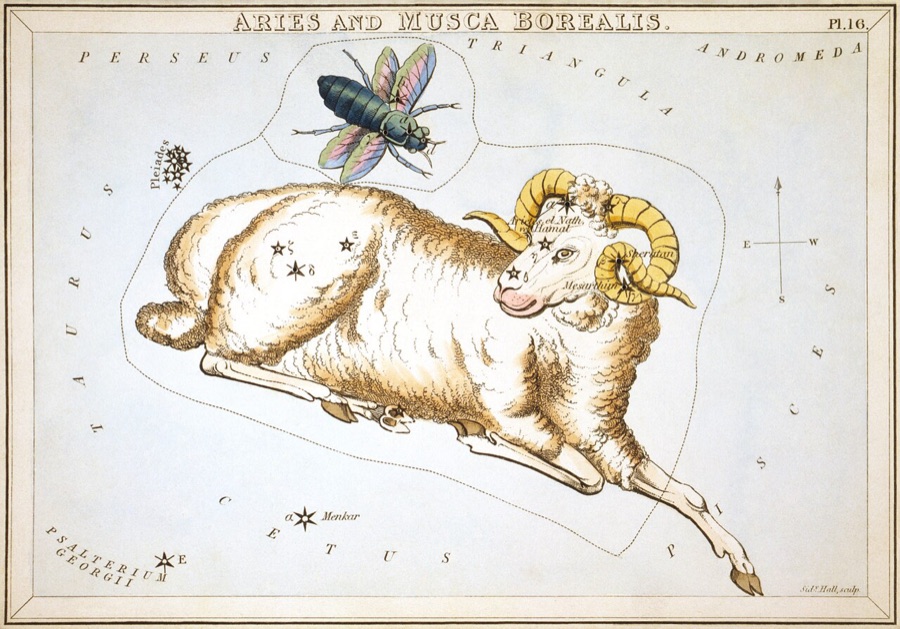
- Entry type
- Sign
- Number
- 1
- Abbreviation
- ARI
- Element
- Fire
- Modality
- Cardinal
- Polarity
- Active
- Modern ruler
- Mars
- Traditional ruler
- Mars
- Dates
- March 21 - April 19
- Symbol
- The Ram
- Traditional body rulership
- Head and face
- Matching tarot card
- The Emperor
Aries
The sign of the opening move. Aries describes the impulse to start before the ground is fully known, and the tradition reads it as a posture toward beginnings rather than a personality anybody is stuck with.
- initiative
- directness
- impatience
- courage
- beginnings
What this describes
Aries is the first sign of the tropical zodiac, and everything the tradition says about it follows from that position. It begins at the March equinox, the moment the Sun crosses the celestial equator going north. The sign is cardinal fire: cardinal because it starts a season, fire because the tradition associates it with initiative rather than reflection. What it describes is the first move, made before the situation is understood.
Read as a temperament, Aries is direct, fast and uninterested in preamble. It is the placement associated with people who would rather act and correct than plan and wait. That is a genuine capability and it is not the same as courage; the tradition is careful to say that Aries describes willingness to move, not the quality of the judgement behind it.
The useful thing about the sign is that it is a description of tempo, not of outcome. Astrology has no way to say whether the move works. Where it earns its keep is in naming a pattern somebody already recognises: the tendency to be first into a room and first bored in it. Read alongside Libra, its opposite, the pair describe self and other, the sign that acts and the sign that consults.
What it does well
What Aries is good at is starting. Not planning to start, not preparing to start: the actual first step, taken while other people are still weighing it. In a group that has been stuck, this is the placement that breaks the deadlock, and the value of that is easy to underrate until you have sat through a year of meetings.
It is also honest in a specific way. Aries tends to say the obvious thing nobody senior wants to say, without much calculation about how it lands. That makes it useful in rooms where politeness has become a form of avoidance.
The third strength is recovery. The tradition consistently describes Aries as quick to anger and quick to drop it, which in practice means grudges are rare.
Where it goes wrong
The failure mode is not aggression, which is what the popular version says. It is abandonment. Aries starts well and finishes badly, and the specific shape of that is a trail of things that were genuinely interesting for six weeks. The energy is real; the follow-through is where the tradition says to look.
The second failure is speed used as avoidance. Moving fast is an excellent way to not think about something, and the sign is well suited to it. Somebody who is always launching is not always someone with momentum; sometimes they are someone who cannot sit still with a difficult question.
Third, the directness that works in a stuck room does not work in a hurt one. Aries is poor at reading whether a moment can take the truth being delivered to it.
In relationships
In relationships the tradition reads Aries as pursuit. It is the placement associated with wanting openly and early, with saying so before it is strategically sensible, and with finding the negotiating phase of a relationship tedious.
The difficulty this produces is well documented and it is not infidelity, whatever the magazines say. It is that pursuit and interest are hard to tell apart from inside, and the sign is better at the chase than at the maintenance. Where it works, it works because somebody has learned that ordinary Tuesday attention is a skill and not a downgrade.
None of this tells you what a particular person does. A Sun sign is one factor among many, and the placements that describe how somebody actually behaves in a relationship are more often Venus and the seventh house.
In work
At work Aries is the person who takes the unproven brief. New territory, no precedent, nobody to ask, those are the conditions the sign is described as suiting. It is much less suited to maintaining something that already runs.
Traditionally the sign is associated with soldiers, surgeons, athletes and anyone whose work involves acting decisively under time pressure. That list is a thousand years old, but the underlying observation survives: Aries describes work where hesitation costs more than error.
The practical reading is about sequencing rather than job titles. This is a placement that does its best work at the start of things and should be honest with itself about the point at which it stops enjoying them. Handing something over is not failure, and treating it as failure is how the pattern turns into a problem.
In money
The tradition reads Aries as spending decisively and without much revisiting. Money goes on the thing that has just become interesting, the decision is made quickly, and it is rarely renegotiated afterwards.
That is a description of temperament, not of a balance. It says nothing about whether there is enough, and this page has no way of knowing. The pattern worth watching is the one the sign is actually prone to: not extravagance, but the small repeated cost of starting things. Equipment for the hobby that lasted a season, the deposit on the plan that changed. Individually trivial and collectively not.
How to read it in a chart
Aries in a chart is not one thing. The Sun in Aries describes what somebody is trying to become; the Moon in Aries describes how they react before they have thought; the Ascendant in Aries describes how they arrive in a room. These are routinely collapsed into each other by popular writing and they are not interchangeable.
What modifies it most is Mars, the ruler. A chart with the Sun in Aries and Mars in a slow, fixed sign reads very differently from one where both are fast, and traditional practice would look at the ruler before saying anything confident about the sign.
What Aries is most often confused with is Leo. Both are fire, both are read as bold. Aries is cardinal and starts; Leo is fixed and sustains. If somebody is described as attention-seeking, that is usually Leo. If they are described as impatient, it is usually this.
How it meets other placements
The tradition handles this with element and modality rather than with a list of matches. Aries is fire, so it is read as easy with the other fire signs, Leo and Sagittarius, and compatible in a different way with air, which feeds it. Earth slows it and water dampens it, and both of those are described as friction rather than as failure.
Modality matters more than most popular writing admits. Aries is cardinal, and the other cardinal signs, Cancer and Libra and Capricorn, sit at ninety or a hundred and eighty degrees from it. Cardinal signs all want to initiate, which is why two of them in a room is either very fast or a standoff.
The honest version: this is a framework for describing friction, not a compatibility test. Two charts are not two Sun signs, and no serious practitioner has ever claimed otherwise.
The part people leave out
What popular astrology leaves out about Aries is fear. The sign is written up as fearless, and the tradition it comes from is more careful: the associated planet is Mars, and Mars in Hellenistic astrology was a malefic, a source of injury and haste, not a mascot.
The part that gets edited out is that speed is often a response to dread rather than an absence of it. Moving first means never being the one who waited and lost. Somebody who cannot tolerate not knowing will act early, and from outside that looks identical to confidence.
The other omission is what the anger is for. Aries anger is usually cheap and short, and it is often standing in for a sentence that would be harder to say slowly.
Where the symbol comes from
The Ram is old. Babylonian star lists called the constellation the Hired Man or the Agrarian Worker, and the ram appears later, probably through association with the god Dumuzi. The Greeks attached it to the golden-fleeced ram of the Argonaut story, the animal that carried Phrixus to Colchis and was sacrificed on arrival. That story is about escape and a debt paid, which is not what modern books do with the sign.
The glyph is not a picture of a ram, though it is usually described as one. It is conventionally read as the animal's horns, and it is also read as the eyebrows and nose of a face, since the sign traditionally governs the head. The form is medieval; it does not appear in Babylonian or Greek sources, and the earliest surviving zodiac glyphs of this kind are from Byzantine manuscripts of roughly the tenth to twelfth centuries.
Being first in the sequence does most of the interpretive work here. Aries means beginning largely because the equinox put it at the start of the list.
Where this meaning came from
The zodiac is Babylonian. By roughly 500 BCE, Mesopotamian astronomers had divided the ecliptic into twelve equal thirty-degree segments named after nearby constellations, an administrative simplification of a much older and messier star catalogue. Aries was among them, though the sign and the constellation were already not quite the same thing.
The system that produces sentences about character is Hellenistic, assembled in Egypt under Greek rule between about 100 BCE and 200 CE. That is where rulerships, elements, houses and aspects come from. Ptolemy's Tetrabiblos, written in Alexandria in the second century CE, organised it into the form that the Islamic world and then medieval Europe inherited, and it stayed close to that shape for over a thousand years.
The version most people meet today is younger than the telephone. Alan Leo, working in London around 1900, stripped out most of the technical apparatus and recast the signs as psychological types, partly because that was easier to sell by post. The newspaper Sun sign column arrived in 1930, in the Sunday Express, and the idea that a birth date alone gives you a personality is essentially a twentieth-century press format.
What the astronomy actually says
Tropical astrology, which is what almost every English-language horoscope uses, does not use the constellation Aries at all. It uses a twelve-part division of the ecliptic that starts at the March equinox. That starting point is still called the First Point of Aries, and it has not been in Aries for about two thousand years.
The Earth's axis wobbles, completing one circuit in roughly 25,800 years, which drags the equinox westward along the ecliptic at about one degree every seventy-two years. The vernal point crossed out of the constellation Aries and into Pisces around the first century BCE. The gap between the tropical signs and the constellations behind them is now roughly twenty-four degrees, about one sign. So somebody born in early April with the Sun in tropical Aries has it in front of the stars of Pisces.
Sidereal astrology, used across most of India, keeps the constellations and drops the equinox. Neither is the correct one; they measure different things. What neither has is a mechanism. No proposed physical influence has survived testing, and these pages treat the material as descriptive and cultural rather than causal.
The common misreading
The most common misreading of Aries is as a licence. Offered as an explanation for having been rude, the sign becomes a way of not apologising: I am an Aries, I say what I think. The tradition does not support that. It describes a tendency, and a tendency is something you can know about yourself and account for, not a fixed property other people have to absorb.
The second is the assumption that a Sun sign is a person. The Sun is one body in a chart of ten, and the tradition that produced the sign meanings never read it alone. Somebody with the Sun in Aries, the Moon in Pisces and a Capricorn Ascendant is not going to behave like the magazine version, and no competent practitioner from any period would have expected them to.
The third is subtler and it runs the other way. Because Aries is written up as bold, people who have the placement and do not feel bold conclude they have failed at their own sign. There is nothing to fail. The sign is a description that fits loosely at best, assembled by people with reasons of their own, and somebody who does not recognise themselves in it has learned something accurate.
Questions to sit with
- What did you start this year, and how many of those are still running?
- When you moved fast on this, were you moving toward something or away from it?
- Where does your directness cost other people something you have not counted?
- If you handed this over now, would that be failure or simply the right point to stop?
See where this sits in your own chart.