- Entry type
- Sign
- Number
- 5
- Abbreviation
- LEO
- Element
- Fire
- Modality
- Fixed
- Polarity
- Active
- Modern ruler
- Sun
- Traditional ruler
- Sun
- Dates
- July 23 - August 22
- Symbol
- The Lion
- Traditional body rulership
- Heart and spine
- Matching tarot card
- Strength
Leo
The sign of being seen. Leo describes the need to be witnessed and the willingness to take responsibility for what other people see, and the tradition reads that as a duty as often as a pleasure.
- warmth
- pride
- generosity
- visibility
- showmanship
What this describes
Leo is the fifth sign, fixed fire, and the only one ruled by the Sun. That rulership is the whole card. Everything else in a chart moves, changes sign, goes retrograde; the Sun does not, and the tradition treats Leo as the placement of the thing in a person that does not vary. The Sun and the Moon are the two luminaries, and neither is a planet in the modern astronomical sense, which the tradition never claimed they were.
What it describes is the relationship between a person and an audience. Not vanity, the tradition is more precise than that. Leo is read as the capacity to occupy a role in public and be identified with it, which is genuinely difficult and which most people avoid. A person who is willing to be the face of something has also agreed to be blamed for it.
The fixed part matters as much as the fire. Where Aries starts and drops things, Leo sustains: the same commitment, held in public, for years. Read opposite Aquarius, the pair divide the world into the individual and the collective, the person who signs the work and the group that produced it, and neither is comfortable with the other's answer.
What it does well
Leo is good at carrying something in public. Fronting a project, taking the questions, standing next to the work when it is criticised. That is a specific skill and most organisations have very few people willing to do it.
It is also generous in an unusual way: the tradition consistently describes Leo as wanting other people to do well and being conspicuous about arranging it. Praise given by somebody who is comfortable being the centre of attention costs them something, and the sign is described as giving it easily.
Third, it is durable. Fixed fire holds. Whatever this placement has decided to be loyal to, a person, a craft, a cause, it will still be loyal to in ten years, long after the enthusiasm has become work.
Where it goes wrong
The failure is not arrogance, which is the accusation people reach for. It is that the need to be seen can quietly become the criterion for what gets done. Work chosen because it will be noticed rather than because it matters, positions taken because they are visible, and the difference is invisible from inside.
The second is difficulty with correction. Fixed fire does not concede easily, and criticism lands on this placement as a claim about the person rather than about the work. That produces defensiveness in exactly the moments where accuracy would be more useful.
Third, the generosity has a condition attached that is rarely stated: it expects the gift to be acknowledged. Nothing is wrong with that until the acknowledgement does not come, at which point a warm person can become a cold one very quickly.
In relationships
In relationships Leo is read as wholehearted and unembarrassed. The sign is described as declaring rather than hinting, and as being straightforwardly pleased to be somebody's partner in public, which is rarer than it sounds.
The recurring difficulty is the audience. Leo tends to need the relationship to be visibly good as well as actually good, and those two can come apart. A partner who is undemonstrative in company is not withholding anything; they simply are not performing, and this placement reads the absence of performance as the absence of feeling more often than it should.
The Sun sign carries a little more weight here than usual, because the Sun rules Leo. It still carries much less than Venus or the seventh house.
In work
Leo is the placement the tradition puts with leadership, performance and anything requiring somebody to be identifiable. The older lists say kings, actors, goldsmiths; the modern translation is any role where a name is attached to the output.
Its real advantage is that it will take the exposure. Most people will do the work and decline the podium, and organisations run short of anyone willing to stand up and be the answer. Leo does that without needing to be persuaded.
The characteristic problem is credit. This placement notices when its contribution is absorbed into a group and finds that harder to let go than it admits. That is not vanity; it is that being seen is how the sign checks that the work was real. Naming it explicitly is more useful than pretending it does not matter.
In money
The tradition reads Leo as spending on visible things and on other people. Hospitality, gifts, the good version of whatever is being bought. The sign is described as generous rather than careless, and the distinction matters: the money is going somewhere deliberate.
The pattern to watch is the cost of maintaining an appearance, which is a real expense and one nobody itemises. A standard of living adopted because it matches a self-image is much harder to reduce than one adopted for comfort. That is an observation about how the sign is described, not a judgement about anybody's budget, and this page cannot see your numbers.
How to read it in a chart
Leo in a chart behaves differently from most signs because its ruler is the Sun and the Sun is always somewhere prominent. The Sun in Leo is domicile, the strongest placement available: the tradition reads it as a person whose identity is unusually settled. The Moon in Leo describes somebody who needs to be appreciated in order to feel secure, which is a more vulnerable claim than it sounds. A Leo Ascendant reads as warm and slightly formal on arrival.
Because the Sun rules it, a Leo chart cannot be read without looking at the Sun's house, which says where the visibility actually happens: the fifth house is a different life from the tenth.
Leo is most often confused with Aries. Both are fire and both are read as confident. Aries wants to go first; Leo wants to be recognised. If somebody needs to win, that is usually Aries. If they need to be seen winning, it is usually this.
How it meets other placements
Element logic puts Leo with the other fire signs, Aries and Sagittarius, and with air, which is described as carrying it. Earth and water read as friction: earth is unimpressed by display and water finds the whole performance exhausting, though both descriptions are caricatures of a real difference in register.
Modality is the more informative axis. Leo is fixed, and the other fixed signs, Taurus and Scorpio and Aquarius, sit at ninety or a hundred and eighty degrees. Two fixed signs in conflict do not resolve anything; they simply wait, and the tradition has been saying so for two thousand years.
The framework describes where friction is likely, not whether a relationship works. Anybody offering a compatibility verdict from two Sun signs is working from about one per cent of the available information.
The part people leave out
What popular astrology leaves out about Leo is how much of the display is checking. The sign is written up as confident, and the older material describes something closer to a person who needs external evidence that they exist as a distinct thing. Attention is not the reward; it is the measurement.
That reframes the whole placement. Somebody who is genuinely secure does not need the room to keep confirming it, and Leo is described as needing exactly that, repeatedly, from people whose opinion it claims not to care about.
The other omission is what happens when the audience leaves. Fixed fire in an empty room is a specific and rarely discussed difficulty, and it is the reason this sign is associated with the heart in the traditional body scheme.
Where the symbol comes from
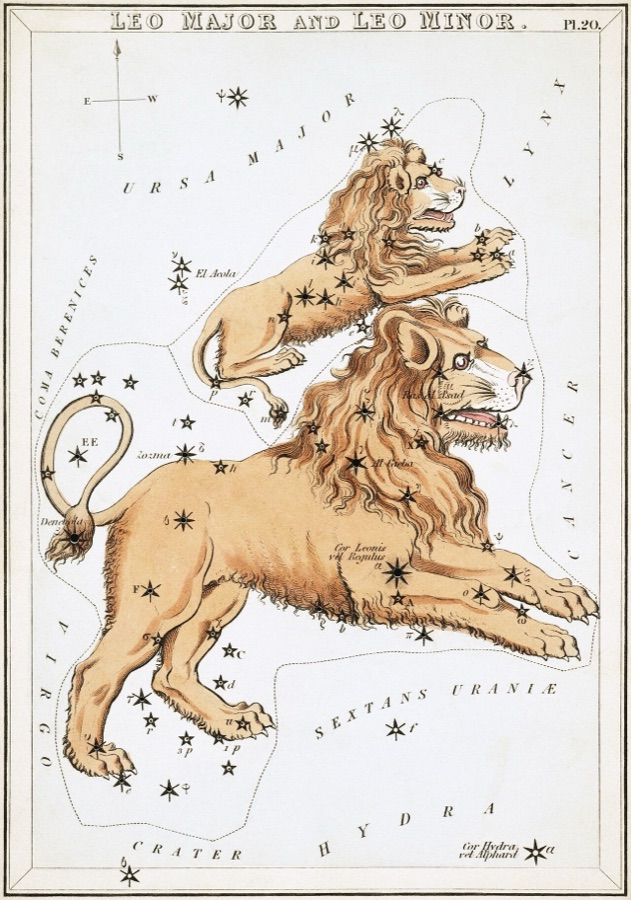
The Lion is the Nemean lion of the Heracles cycle, an animal whose hide no weapon could pierce, killed by being strangled and then worn as armour. The Greek story is about a thing that cannot be cut open, which is a more interesting emblem for this sign than the noble-beast reading it usually gets.
Babylonian sources have the constellation as a lion much earlier, and its rising once marked the hottest part of the year in Mesopotamia and Egypt, which is where the association with the Sun begins. It is one of the few zodiac attributions with an observable reason behind it rather than a purely symbolic one.
The glyph is a loop with a curved tail rising from it, generally described as the lion's mane or tail. As with the rest of the set it is a medieval scribal invention, and the older traditions used no such marks.
Where this meaning came from
The lion is on the Babylonian star lists and is one of the oldest identifications in the sky. The zodiac as twelve equal signs, rather than as a set of uneven constellations, was settled in Mesopotamia by about 500 BCE.
Solar rulership of Leo comes from the Hellenistic system assembled in Greek-speaking Egypt between roughly 100 BCE and 200 CE. That scheme gave the Sun one sign and the Moon one sign, Leo and Cancer, and divided the remaining ten between the five visible planets, two each. It is an elegant piece of design and it is the reason the modern additions of Uranus, Neptune and Pluto sit so awkwardly on top of it. Ptolemy recorded the arrangement in the Tetrabiblos in the second century CE.
The theatrical, attention-loving Leo is a twentieth-century product. Alan Leo, a pen name adopted by William Frederick Allan, who was himself born under the sign, rebuilt astrology as character description around 1900, and newspaper Sun sign columns from 1930 onwards fixed the twelve signs as personality types for a mass readership. The older sources describe Leo in terms of rulership and responsibility far more than in terms of showing off.
What the astronomy actually says
Regulus, the brightest star in Leo, sits almost exactly on the ecliptic, within about half a degree of the path the Sun appears to follow. That is why the Moon regularly passes in front of it, which is unusual for a first-magnitude star and made it a useful reference point for ancient astronomers.
It is roughly seventy-nine light years away and is not one star but four, in two pairs. The main star spins so fast, near the speed at which it would fly apart, that it is visibly flattened into an oblate shape rather than a sphere.
The Leonid meteor shower appears to radiate from Leo every November. It has nothing to do with the constellation: the debris comes from comet Tempel-Tuttle, and the radiant is a perspective effect of the Earth ploughing into that debris stream. Tropical Leo is a thirty-degree segment measured from the March equinox rather than a patch of stars, and precession has moved it roughly one sign away from the lion. The Sun is actually in front of those stars from about the tenth of August to the middle of September.
The common misreading
The most common misreading of Leo is as vanity, and it is usually delivered by somebody who has just been outshone. The tradition describes a need to be witnessed, which is not the same as a belief in one's own superiority. A person can need an audience and think very little of themselves; those two things frequently arrive together, and the popular version of the sign has no room for it.
The second is treating the confidence as a fixed quantity. Fixed fire is durable, not invulnerable, and the sign is associated with the heart precisely because the older writers understood it as the place where something can be broken. A Leo who has been humiliated does not become a smaller Leo; they become a person with a permanent private edit.
The third is the assumption that a Leo Sun means a loud person. The Sun describes what somebody is oriented toward, not how they behave in a room. Plenty of people with this placement are quiet, and what the chart is describing is where their attention is aimed rather than the volume at which they aim it. Confusing orientation with behaviour is the single most common error in reading any Sun sign.
Questions to sit with
- Would you still do this if nobody found out you had done it?
- When did somebody last correct you, and what did you do with it?
- Whose recognition are you actually working for?
- What have you kept going long after the enthusiasm ran out, and was it worth it?
See where this sits in your own chart.