- Entry type
- Planet
- Abbreviation
- SUN
- Modern ruler
- Sun
- Matching tarot card
- The Sun
Sun
The Sun is the chart's organising principle: what a person is consciously trying to become, rather than how they behave. It is one factor among many, and the only one most people are ever told.
- identity
- purpose
- vitality
- centre
- direction
What this describes
In a chart the Sun marks the organising principle: the thing a life is arranged around, the direction a person keeps returning to after being pulled off it. Traditional texts call it the significator of vitality and of the father. Twentieth-century writing recast it as identity and purpose. Both are describing a centre rather than a set of traits.
The distinction that matters is between the Sun and behaviour. What somebody is trying to become and what they actually do on a Tuesday are different things, and a chart separates them: the Sun holds the first, while the Ascendant, Mars and the Moon hold much of the second. A great deal of the confusion around astrology comes from collapsing all of that into a single word.
The Sun is also the placement everybody knows and the one that carries the least information on its own. It changes sign once a month, so roughly a twelfth of everyone alive shares it. Its house, and what it touches by aspect, are what make it specific. The Sun in Leo, the sign it rules, is a different proposition from the same Sun in the Twelfth House.
What it does well
A well-integrated Sun shows up as coherence. The person's choices point in a consistent direction, they can say what they are for without rehearsing it first, and they do not need every room to agree in order to keep going.
The Sun is also the source of what older texts call vitality, meaning the capacity to spend energy on something and get more back than was put in. Where it is strong by sign and house, work tends to be generative rather than depleting, and people notice the difference without being able to name it.
Third, it supplies a centre to argue from. A clear Sun means disagreement does not feel like dissolution, which is the quality that makes somebody straightforward to negotiate with rather than difficult.
Where it goes wrong
The Sun's failure mode is the centre becoming the only thing. A life organised around being somebody in particular can spend enormous energy defending the version rather than living it, and the defence is invisible from the inside because it feels like integrity.
The second failure looks like the opposite. A Sun that has never been given anything to organise produces a competent life with no direction in it: nothing wrong, nothing chosen. The older tradition has little vocabulary for this, and modern writing tends to call it a weak Sun, which explains nothing.
Third, the Sun is bad at rest. Whatever it marks, it wants to continue, and it does not register the cost until well after the other placements have.
In relationships
In relationships the Sun describes what somebody needs in order to remain themselves inside the relationship, which is a narrower and more useful question than compatibility. It marks the thing that cannot be given up without the person going quiet.
Sun-sign compatibility, the version everybody has met, takes one factor out of a dozen and compares it with one factor out of a dozen. It is not useless, since element and modality do describe real differences in tempo, but it is a very coarse instrument sold as a precise one. Where two charts are genuinely being compared, the Sun's house and its contacts with the other person's Moon and Venus carry far more than the sign does.
In work
At work the Sun describes what a person is trying to be recognised for, which is not the same as what they are good at. Those two frequently diverge, and where they do, the gap is usually the source of a long dissatisfaction that promotion does not resolve.
The Sun's house is more informative here than its sign. The same Sun sign in the sixth house and in the tenth describes two very different working lives: one organised around the daily craft, the other around visible standing. Reading the sign alone and calling it a career indicator is the commonest way this placement gets wasted.
In money
The Sun says little about money directly and a fair amount about what money is being used for. It marks what somebody is trying to build toward, and spending tends to follow that, coherently or otherwise.
Where the Sun and the actual pattern of spending disagree, the disagreement is worth looking at, because it usually means effort is going somewhere the person has not admitted to choosing. That is an observation about attention rather than a recommendation. Nothing in a chart has any bearing on what anybody should do with their money.
How to read it in a chart
The Sun is read by sign, house and aspect, and the house is the part most often skipped. Sign describes the manner, house describes the area of life where the organising principle actually operates, and aspects describe what supports or obstructs it.
Two confusions are common. The Sun is regularly conflated with the Ascendant, which describes how a person meets the world and is frequently what others would name if asked to describe them. And a conjunction to the Sun is often read as strengthening, where the tradition is more careful: a planet too close to the Sun is called combust, which older texts treat as a weakening rather than a boost. Modern writing has largely dropped that distinction without putting anything in its place.
Retrograde
The Sun is never retrograde, and that is not a convention or a simplification. Retrograde motion is an apparent effect. A planet seems to move backwards against the stars when its orbital motion and Earth's combine to produce that appearance from where we stand. Nothing physically reverses direction.
The Sun's apparent path is Earth's own orbit seen from the inside, so there is no relative motion available to produce the illusion. The Sun moves steadily eastward along the ecliptic, roughly one degree per day, every day, without exception. The same holds for the Moon. Any source offering a Sun retrograde is describing something that does not exist.
How it meets other placements
The Sun meets other placements as the thing that has to survive them. Within one chart, a planet in hard aspect to the Sun describes a pressure on the organising principle rather than a flaw in the person: Saturn on the Sun as a demand for proof, Neptune on the Sun as difficulty seeing the centre clearly, Mars on the Sun as force applied to it.
Between two charts the informative contacts are the Sun to the other person's Moon, Venus and Ascendant. Sun to Moon in particular is the classic marker of two people who make sense to each other without necessarily agreeing. It says nothing about whether they will stay together, which no contact can.
The part people leave out
The part popular astrology leaves out is that the Sun is a demand. It marks what a person has to become in order to feel like themselves, and it is indifferent to whether that is convenient, affordable, or good for anybody else. Solar language in modern writing is relentlessly positive. The older tradition was not: the Sun burns what stands too close to it, which is precisely what the doctrine of combustion describes.
There is also a cost borne by the people around a strong Sun. A life organised firmly around one direction is easy to admire and harder to live beside, and the person at the centre of it is generally the last to hear so.
Where the symbol comes from
The glyph is a circle with a single point at its centre, and it is the most economical symbol in the system. The circle is wholeness, or the horizon; the point is the thing that cannot be divided any further. Alchemical texts used the same mark for gold, and the association of the Sun with gold, with the heart and with kingship runs through every layer of this material.
The identification with a ruler is not decoration. In Hellenistic and medieval astrology the Sun is the significator of the king, the father and the authority in a situation, and much of what modern writing calls identity is a psychologised version of that older political reading.
The Sun rules Leo, is exalted in Aries, and is said to be in fall in Libra: brightest where the terms are its own, weakest where everything has to be negotiated.
Where this meaning came from
The Sun is one of the seven classical planets, which meant wandering star: the seven bodies visible to the unaided eye that move against the fixed background. The Sun and Moon were counted among them and called the luminaries. That is why a page like this calls the Sun a planet. It is a traditional category, not an astronomical claim.
Babylonian astronomers tracked the Sun's path and divided it into twelve equal signs by roughly the fifth century BCE. Hellenistic astrologers in Egypt, from about the second century BCE, gave it rulership of Leo and its place in the system of dignities. Ptolemy's Tetrabiblos, around 150 CE, fixed that structure for Europe.
The idea that a person has a sign, singular, and that it is the Sun's, is very recent. Newspaper sun-sign columns begin with R. H. Naylor in the Sunday Express in August 1930, writing on the birth of Princess Margaret. The column was popular, it was repeated, and within a decade the Sun sign had become what most people meant by astrology.
What the astronomy actually says
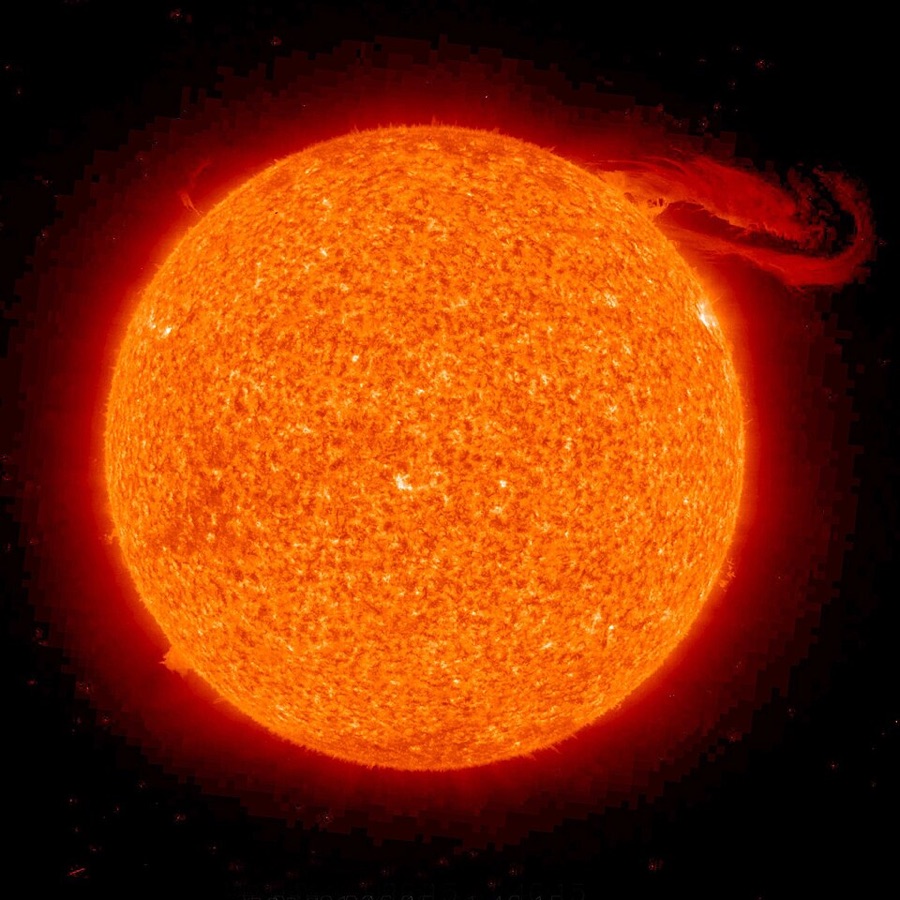
The Sun is a G-type main sequence star, about 4.6 billion years old and roughly 1.39 million kilometres across, holding about 99.86 per cent of the mass of the solar system. Light from it takes 8 minutes and 20 seconds to reach Earth, so any observed position is always slightly historical.
Its apparent movement through the zodiac is Earth's orbit, not the Sun's. Earth completes one circuit in 365.256 days, which puts the Sun's apparent position along the ecliptic at close to one degree per day and gives roughly thirty days in each sign. That regularity is why sun-sign dates can be printed on a card while every other placement needs a calculation.
The signs themselves are tied to the equinoxes rather than to the stars. Because of precession, the constellation actually behind the Sun on any given date now sits about one sign away from the tropical sign named for it. Astrology has never demonstrated a mechanism linking any of this to a person, and this page does not claim one.
The common misreading
The Sun is the most misread placement in astrology, and the error is one of scale. It is a single factor. A chart contains planets in signs, planets in houses, and the aspects between them, and the Sun is one line of that. Describing a person from their Sun sign is like describing a book from its first sentence: not nothing, and not the book.
The second misreading follows from the first. Sun-sign compatibility takes that single factor from two people and treats the pairing as a verdict. Element and modality do describe genuine differences in tempo, so the exercise is not empty, but it is offered with a precision it cannot support, and it can tell you nothing about how two particular people will treat each other.
The third is subtler. Because modern writing equates the Sun with identity, somebody whose life does not match their Sun sign description often concludes there is something wrong with them. The tradition offers a better frame: the Sun describes what a person is moving toward, not what they have arrived at, and a mismatch is ordinary rather than diagnostic.
Questions to sit with
- What are you organised around, and would somebody who knows you well name the same thing?
- Where are you defending a version of yourself rather than living it?
- What would you keep doing if nobody ever recognised you for it?
- What has your energy actually gone into this year, as opposed to where you meant it to go?
See where this sits in your own chart.