- Entry type
- House
- Number
- 12
- Element
- Water
- Modality
- Mutable
- Modern ruler
- Neptune
The Twelfth House
The house of what is out of sight: what a person does alone, what they do not admit, and the institutions that operate away from public view. It is the hardest house to read and the easiest to dramatise.
- solitude
- concealment
- unconscious
- retreat
- undoing
What this describes
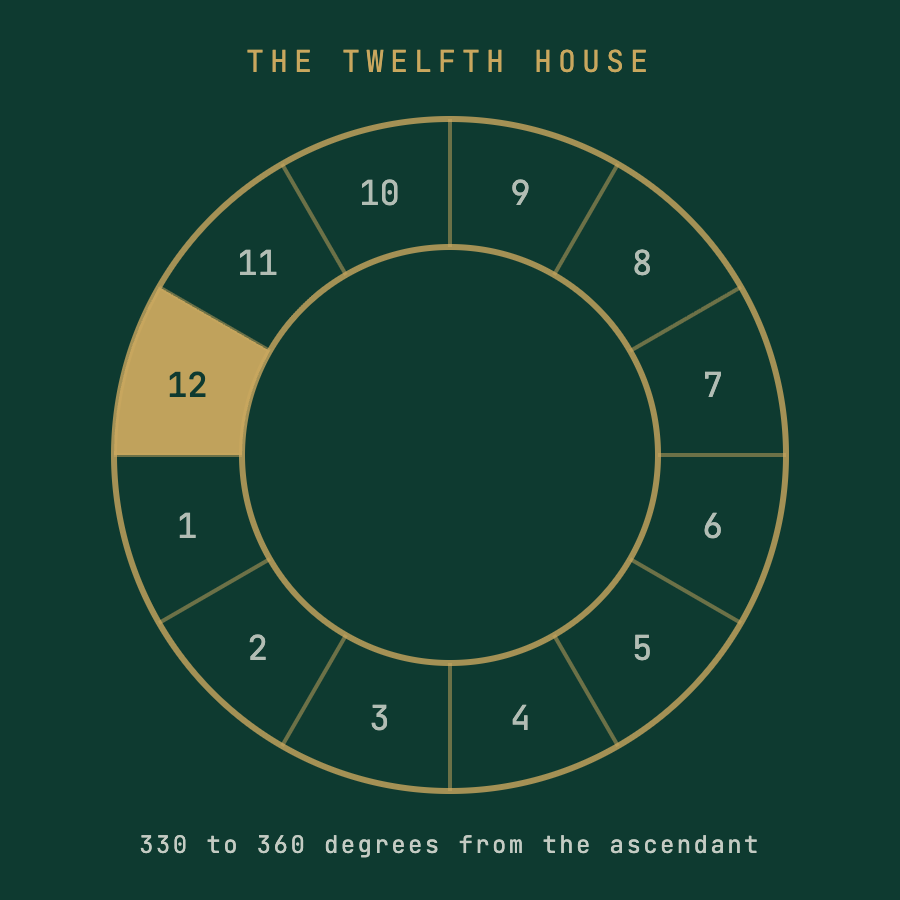
The Twelfth House is the sector immediately before the Ascendant, the part of the sky that has just risen and is not yet visible in the way the rest of the chart is. That position does the interpretive work: it is read as what is present and not seen, by other people and frequently by the person themselves. It is a cadent house, which the tradition read as weaker in expression.
Its traditional territory is unusually concrete and unusually grim. Hellenistic sources give the twelfth place enemies, loss, and confinement, and the medieval lists add prisons, hospitals, monasteries and large animals. The common thread is not suffering, which is how it gets summarised; it is places and conditions that remove somebody from ordinary social circulation. That is a description of a situation, not of a fate.
The modern reading translates this inward: the unconscious, what a person hides, what they do in private, and the things they are doing to themselves without noticing. Read opposite the Sixth House, the pair split daily life into the visible routine and everything that happens outside it. The honest caution is that this is the house most easily used to say something ominous and unfalsifiable, and it is worth being unusually careful here.
What it does well
What this house describes well is the private life, in the plain sense: what somebody does when nobody is watching and no account of it is required. That is a real and large part of a person, and it is the part almost no other section of a chart addresses.
Its second use is naming the withdrawal that people need. Solitude is not a symptom. The tradition's association of this house with monasteries and retreats treats deliberate removal from circulation as a functional thing rather than a failure, which is a more generous framing than the modern one about isolation.
Third, it is where a chart can point at a blind spot without claiming to know its content. Saying that somebody has a pattern they cannot see is defensible; saying what it is would not be, and the better readings of this house observe that line.
Where it goes wrong
The characteristic difficulty is self-undermining that does not feel like a decision. This house is traditionally read for the ways a person gets in their own way, and the reason it is filed under the hidden is that the mechanism is genuinely not visible from inside. Somebody who repeatedly arranges circumstances that defeat them is not choosing to.
The second is avoidance that has become a life. Withdrawal is useful and it is also the easiest thing in the world to keep doing, and the difference between a retreat and a hiding place is mostly duration.
Third, secrecy costs more than it saves. What is kept out of sight has to be maintained out of sight, and the effort of that is continuous, invisible to everyone else, and paid entirely by the person doing it.
In relationships
In relationships this house covers what is not being said, on both sides. Secret attachments are the reading it is famous for, and the tradition does include them, but the far more common content is ordinary and unglamorous: the thing one partner has never mentioned, the resentment nobody has raised, the part of a person their partner has simply never met.
Its useful application is not detection. A chart cannot tell you whether somebody is hiding something, and any reading that claims to is manufacturing suspicion out of a symbol. What it can do is prompt the question of what you are not saying, which is answerable, and which is usually the more productive end of that conversation to start from.
In work
At work the Twelfth House covers what happens behind the visible role: the research nobody sees, the preparation, the work done alone before anything is presented. A great deal of competent work lives here and none of it appears on an organisation chart.
The traditional reading also gives it hidden opposition, which in a modern workplace means the objection raised when you are not in the room. That is a real phenomenon and a chart cannot identify who or whether. Treating a symbol as evidence of a specific colleague's hostility is how this house does damage.
Its more defensible use is about fit. Some people work best out of sight and are miserable in visible roles, and this is the part of a chart that describes that preference rather than treating it as a deficiency of ambition.
In money
The Twelfth House has little direct financial content and what it has is about what is not visible in the accounts: expenses nobody itemises, support given quietly, costs a person absorbs without mentioning them.
The one pattern worth naming is the money that goes toward not thinking about something. It is rarely large in any single instance and it is often the largest recurring category in a life. That is checkable against a statement, which is more than the symbolism usually offers.
Nothing here forecasts a balance and nothing here is financial advice. A chart has never been able to say whether there is enough, and the twelfth house is the last place anybody should go looking for that answer.
How to read it in a chart
Read the sign on the cusp, then any planets in the house, then the ruler of that sign and where it went. Planets here are traditionally read as operating with less visibility rather than less strength, which is a distinction most modern summaries lose.
The house system matters more here than almost anywhere, because the Twelfth borders the Ascendant. A planet a few degrees before the rising degree sits in the Twelfth under whole sign or equal houses and may sit in the First House under Placidus, or the reverse. Those are opposite readings of the same planet, and any page presenting one of them as fact without naming its system is overstating what it knows.
The house is routinely confused with Pisces, its natural sign, and with Neptune, the planet modern astrology assigned to it. Jupiter was the traditional ruler of this territory, and the difference in tone between Jupiter and Neptune is most of the difference between the old reading and the new one.
How it meets other placements
Between two charts, contact to the Twelfth House is the one people romanticise most and understand least. It is read as a connection that operates below the level of stated reasons: recognition without an account of why, or an attachment that is difficult to explain to anybody outside it.
That is a real experience and it is not evidence of anything. The same description fits a profound bond and a situation somebody cannot see clearly, and the symbolism does not distinguish them. Anyone using this contact to argue that a difficult relationship is fated is doing something irresponsible with a genuinely interesting idea.
The comparison worth making is with the Sixth House opposite, which covers the daily practical business of two people managing a shared life. Most relationships are decided there rather than here.
The part people leave out
What popular astrology leaves out about the Twelfth House is that its content is mostly boring. The writing around it reaches immediately for karma, past lives and hidden enemies, and the actual material of an unexamined life is duller and harder: a habit nobody has looked at, an evasion repeated for years.
The second omission is that this house is where astrology is easiest to abuse. An unfalsifiable claim about something hidden cannot be checked by the person it is made about, which makes it the perfect instrument for anybody selling anxiety or a remedy for it.
The third is that self-knowledge has a limit. Some of what this house describes is not available to introspection at all, and pretending a page can hand it over is the most dishonest thing on offer here.
Where the symbol comes from
The Twelfth House has no image and no myth. Like every house it is a sector of the local sky, and its meaning was reasoned from its position: the region just above the eastern horizon, containing what has risen but is not yet fully in view.
The Hellenistic name is blunt. The twelfth place was the Kakos Daimon, the Bad Spirit, named as the counterpart of the eleventh place, the Good Spirit, and it was counted among the difficult places because it makes no favourable geometric relationship to the Ascendant at all. A sector that cannot see the rising degree was taken to describe what a person cannot see about themselves. The reasoning is by analogy, and knowing that is the difference between using it and being frightened by it.
The medieval additions of prisons, hospitals and monasteries follow the same logic rather than any observation: they are the places where somebody is present in the world and removed from its ordinary traffic.
Where this meaning came from
Houses are Hellenistic. The twelvefold division of the local sky appears in the Greek-speaking Mediterranean around the first century BCE, and Babylonian astrology, which had signs and planets and omens, had nothing like it.
The twelfth place was difficult from the beginning. Hellenistic sources assign it enemies, slaves, loss and confinement, and it is one of the places in aversion to the Ascendant, meaning it forms no classical aspect to the rising degree. The medieval and Renaissance lists elaborate rather than soften: Lilly, writing in seventeenth-century London, gives it imprisonment, secret enemies and great cattle, and treats it as straightforwardly unfortunate.
The psychological reading is twentieth-century and is the reason this house is bearable to modern readers. The turn that recast the chart as a map of the psyche, running from Alan Leo around 1900 through Dane Rudhyar and the humanistic astrologers from the 1930s, converted confinement into the unconscious and secret enemies into self-sabotage. That is a substantial reinterpretation. It is also the version almost every current page presents as the traditional meaning, which it is not.
What the astronomy actually says
A house is not a place in space. It is a division of the local sky defined by the horizon and meridian at one moment and place, and two people born at the same instant in different cities have the same planets in entirely different houses.
The Twelfth House is the sector immediately above the eastern horizon: the degrees that rose most recently. Because it borders the Ascendant, it is the house most sensitive to birth time. The rising degree moves about one degree every four minutes, so a time wrong by half an hour shifts the boundary by about seven or eight degrees, moving a nearby planet into the next house.
House systems disagree about where the boundary falls. Whole sign and equal houses put it a fixed distance from the Ascendant; Placidus and Koch calculate it by time and produce houses of unequal width, and above about sixty-six degrees latitude those systems break down entirely. No mechanism has ever been demonstrated by which any of this would act on a person, and this house in particular is read for things that could not be checked even in principle.
The common misreading
The commonest misreading of the Twelfth House is as a sentence. It has a long association with prisons, hospitals and institutions, and that folklore is regularly delivered to readers as though a chart could indicate confinement or illness ahead. It cannot. Those associations are medieval category-making about places that remove somebody from ordinary life, not observations and not predictions, and nothing on this page is a claim about anybody's health or liberty. A health question belongs with a doctor and a legal one with a lawyer.
The second is the karma reading. The idea that this house records debts from a previous life is a twentieth-century import from theosophy, not part of the Hellenistic or medieval material, and it has the specific property of being unfalsifiable. A claim nobody can check is not a deep claim; it is an empty one wearing a serious expression.
The third is treating the hidden as necessarily bad. The same sector covers solitude, private work, rest and the parts of a person that are simply nobody else's business. A reading that converts all of that into secret enemies and self-sabotage has taken the most ambiguous house in the chart and resolved every ambiguity in the most frightening available direction, which is a choice the symbolism does not require.
Questions to sit with
- What do you do when nobody is watching that you would not describe to anybody?
- Is your current withdrawal a rest or a hiding place, and how long has it been going on?
- What pattern have people who know you well tried to point out more than once?
- What are you spending time or money on mainly to avoid thinking about something?
See where this sits in your own chart.