- Entry type
- Sign
- Number
- 12
- Abbreviation
- PIS
- Element
- Water
- Modality
- Mutable
- Polarity
- Receptive
- Modern ruler
- Neptune
- Traditional ruler
- Jupiter
- Dates
- February 19 - March 20
- Symbol
- The Fish
- Traditional body rulership
- Feet and lymphatic system
- Matching tarot card
- The Moon
Pisces
A mutable water sign with two rulers, drawn as two fish tied together and swimming apart. Pisces describes the loosening of boundaries, which is the source of both its range and its trouble.
- receptivity
- dissolution
- imagination
- compassion
- diffusion
What this describes
Pisces is mutable water, and it is the last sign, which the tradition takes seriously. Mutable signs close a season and adapt. Water is the element of feeling, and of things that take the shape of whatever holds them. Together they describe a placement with unusually thin edges: quick to take on the tone of a room, slow to say where it ends and the room begins.
That is the sign's capacity and its problem in one description. Thin edges make for real receptivity. Pisces placements register what is going on with other people before it has been said, and they are frequently right. The same thinness makes it hard to hold a position, keep a boundary, or tell a strong feeling that belongs to somebody else from one that belongs to them.
Like everything else in this material it describes a mode rather than a person. Pisces on the Moon reads very differently from Pisces on the Ascendant, or Pisces holding Neptune, and a chart holds a dozen other things at the same time. The sign says something about how experience is met. It says nothing about what is going to happen.
What it does well
Pisces is good at the thing that cannot be done deliberately: noticing the mood underneath the conversation. The placement picks up tone, hesitation and what is being carefully avoided, and it does so early enough for the information to be useful.
It is also unusually free of the need to be right. Where fixed signs defend a position and cardinal signs push one, Pisces will let a framing go when a better one appears, and does not experience that as a loss. In a long argument this is often the placement that ends it.
Third, imaginative range. A mind with loose edges can hold several incompatible versions of a situation at once, which is a liability in a negotiation and the basic requirement of anything creative.
Where it goes wrong
The failure mode is not weakness. It is diffusion: energy spread across so many possible directions that none of them gets the weight to move. Pisces placements often mistake having considered something for having decided it.
The boundary problem is the real one. A placement that absorbs other people's states will take on obligations nobody actually asked of it, resent them privately, and then have no clear account of what happened, because nothing was ever said out loud. That pattern is the source of most of what popular writing calls the Pisces martyr complex, and it is a good deal more ordinary and more fixable than the phrase suggests.
Third, avoidance. The sign is skilled at leaving a situation without physically going anywhere.
In relationships
In relationships Pisces is attentive, adaptive and prone to merging. It will meet a partner where they are, which is generous, and it will go on doing so well past the point where its own position has disappeared, which is not.
The characteristic difficulty is that Pisces frequently loves the potential in somebody rather than the person, and it is genuinely hard for the placement to tell those apart from the inside. That is not naivety. It is a mode of attention that takes possibility as seriously as fact. Where a question is about somebody else's intentions, this placement describes the depth of the querent's own attachment, and mistaking that for evidence about the other person is the commonest error made with this sign.
In work
At work Pisces is strongest where ambiguity is the material: creative work, care work, anything that requires sitting with a situation before naming it. It reads rooms accurately and is often the person who knows what is actually wrong with a team long before it is raised.
The recurring difficulty is structure. Deadlines, scope and self-advocacy are all boundary problems, and the sign is not naturally good at any of the three. That is a real constraint rather than a character flaw, and the practical answer is usually external structure rather than more resolve. The Twelfth House covers overlapping ground and is often confused with the sign.
In money
Pisces is the least tracked sign with money, and the reason is boundaries rather than extravagance. Money lent and never chased, work done and not invoiced, an unclear line between what is shared and what is owned.
The generosity is genuine. The difficulty is that it is often not decided: the placement gives because refusing would require drawing an edge it does not want to draw. Writing down what has actually been agreed is the useful move, since the vagueness rather than the amount is where the trouble accumulates. None of this is guidance about anybody's finances.
How to read it in a chart
Pisces softens and dissolves whatever it touches. On Mercury it produces associative, image-led thinking, poor at sequential argument and good at analogy. On Venus it reads as romantic idealism and a real difficulty with refusing anybody. On Mars it is indirect action, which is often effective and rarely legible to other people.
Two cautions. Neptune, the modern ruler, takes about 164.8 years to orbit the Sun and so spends roughly fourteen years in each sign; Neptune in a sign is a generational marker shared by everyone born in that window, and only its house and aspects make it personal. Second, Pisces is routinely conflated with the Twelfth House. The house is an area of life, the sign is a manner, and a chart very often carries one without the other.
How it meets other placements
Element and modality do the work here. Pisces shares water with Cancer and Scorpio, which usually means feeling gets treated as information rather than as an interruption. It sits easily with the earth signs, which supply the edges it does not generate and which benefit from being given something to feel about.
The instructive axis is Virgo, its opposite. Both are mutable and both are in service of something outside themselves; Virgo does it by discriminating and Pisces by including. Opposition is not incompatibility. It is one function split in two, and each end is usually short of exactly what the other has too much of.
The friction is with fire, where speed meets a placement that needs to sit with things first.
The part people leave out
The part popular astrology leaves out is that Pisces can use its own softness as a position of power. A placement that will not state a boundary makes other people responsible for guessing where it is, and being difficult to disappoint is a way of never being refused. This is rarely deliberate, and it is still what is happening.
The second omission is that the sign's receptivity is selective. Pisces registers what it is already inclined to register and can be remarkably deaf to information that would require it to act. Sensitivity and accuracy are not the same thing, and the tradition tends to credit the first and assume the second follows.
Where the symbol comes from
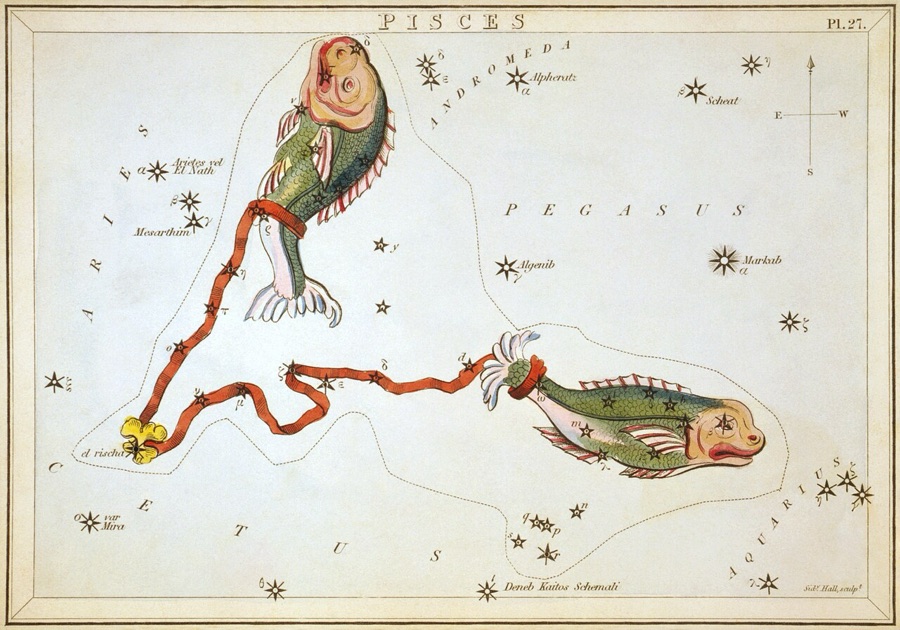
Two fish, swimming in opposite directions, joined by a cord. The cord is the part that matters and the part most illustrations underplay. This is not a symbol of two separate impulses. It is a symbol of two impulses that cannot get away from each other.
The Babylonian material behind it is a pair of figures rather than a single beast, and the Greek story attached later has Aphrodite and Eros turning into fish to escape Typhon, tied together so that neither would be lost. That story is a graft onto an older constellation, as most of the Greek myths in the zodiac are.
The glyph is two crescents facing away from one another with a bar joining them, which is the same idea again: divergence with a fixed connection.
Where this meaning came from
The twelve equal signs are Babylonian, standardised by roughly the fifth century BCE, and Hellenistic astrologers in Egypt assembled the interpretive system on top of them from about the second century BCE. In that system Pisces belonged to Jupiter, which also ruled Sagittarius.
That matters more than it is usually given credit for. Jupiter's Pisces is expansive, generous and religious in temper. The dissolving, oceanic, escapist Pisces that dominates modern writing comes from Neptune, which was not discovered until 1846 and was assigned to the sign afterwards. Two readings are in circulation, roughly two thousand years apart in age, and popular sources rarely distinguish between them.
Ptolemy's Tetrabiblos, around 150 CE, gave the older scheme its authoritative form. The character-based reading arrived in the early twentieth century with Alan Leo, who recast astrology as a description of temperament rather than a prediction of events, partly because predicting events had become legally risky in Britain. He was prosecuted for fortune-telling in 1914 and again in 1917.
What the astronomy actually says
The most important fact in tropical astrology sits in this sign. Zero degrees of Aries, the point where the Sun crosses the celestial equator each March, is still called the First Point of Aries. It has not been in the constellation Aries for roughly two thousand years. It is in Pisces, and has been since about the last century BCE.
That is precession. Earth's axis traces a slow circle, one turn in about 25,772 years, carrying the equinox point backwards through the constellations at roughly one degree every seventy-two years. Tropical astrology is defined by the equinoxes, so its signs stay put while the stars behind them slide. Sidereal astrology is defined by the constellations, so its signs move with them. The gap between the two is now close to a full sign, and neither is the correct one. They answer different questions.
Neptune, the modern ruler, was found in 1846, orbits in about 164.8 years, and cannot be seen without optical aid.
The common misreading
Pisces is most often read as psychic. What the tradition describes is receptivity, which is a real and entirely ordinary capacity: reading tone, noticing what has been left out, picking up a mood before it is announced. Inflating that into knowledge of things that could not be known makes the actual skill harder to trust and easier to dismiss.
The second misreading is the victim frame. Popular writing tends to describe this sign as passive and put-upon, which flattens a boundary problem into a character defect and, worse, tells somebody that a fixable pattern is who they are.
The third is the most serious. Pisces attracts loose talk about addiction and mental health, mostly by way of Neptune and the twelfth house. A birth chart is not a diagnosis and cannot be one. Nothing in this material identifies a condition, and a page that implies otherwise is doing something it has no basis for. If a description here sounds like a real difficulty in somebody's life, that is a reason to talk to a person, not to a chart.
Questions to sit with
- Where does this feeling actually belong, and did it start with you?
- What have you agreed to simply by not refusing it?
- Which possibility are you in love with, and what is the person or the thing actually like?
- What structure would let you do your best work without having to hold the line yourself?
See where this sits in your own chart.