- Entry type
- Sign
- Number
- 6
- Abbreviation
- VIR
- Element
- Earth
- Modality
- Mutable
- Polarity
- Receptive
- Modern ruler
- Mercury
- Traditional ruler
- Mercury
- Dates
- August 23 - September 22
- Symbol
- The Maiden
- Traditional body rulership
- Digestive system
- Matching tarot card
- The Hermit
Virgo
The sign of the correction. Virgo describes the instinct to improve what is already in front of you, and the tradition reads it as a relationship to craft rather than a verdict on anybody's tidiness.
- precision
- service
- analysis
- self-criticism
- craft
What this describes
Virgo is the sixth sign, mutable earth, and it closes the summer. Mutable signs adapt rather than initiate, and earth deals in the material rather than the abstract, so the combination describes somebody who works on what exists instead of proposing something new. That is the whole sign, and almost everything else follows from it.
The tradition reads it as discrimination in the old sense: the capacity to tell one thing from another, to notice the difference between adequate and correct, and to care about that difference when nobody else has noticed there is one. This is a genuine faculty and a socially expensive one. People who see the flaw are rarely thanked for mentioning it. The older sources do not describe Virgo as tidy. They describe it as exact, which is a different and more demanding thing, and a person can be exact about their work and chaotic about their kitchen.
It shares a ruler with Gemini, which is worth sitting with. Both are Mercury signs and both are about processing information; Gemini gathers and connects, Virgo sorts and corrects. Placed opposite Pisces, the pair divide the world into the specific and the boundless, the thing measured and the thing felt, and each finds the other's method faintly irresponsible.
What it does well
Virgo is good at the last ten per cent. Most work is broadly finished long before it is actually finished, and the gap between those two states is where this placement lives. It is the difference between a thing that works and a thing that works reliably.
It is also unusually willing to be useful. The tradition puts Virgo with service, and the modern reading of that word has gone soft; what the older material means is somebody who takes on the necessary unglamorous task because it needs doing and they can see that nobody else will.
Third, it notices. The specific talent is pattern recognition applied to detail: the discrepancy in the figures, the sentence that does not follow, the small thing that is about to become a large one.
Where it goes wrong
The failure is not fussiness. It is that the standard is applied inward first and without mercy, and only then outward. Virgo is described as its own harshest critic, and a person who cannot let their own work be adequate will eventually find it very difficult to let anybody else's be.
The second is the substitution of improvement for decision. There is always another pass available, and refining something is a comfortable way of not shipping it. The sign is prone to mistaking that for diligence.
Third, the criticism is usually accurate, which is what makes it hard to receive. Being right is not the same as being useful, and this placement is described as slow to learn the difference between a true observation and a helpful one.
In relationships
In relationships the tradition reads Virgo as showing affection through attention to detail rather than through declaration. The remembered preference, the practical problem quietly solved, the thing fixed before anybody mentioned it was broken. That is a real language and it is frequently not understood as one.
The recurring difficulty is that the same attention finds faults, and the sign has trouble not mentioning them. Somebody who notices everything about a person will notice the things that are wrong, and a relationship where the small corrections never stop becomes exhausting even when every individual correction was fair.
As with every sign, this describes a tendency and not a person. Venus and the seventh house carry far more weight on this question than a Sun sign does.
In work
This is the placement the tradition assigns to skilled work, and it is one of the few sign descriptions that has aged well. Editors, analysts, technicians, clinicians, anybody whose job is to find the error before it reaches the customer. The older lists say healers, servants and craftsmen, the same category in an earlier economy.
Its advantage is that the work is genuinely better. Organisations tend to discover the value of this placement by removing it and watching the defect rate.
The cost is visibility. Correcting is invisible when it succeeds and conspicuous when it fails, so the sign accumulates less credit than it earns and more blame than it deserves. That is a structural problem rather than a personal one, and it is worth naming as such rather than treating it as a failure of self-promotion.
In money
Virgo is read as careful rather than acquisitive. The sign is associated with knowing where the money actually goes, which is a rarer skill than it sounds and has very little to do with how much of it there is.
The characteristic pattern is anxiety disguised as prudence. Checking the balance is sensible; checking it four times in an evening is a different activity wearing the same clothes, and this placement is described as prone to the second while sincerely reporting the first. That distinction is worth noticing on its own terms. Nothing on this page is financial advice, and the tradition never claimed to offer any.
How to read it in a chart
The Sun in Virgo describes what somebody is trying to get right. The Moon in Virgo describes a person who settles by tidying something, and who processes distress by making a list. A Virgo Ascendant reads as reserved, precise and slightly watchful on first meeting, which is often mistaken for coldness.
The ruler is Mercury, and Mercury is the fastest-moving of the traditional planets after the Moon, so it is frequently in a neighbouring sign to the Sun. A Virgo Sun with Mercury in Leo produces a noticeably warmer version than one with Mercury in Virgo, and traditional practice checks that before generalising.
Virgo is most often confused with Capricorn. Both are earth and both are read as disciplined. Capricorn is cardinal and organises toward an outcome; Virgo is mutable and improves what is in front of it. If somebody is described as ambitious, that is usually Capricorn. If they are described as exacting, it is usually this.
How it meets other placements
Element logic puts Virgo with the other earth signs, Taurus and Capricorn, and with water, which is described as softening it. Fire and air read as friction: fire will not slow down for the detail and air would rather discuss the principle than check the figure.
Modality matters here more than usual. Virgo is mutable, and the other mutable signs, Gemini and Sagittarius and Pisces, sit at ninety or a hundred and eighty degrees. Mutable pairs adapt to each other endlessly, which sounds pleasant and in practice means nothing is ever settled and both people are quietly waiting for the other one to decide.
None of this is a verdict. Element and modality name where friction is likely to arise; they were never designed to grade a relationship, and reading them that way is a modern invention.
The part people leave out
What popular astrology leaves out about Virgo is that the perfectionism is a control strategy. The sign is written up as helpful, and what the older material describes is closer to a person managing anxiety by managing detail, because detail is the part of the world that will hold still.
That reframes the whole placement. Cleaning is not about cleanliness. Checking is not about accuracy. Both are ways of converting an unmanageable feeling into a task that can actually be completed, and they work, temporarily, which is why they repeat.
The other omission is the contempt. A person who holds themselves to an impossible standard tends to hold the world to one too, and the resulting judgement is usually silent, frequently accurate, and corrosive to everybody including the person having it.
Where the symbol comes from
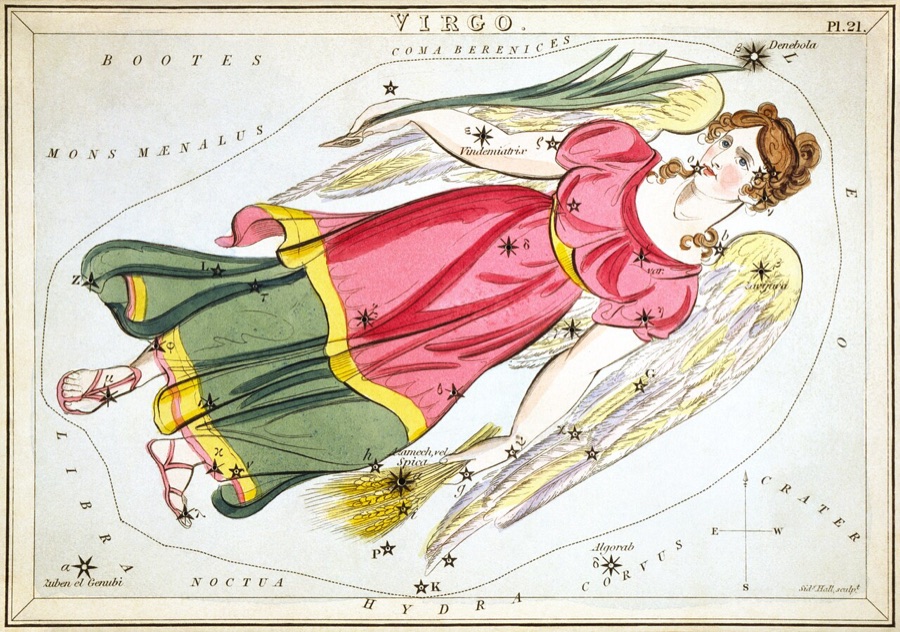
The Maiden is the oldest continuously identified female figure in the zodiac and she has been several people. Babylonian sources associate the constellation with a grain goddess; the Greeks read her variously as Demeter, as her daughter Persephone, and as Astraea, the goddess of justice who left the earth when human behaviour became intolerable. The common element is not virginity in the modern sense but independence: an unmarried woman, in the older usage, meant a woman belonging to nobody.
The wheat is the durable part. The constellation's brightest star is named Spica, Latin for the ear of grain she holds, and the whole figure sits over the harvest.
The glyph is an M with a closed loop on its final stroke, generally explained as the initial of a Greek word or as a stylised figure. Like the rest, it is a medieval scribal form rather than an ancient symbol, and the confident etymologies offered for it are guesses.
Where this meaning came from
The constellation is Babylonian and agricultural, tied to the barley harvest, and it was on the star lists long before anything resembling a horoscope existed. The twelve equal thirty-degree signs were fixed in Mesopotamia by about 500 BCE.
The sign's character comes from the Hellenistic system assembled in Greek-speaking Egypt between roughly 100 BCE and 200 CE, which gave Mercury rulership of both Gemini and Virgo, made Virgo mutable earth, and attached it to the sixth house, traditionally the house of illness, work and servants. That house association is the source of nearly every modern claim about Virgo and health, and it is a claim about a house rather than about a person's body. Ptolemy recorded the scheme in the Tetrabiblos in the second century CE.
The tidy, anxious, list-making Virgo is twentieth-century. Alan Leo turned the signs into psychological types around 1900, and the newspaper Sun sign column from 1930 onward hardened them into stock characters. The older material is describing a relationship to skilled work; the modern version is largely describing housekeeping, which is a considerable narrowing and one worth resisting.
What the astronomy actually says
Virgo is the largest constellation of the zodiac and the second largest in the sky, which has a consequence people rarely notice: the Sun spends about forty-four days in front of it, from roughly the middle of September to the end of October. Constellations are wildly unequal in size along the ecliptic, and the tropical signs are all exactly thirty degrees, which is one of the plainest illustrations that the two systems are not the same thing.
Spica, its brightest star, is about two hundred and fifty light years away and is not a single star but a close pair of hot blue stars orbiting each other in around four days, so near to one another that both are pulled out of round.
The autumn equinox point currently sits in Virgo. It was in Libra when the Greeks named it, and precession moved it across the boundary around the eighth century CE, which is why the equinox is still called the Libra point in some older texts. Sidereal astrology follows the stars and produces different placements; tropical astrology follows the equinox. Neither has a demonstrated mechanism.
The common misreading
The most common misreading of Virgo is that it is about cleanliness. The sign gets reduced to a joke about labelled cupboards, and the person with the placement is then congratulated on being organised or teased for not being. Neither has anything to do with what the tradition describes, which is a relationship to standards in work. A Virgo whose flat is a mess and whose spreadsheets are immaculate is not an exception; they are the ordinary case.
The second is the health association, which comes from the sixth house and gets applied to bodies with far more confidence than the source supports. Nothing in astrology can tell anybody anything about their health, this page is not attempting to, and a genuine concern belongs with a doctor.
The third is treating the criticism as hostility. The sign is described as noticing the flaw, and noticing is not the same as attacking; a great deal of Virgo commentary is offered as help by somebody who would want to be told. That does not make it welcome, and the honest reading names both halves: the observation is usually correct and the delivery is usually a mistake.
Questions to sit with
- What are you still improving that was finished a month ago?
- Whose standard are you actually applying, and would you apply it to a friend?
- What did you notice this week and choose not to say, and was that the right call?
- If the work were only adequate, what would actually happen?
See where this sits in your own chart.