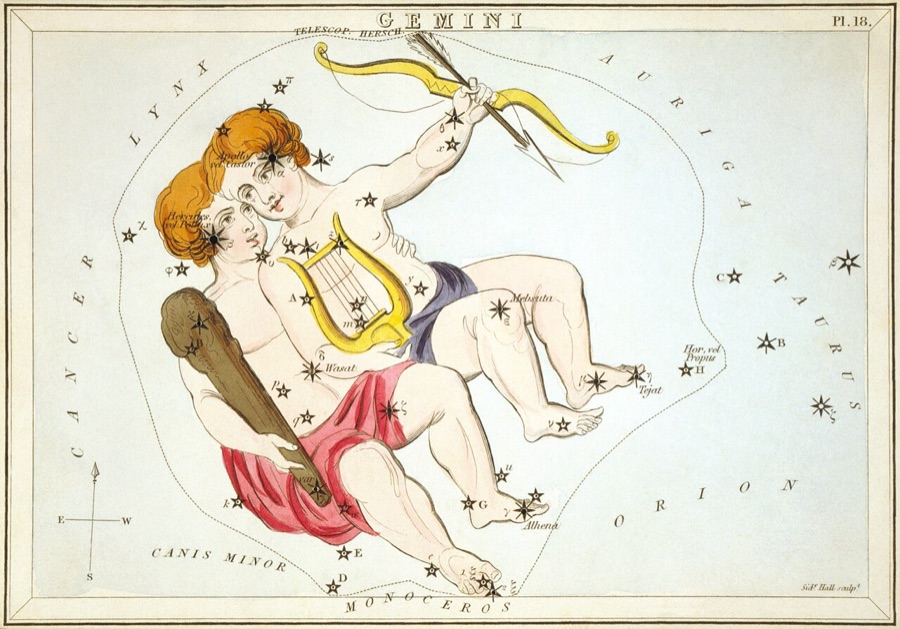
- Entry type
- Sign
- Number
- 3
- Abbreviation
- GEM
- Element
- Air
- Modality
- Mutable
- Polarity
- Active
- Modern ruler
- Mercury
- Traditional ruler
- Mercury
- Dates
- May 21 - June 20
- Symbol
- The Twins
- Traditional body rulership
- Arms, hands and lungs
- Matching tarot card
- The Lovers
Gemini
The sign of the second opinion. Gemini describes a mind that works by comparison, holding two versions of a thing at once, and the tradition treats that as a method rather than a failure to commit.
- curiosity
- versatility
- communication
- restlessness
- wit
What this describes
Gemini is the third sign and the first mutable one. Mutable signs close a season, when the weather is already turning into the next thing, and the tradition reads them as adaptive rather than initiating. Gemini is air, which in this system means the world of language, comparison and exchange rather than the world of objects.
What it describes is a particular relationship to information: the instinct to gather, connect and pass on. Not depth. The tradition is honest about this and modern books usually are not. Gemini is read as the placement associated with breadth, curiosity and talk, and it does not claim that the person knows any one subject well. It claims they can get up to speed on almost anything by Thursday, which is a different and genuinely useful skill.
The Twins are the point. The sign is drawn as two figures because the pattern it names is doubleness, the ability to hold a position and its opposite without distress. Read charitably that is intellectual honesty; read uncharitably it is unreliability. Both readings describe the same behaviour, and only context decides. Placed opposite Sagittarius, the pair split knowledge into the local and the distant, the detail and the belief.
What it does well
Gemini is good at translation. Not between languages necessarily: between a specialist and a room that does not share the vocabulary, between two people who are arguing because they are using one word for two things. The tradition puts this sign with Mercury, the messenger, and messengers are undervalued until the message stops arriving.
It is also fast. The specific speed is uptake, not action: reading a situation, finding the relevant fact, changing approach when the first one is clearly not working. Most people are slow to abandon an argument they have already started, and this placement is not.
Third, it is genuinely interested. Curiosity is easy to fake and hard to sustain, and the sign describes people who keep asking questions long after it would be socially safer to stop.
Where it goes wrong
The failure is not dishonesty, which is the lazy version. It is that Gemini can be entirely sincere in two directions and see no problem. The sign describes a mind that reorganises around whoever it is talking to, which produces a person who has agreed with everyone in the meeting and meant it every time.
The second is the substitution of talking for doing. Describing a plan well is close enough to having a plan that the difference is easy to miss for months. This is the placement most likely to have an excellent account of a project that does not exist.
Third, boredom arrives early and is treated as information. It is often just boredom. Leaving at the point where things get repetitive means never getting past the repetitive part, which is where most competence is built.
In relationships
In relationships the tradition reads Gemini as conversation. The sign is described as wanting somebody to think with, and as losing interest faster from silence than from conflict. Being found interesting matters more here than being found attractive.
The difficulty is restlessness with the ordinary. A relationship spends most of its life in a settled register, and this placement is described as poor at that register, prone to introducing novelty rather than sitting inside something quiet. That is not the same as infidelity, whatever the compatibility columns imply.
As always, the Sun sign is the weakest available evidence about how a specific person behaves with a partner. Venus, the Moon and the seventh house all describe it more directly.
In work
Gemini is the placement the tradition assigns to writing, teaching, selling, negotiating and anything else where the work is mostly language. The older lists say messengers, scribes and merchants, which maps onto a surprising amount of modern office work.
Its real advantage is range. Somebody who can hold three unrelated domains loosely is useful in exactly the situations where a specialist is stuck, and organisations tend to discover this late. The corresponding cost is that range reads as unseriousness to people who value depth, and this placement will be underestimated by them for years.
The practical reading is about structure rather than field. Gemini does well where the work changes often and badly where it does not, and choosing a job for its subject rather than its rhythm is the mistake the sign is most prone to.
In money
The tradition reads Gemini as earning in several places at once and tracking none of them closely. Multiple income streams, side arrangements, work that arrives through conversation. Money is treated as a medium rather than as a store, which is the air element doing what it does.
The characteristic problem is not overspending but not looking. Attention is the scarce resource for this placement, and finances reward attention more than cleverness. Nothing here is advice; the observation is only that the sign describes a person who would rather understand a system than maintain one, and personal finance is almost entirely maintenance.
How to read it in a chart
The Sun in Gemini describes what somebody is trying to work out. The Moon in Gemini describes a person who processes feeling by talking about it, sometimes before the feeling has settled enough to be described accurately. A Gemini Ascendant reads as quick and sociable on arrival regardless of what is behind it.
The ruler is Mercury, and its condition changes the sign more than in most cases. Mercury in Gemini and Mercury in Taurus, with the Sun in Gemini either way, describe noticeably different minds, and traditional practice would look there first.
Gemini is most often confused with Aquarius. Both are air and both are read as clever. Aquarius is fixed and holds a position on principle; Gemini is mutable and changes position on evidence, or on mood. If somebody is described as detached, that is usually Aquarius. If they are described as scattered, it is usually this.
How it meets other placements
Element logic puts Gemini easily with the other air signs, Libra and Aquarius, and with fire, which it is described as feeding. Earth and water are read as friction: earth wants a decision and water wants the emotional content named, and this sign is reluctant about both.
Modality is the sharper tool. Gemini is mutable, and the other mutable signs, Virgo and Sagittarius and Pisces, sit at ninety or a hundred and eighty degrees. Two mutable signs together are extremely flexible and almost incapable of settling anything, which is a pleasant way to spend a year and a poor way to buy a house.
None of this grades a relationship. It names where the friction is likely to come from, which is all element and modality were ever designed to do.
The part people leave out
What popular astrology leaves out about Gemini is loneliness. The sign is written up as sociable, and the older material is describing something more uncomfortable: a person who is fluent with everybody and known by almost nobody, because being interesting is an excellent place to hide.
The doubleness has the same edge. Holding two positions is a genuine intellectual capacity and it is also a way of never being pinned down, and a person who is never pinned down is never quite reachable either.
The third omission is what the talking is for. A great deal of Gemini conversation is not exchange; it is the sound made while avoiding a specific sentence. The tradition, unlike the horoscope columns, does not treat that as charming.
Where the symbol comes from
The Twins are Castor and Pollux, and the Greek story is about a difference between them. Pollux was the son of Zeus and immortal; Castor was the son of a mortal father and was not. When Castor died, Pollux asked to share his immortality, and the pair were placed in the sky alternating between the underworld and Olympus. The myth is not about similarity. It is about two things bound together that are not the same kind of thing.
Babylonian sources name the same stars the Great Twins, associated with a pair of minor gods who guarded gateways. The gatekeeper reading is older than the Greek one and fits the sign's later associations with messages and thresholds rather better.
The glyph is two vertical strokes joined top and bottom, usually described as the Roman numeral two or as two figures side by side. Like the rest of the zodiac glyphs it is medieval shorthand, not an ancient sign.
Where this meaning came from
The Great Twins appear on Babylonian star lists well before the zodiac existed as a system. The twelve equal signs were standardised in Mesopotamia by about 500 BCE, replacing an uneven set of constellations with a clean thirty-degree grid that could be calculated rather than observed.
The character of the sign is Hellenistic. Between roughly 100 BCE and 200 CE, astrologers working in Greek-speaking Egypt assembled the framework of rulerships, elements, modalities and houses, and it is there that Gemini becomes mercurial, dual and associated with language. Ptolemy set it down in the Tetrabiblos in the second century CE, and that text carried the system through Arabic scholarship into medieval and Renaissance Europe.
The talkative, flighty Gemini of popular culture is much newer. Alan Leo rebuilt astrology as character psychology in London around 1900, and R. H. Naylor's newspaper column, which began in the Sunday Express in 1930, turned the signs into twelve reliable personality sketches for a mass audience. The reputation for being two-faced is largely a twentieth-century press invention, and it does not appear in that form in the older sources.
What the astronomy actually says
The two bright stars of Gemini are not twins in any physical sense. Pollux is an orange giant about thirty-four light years away and has a confirmed planet in orbit around it. Castor is roughly fifty light years away and is not one star but six, three pairs bound together. They are different types, at different distances, unrelated to each other, and they only look like a pair from here.
Pollux is also brighter than Castor, despite Castor carrying the alpha designation. Bayer assigned the letters in 1603 and they were never corrected.
Tropical Gemini has nothing to do with those stars. It is the third thirty-degree segment measured from the March equinox, and precession has carried it roughly one sign clear of the constellation it was named for. The Sun passes in front of the stars of Gemini from about the twenty-first of June to the twentieth of July. The June solstice point itself, which sat in Gemini in antiquity, moved into Taurus around 1990. Sidereal astrology tracks the stars; tropical astrology tracks the seasons. Neither has ever shown a mechanism, and these pages do not claim one.
The common misreading
The most common misreading of Gemini is two-faced, and it is worth being precise about why it is wrong. The sign describes a mind that genuinely holds more than one position, not a person who conceals one position while stating another. Duplicity requires a settled private view. What the tradition actually describes is the absence of one, which is a different problem and often a more honest one.
The second is treating the talkativeness as the whole sign. Mercury governs exchange in both directions, and the older material puts as much weight on gathering as on broadcasting. A quiet Gemini is not a contradiction; a Gemini who does not want to know things would be.
The third runs the other way. Because the sign is written up as quick and verbal, people with the placement who are slow, deliberate or shy conclude the chart is wrong about them. It is not a claim about them. A Sun sign is one factor among ten bodies and twelve houses, and anybody who has read a chart properly knows that the Sun is regularly the least visible thing in it.
Questions to sit with
- Which of the things you know a little about would you like to know properly?
- When you changed your mind last, was it new evidence or a new audience?
- What conversation are you filling with talk to avoid one specific sentence?
- What have you described so often that you no longer notice you have not started it?
See where this sits in your own chart.