- Entry type
- Sign
- Number
- 9
- Abbreviation
- SAG
- Element
- Fire
- Modality
- Mutable
- Polarity
- Active
- Modern ruler
- Jupiter
- Traditional ruler
- Jupiter
- Dates
- November 22 - December 21
- Symbol
- The Archer
- Traditional body rulership
- Hips and thighs
- Matching tarot card
- Temperance
Sagittarius
A mutable fire sign ruled by Jupiter, drawn as an archer aiming away from himself. Sagittarius describes the appetite for a bigger frame, and the restlessness that comes with never quite arriving in it.
- expansion
- candour
- restlessness
- search
- overreach
What this describes
Sagittarius is the mutable fire sign, and both halves of that matter. Fire is the element of appetite and movement. Mutable is the quality of the signs that close a season, which adapt rather than initiate. Together they describe energy that changes direction easily, which is a strength when the terrain is unknown and a liability when the task is to finish something. The sign is not restless because it is shallow. It is restless because closure ends the search.
What it actually describes is hunger for a larger frame. Not travel specifically, though travel is the easiest expression of it, but the impulse to widen the terms of a question until the question becomes interesting. Sagittarius placements tend to be uncomfortable with the merely local, and that discomfort produces both real curiosity and a habit of skipping the details that would make the curiosity useful. The archer is aiming at something outside the frame of the picture, and that is close to literal.
It is not a personality type. A sign describes a mode, and a chart holds ten or more of them at once. Sagittarius on the Sun says something different from Sagittarius on the Ascendant, or Sagittarius holding Jupiter. Read it as one voice in an argument rather than as a verdict. The rest of the chart, and the person's actual life, decide how loud it gets. Nothing here predicts what anybody will do.
What it does well
Sagittarius placements are good at the part most people skip: enlarging the question before answering it. Given a problem, the instinct is to ask what it is a case of, and that reframing is often what unlocks it.
The sign carries genuine tolerance for uncertainty. Sagittarius will start something before the route is known and treat the unknown stretch as interesting rather than threatening. That is rarer than it sounds, and it is why this placement so often ends up somewhere nobody planned for it.
There is also plain candour. Sagittarius tends to say the thing, which costs it socially and saves other people a great deal of time. In a group that has been talking around a subject for an hour, this is the placement that names it.
Where it goes wrong
The failure mode is not recklessness. It is leaving. Sagittarius reframes a problem beautifully and then loses interest at the point where the work turns into maintenance, and the reframing gets counted as the contribution when the finishing was the contribution.
The candour has a cost the sign consistently underestimates. Saying a true thing bluntly is not the same as saying it usefully, and Sagittarius often mistakes the discomfort it causes for evidence that it was necessary. Some of it is necessary. Not all of it, and the sign is poor at telling the difference.
Third, certainty. A placement that likes big frames is prone to adopting one and then defending it as though the size of an idea were evidence for it.
In relationships
In relationships Sagittarius wants a companion for the enquiry rather than an audience for it. The placement is warm, direct and genuinely uninterested in games, which makes it easy company and occasionally careless company.
The pressure point is not fear of commitment, which is the standard accusation and usually wrong. It is that Sagittarius commits to the version of a relationship in which both people are still moving, and struggles when the relationship becomes a settled arrangement to be maintained rather than explored. Where the question is about somebody else's intentions, this placement describes a way of being present. It is not a forecast of whether they will stay.
In work
At work Sagittarius is strongest early: opening a market, framing a strategy, teaching, anything where the job is to make a large thing legible to other people. It handles ambiguity well and dislikes process for its own sake, which is a real difference from disliking rigour.
The recurring difficulty is the middle of projects. Sagittarius placements often build a strong reputation on starts and a quieter one on completions, and the second is the durable currency in most organisations. Where a chart shows Sagittarius alongside a fixed sign, the finishing problem is usually solved elsewhere. Where it does not, it is worth naming plainly rather than reframing as a strength.
In money
Sagittarius is not careless with money so much as uninterested in tracking it. The pattern is generosity, optimism about future income, and an aversion to the admin that would make either of those safe.
Its real financial characteristic is a preference for options over reserves: spending on things that widen the range of what is possible next, which is a coherent position and not the same as impulsiveness. Whether it is wise depends on circumstances a chart knows nothing about. This is a description of a disposition toward money, not guidance about anybody's finances.
How to read it in a chart
Sagittarius modifies whatever it touches by widening it and loosening it. On the Ascendant it reads as an open, direct manner that people find easy and sometimes mistake for a lack of seriousness. On the Moon it is emotional buoyancy that does not settle. On Mercury it produces broad, associative thinking that is frequently right about shape and wrong about detail.
Two confusions are common. Sagittarius is regularly mistaken for Aries, since both are fire and both are direct, but Aries is cardinal and initiates while Sagittarius is mutable and redirects. It is also confused with the Ninth House, which covers similar territory. The house is where a subject shows up in a life; the sign is the manner in which it is met. A chart can easily have one without the other, and reading them as the same thing flattens both.
How it meets other placements
Element and modality do more work here than any list of best matches. Sagittarius shares fire with Aries and Leo, which usually means a shared tempo and a shared assumption that enthusiasm is a legitimate reason to do something. It sits in easy relation to the air signs, which supply the argument the fire wants.
The instructive tension is with Gemini, its opposite. Both are mutable and both are curious; one gathers breadth and the other gathers detail. Opposition in astrology is not incompatibility. It is one axis approached from two ends, and the useful reading is what each side is failing to do.
The harder contacts are with the fixed signs, where the disagreement is about whether finishing counts.
The part people leave out
The part popular astrology leaves out is that Sagittarian optimism is often a way of not looking at something. The sign's reputation for honesty is loud and its capacity for avoidance is quiet, and the second is the more reliable of the two.
There is also a specific failure around other people's constraints. A placement that experiences the world as open tends to hear other people's limits as excuses, and the generosity the sign is known for can arrive with an implicit instruction to cheer up. That lands as dismissal. Sagittarius is usually surprised to hear it described that way, which is itself the problem.
Where the symbol comes from
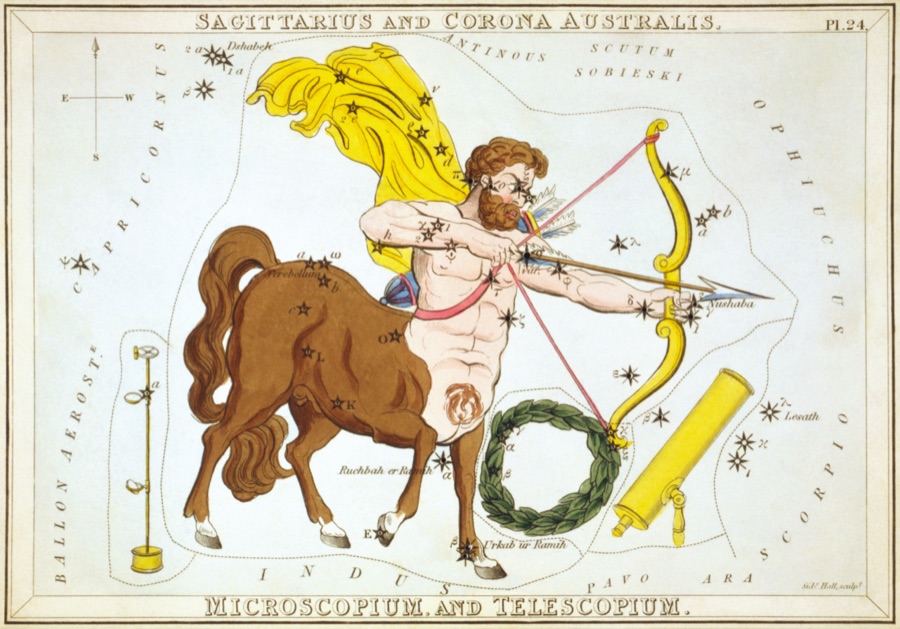
The symbol is a centaur drawing a bow, and the composition matters more than any myth attached to it. The figure is half animal and half human, aiming at something outside the frame. What it is shooting at, the picture does not show, and the reader supplies it.
The Greek identification with Chiron is late and unstable. More often the figure is simply an archer, and the Babylonian figure standing behind it, Pabilsag, is older than either and only partly understood. The glyph is an arrow with a short crossbar across its shaft, and the crossbar is usually read as the point where the animal ends and the aim begins.
That is the sign in one drawing: appetite pointed at a target the picture does not contain.
Where this meaning came from
The twelve equal signs are Babylonian. Star lists such as MUL.APIN, compiled by about 1000 BCE, describe the constellations along the Sun's path, and by roughly the fifth century BCE Babylonian astronomers had replaced them with twelve equal divisions of thirty degrees. The oldest surviving individual horoscope dates from around 410 BCE.
Hellenistic astrologers in Egypt, from about the second century BCE, added the machinery: houses, aspects, planetary rulerships, and the rule that each planet governs two signs. Jupiter was given Sagittarius and Pisces, which is why those two still read as a pair despite having almost nothing else in common.
Ptolemy's Tetrabiblos, written in Alexandria around 150 CE, gave the system its authoritative form and a physical rationale borrowed from Aristotle. The body rulerships that still appear on pages like this one come from the same period, from medical astrology of the kind set out in Manilius's Astronomica. They are recorded here as history and are not a medical claim.
The character-based reading is much younger. It dates from the early twentieth century, when Alan Leo and later Dane Rudhyar reframed astrology as a description of temperament rather than a prediction of events.
What the astronomy actually says
The tropical zodiac is tied to the equinoxes, not to the stars. Zero degrees of Aries is defined as the March equinox point, and the twelve signs are equal thirty-degree divisions from there. The constellations are a separate thing, unequal in size, with boundaries fixed by the International Astronomical Union in 1930.
The two have drifted apart. Earth's axis precesses with a period of about 25,772 years, roughly one degree every seventy-two years, so the signs and the constellations behind them now sit about one sign out of step. Somebody born on 1 December has the Sun in tropical Sagittarius while the Sun is in fact in front of Ophiuchus or Scorpius. Sidereal astrology, used across most of India, tracks the constellations instead. Neither is the correct one; they measure different things.
One genuinely striking fact does lie in this direction. The centre of our galaxy, and the black hole Sagittarius A*, sits about 26,000 light years away toward this constellation. Astrology has never demonstrated a mechanism connecting any of that to a person, and this page does not claim one.
The common misreading
Sagittarius is most often read as luck. The association comes from Jupiter, which older texts call the greater benefic, and it has hardened into a claim that things tend to work out for this sign. Nothing in the tradition supports that as a prediction. What the pages making it are actually describing is a disposition to keep moving after a loss, which is a different thing and a more useful one.
The second misreading is treating bluntness as integrity. Sagittarius has a reputation for honesty, and the reputation gets used to excuse carelessness with other people. Saying a true thing at the wrong moment is not courage. The tradition describes a sign that aims. It does not say the aim is good.
The third is the commitment cliche. Nothing in the older material describes this sign as unwilling to commit; that reading is twentieth-century, and it owes more to newspaper columns needing a memorable trait than to anything in the tradition. What the mutable quality actually describes is a tendency to revise, and revising inside a commitment is not the same as refusing one.
Questions to sit with
- What are you actually aiming at, and when did you last say it in one sentence?
- Which unfinished thing would matter most if you finished it?
- Where have you called something honesty when it was mostly impatience?
- What would you have to give up in order to stay somewhere long enough for it to change you?
See where this sits in your own chart.