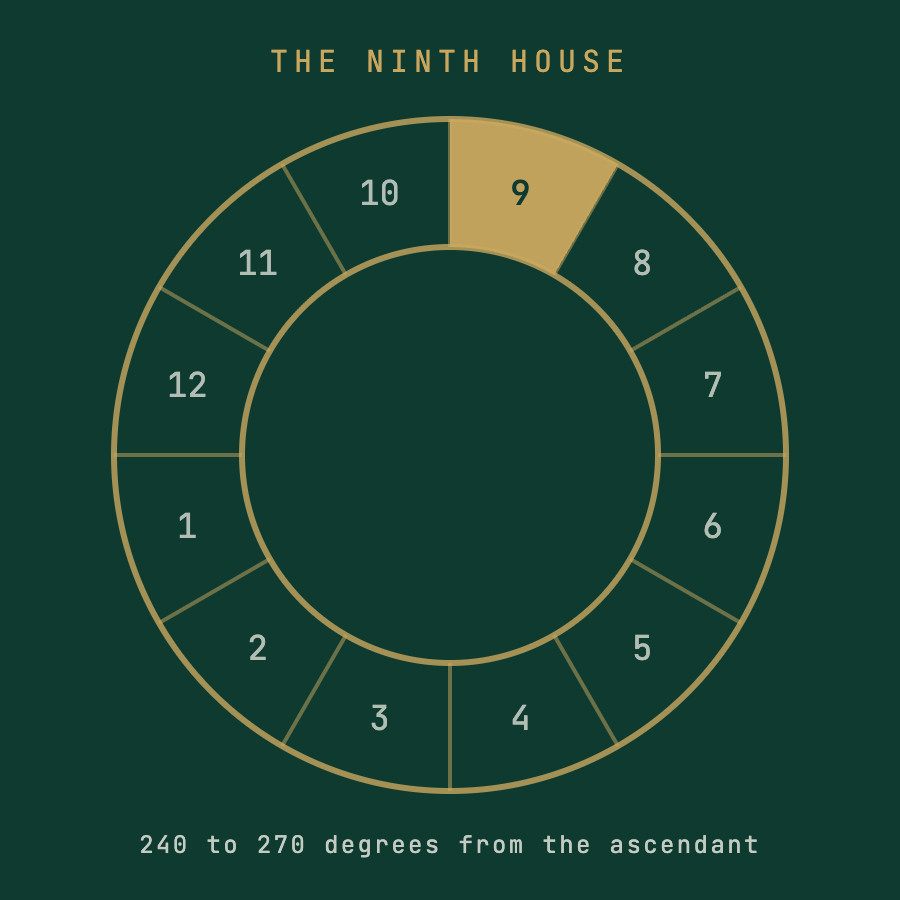
- Entry type
- House
- Number
- 9
- Element
- Fire
- Modality
- Mutable
- Modern ruler
- Jupiter
The Ninth House
The house the Greeks called God: long journeys, foreign places, law, belief and higher learning. The ninth house covers whatever a person has to take on report rather than see for themselves.
- belief
- travel
- law
- meaning
- doctrine
What this describes
The ninth house covers the far distance. Long journeys and foreign places, law and the courts, religion and philosophy, higher learning, and, in the older texts, dreams, oracles and divination. The Greek writers called it Theos, God, and the Latin names are Deus and Iter, the journey.
What holds those together is that none of them can be verified directly. A distant country, a legal system, a body of doctrine and a prediction all have in common that you take them on some kind of authority. That is the ninth house's real subject: not travel or belief specifically, but the whole apparatus by which somebody decides what to accept about a world they have not personally inspected.
It takes Sagittarius as its natural sign and Jupiter as its ruler, and it is cadent. The Sun is said to have its joy here, which is where the name came from. The house also carries an awkward distinction: astrology itself is a ninth house subject, so a page like this one is describing the house it is written from.
What it does well
A well-supported ninth house shows up as the capacity to hold a frame. Somebody with a working ninth can place a specific situation inside a larger account of how things go, and that is the difference between having experiences and learning from them.
It also produces genuine interest in the unfamiliar. Not tourism, but a willingness to be somewhere the rules are different and to treat that as information rather than as an inconvenience.
Third, it supplies the ability to argue from principle. Law, doctrine and philosophy all live here, and the shared skill is reasoning from a stated rule to a particular case, which is a specific competence and not the same thing as being clever.
Where it goes wrong
The ninth house goes wrong when the frame swallows the case. A person who is good at general accounts will reach for one before looking, and the characteristic ninth house failure is a confident explanation arriving ahead of any evidence.
The second failure is flight into the distant. This house sits opposite the third, and its typical evasion is finding the far more interesting than the near: reading about a country while not knowing the neighbours, or working out a philosophy of relationships while a specific one goes unattended.
Third, conviction that has stopped being examined. Belief is a ninth house matter, and beliefs are unusual in that nothing ever forces a review of them. A difficult ninth is somebody defending a position they adopted before they had any means of assessing it.
In relationships
The ninth house is not a relationship house, and it decides whether a relationship makes sense to the people inside it. It covers the shared account: what the two of you believe you are doing, what you think a partnership is for, whether you are working from compatible pictures of a life.
Differences here are quieter than differences elsewhere and considerably harder to resolve, because a belief cannot be negotiated the way a schedule can. Where two people disagree about religion, politics, or how children should be raised, that is ninth house territory. A chart can indicate the subject is live between them. It cannot say how any two people will handle it.
In work
At work the ninth house governs teaching, publishing, law, academic and religious institutions, and anything involving foreign or long-distance work. It is the natural house of several professions and it reads literally in a way most houses do not.
More generally it covers the part of a working life that is about explaining rather than doing. Where the sixth house is the task and the tenth is the standing, the ninth is the account somebody gives of what the work means, which is the part that ends up in a talk, a book or a training course. For some careers that is a sideline. For others it is the whole job.
In money
The ninth house has no direct financial signification, which is worth stating plainly because pages routinely invent one. What it can describe is the belief structure around money: what somebody was taught about it, what they think it is for, and the moral weight they attach to having or not having it.
Those beliefs do more practical work than most financial planning, and they are rarely examined, because they were acquired rather than chosen. Naming them is genuinely useful. Nothing here is guidance about anybody's finances, which depend on facts a chart does not contain.
How to read it in a chart
Read the ninth as you read any house: the sign on its cusp, the ruler of that sign, and whatever occupies it.
The cusp sign describes the manner of belief. A ninth cusp in an earth sign describes convictions that have to be demonstrated; in a water sign, ones held for reasons that cannot easily be stated. The ruler of that sign then locates the matter: a ninth cusp in Cancer puts the house under the Moon, and the Moon's placement is where the ninth house business actually operates.
Planets in the ninth take over the reading. Jupiter there is the classic marker of somebody whose frame keeps expanding; Saturn there, of somebody whose beliefs were inherited as obligations.
This is also the house where the choice of house system bites hardest, so it is worth knowing which system produced a chart before reading it.
How it meets other placements
The ninth sits opposite the third house, and the axis is the most epistemological in the chart: the third gathers what is near and checkable, the ninth what is distant and taken on authority. Information against meaning. Charts weighted heavily toward one end are easy to recognise, and the missing end is usually the interesting part.
As a cadent house it groups with the third, the sixth and the twelfth, the places that run below the level of decision.
Between two charts, planets falling in each other's ninth describe people who change how the other one understands things. That is a real and underrated form of influence, and it says nothing about whether the relationship lasts.
The part people leave out
The part popular astrology leaves out is that this is where certainty gets manufactured. The ninth is described almost entirely in positive terms, as expansion, wisdom and higher understanding, and it is equally the house of doctrine, of the belief that is not up for discussion, and of the conviction that other people's frames are simply errors.
The second omission is the divination signification. The older sources put oracles, dreams and prophecy in the ninth house, which means astrology is describing itself here. That is worth saying out loud rather than passing over, because a system that assigns itself a place in its own scheme should be honest about the awkwardness of having done so.
Where the symbol comes from
The Greek name is Theos, God, and the Latin is Deus. The name comes from the doctrine of joys: the Sun is said to have its joy in the ninth house, and the place took the character of the planet assigned to it.
That derivation explains a great deal. The Sun in this system signifies the highest authority, and the ninth collects the things that carry authority from a distance: religion, law, doctrine, prophecy. It is the counterpart of the third house, which is the Moon's joy and covers what is near and habitual, and the two sit opposite one another as the far and the near.
The other Latin name is Iter, the journey. Long travel belonged here because in the ancient world a distant place was known mainly through report, which puts it in exactly the same category as everything else this house governs.
Where this meaning came from
Houses arrive with the Hellenistic synthesis in Egypt from about the second century BCE, and the ninth carried its full range of significations from early on. Vettius Valens gives it travel abroad, religion, prophecy and the interpretation of dreams together.
The legal signification came with it and stayed. Medieval Arabic and Latin astrologers used the ninth house for questions about the law and about long journeys, and that remained standard practice into the seventeenth century.
The house is also where the tradition placed itself. Divination, oracles and astrology were ninth house matters, so the system's own account of the world sits inside the scheme it describes.
The modern reading emphasises higher education, philosophy and personal growth, which is a shift of emphasis rather than a change of subject: the university replaced the priesthood as the institution the house most obviously points at. That shift belongs to the twentieth century, alongside the broader recasting of astrology as a description of temperament rather than a practice about events.
What the astronomy actually says
The ninth house is where the choice of house system most often changes the answer, and it is worth understanding why.
In quadrant systems such as Placidus, the Midheaven is by definition the tenth cusp, so anything close to the Midheaven falls in the tenth house. In whole sign houses the tenth house is simply the tenth sign from the Ascendant, and the Midheaven is not tied to it: depending on latitude and on the moment, the Midheaven can fall in the ninth, tenth or eleventh sign. A planet sitting near the Midheaven can therefore be a tenth house planet in one chart and a ninth house planet in another chart of the very same birth.
This is the most consequential practical disagreement in house division, and it is not a disagreement about the sky. Both systems compute the same Midheaven and place the same planets at the same degrees. They differ about how to slice the result, which is a convention. Astrology has never demonstrated a mechanism for either.
The common misreading
The ninth house is most often read as travel, flatly. Long journeys are one of its significations and they are the least interesting one. The house is about what a person accepts on authority, and a reading that turns that into a forecast of holidays is spending a twelfth of the chart on an itinerary.
The second misreading is treating it as guaranteed open-mindedness. The ninth is described almost everywhere as expansion and higher wisdom, and it is just as much the house of dogma. The same capacity that lets somebody hold a large frame lets them hold a rigid one, and the tradition never claimed the frames were correct.
The third is specific to this house. Because the ninth traditionally governs prophecy and divination, it attracts the idea that a strong ninth confers accurate foresight. Nothing in astrology has ever demonstrated foresight, this house included. What a well-placed ninth plausibly describes is somebody who thinks in terms of larger patterns, which is a habit of mind rather than a faculty for knowing what happens next.
Questions to sit with
- Which of your beliefs did you choose, and which did you inherit and never revisit?
- What are you certain about that you have no way of checking?
- Where are you more interested in the distant version of something than in the one in front of you?
- Whose authority are you accepting, and what would it take to stop?
See where this sits in your own chart.