- Entry type
- Planet
- Abbreviation
- JUP
- Modern ruler
- Jupiter
- Symbol
- Stylised Greek zeta
- Traditional body rulership
- The liver, the thighs and the arterial system
- Matching tarot card
- Wheel of Fortune
Jupiter
The planet astrologers assign to enlargement and to belief. Jupiter describes where a person expands, what they think a situation means, and the specific ways that reading can be too generous.
- expansion
- belief
- excess
- meaning
- generosity
What this describes
Jupiter is read as the principle of increase. Whatever it touches in a chart is taken to get larger, more confident and more meaningful, and the tradition has consistently regarded that as favourable. It was the greater benefic in Hellenistic astrology, the counterweight to Saturn, and most of what is written about it is still working from that assignment.
What the placement actually describes is closer to interpretation than to luck. Jupiter is where somebody finds significance, and finding significance is what makes a person willing to commit to something without complete information. That covers faith in the religious sense, but also ideology, optimism, the conviction that a plan will work, and the general willingness to say yes. All of those enlarge a situation, and none of them guarantees that the situation was worth enlarging.
The uncomfortable half is that increase is neutral about what it increases. The tradition acknowledges this more readily than modern summaries do: excess, overconfidence, complacency and sprawl are all Jupiter, and they are the same function working. A page that offers only the benefic reading is describing half a planet. Whether the expansion is good news depends on what was being expanded, and the chart does not know.
What it does well
Jupiter is the part of a chart that can proceed without certainty. Most of what people actually undertake is undertaken on incomplete information, and the capacity to commit anyway, without that commitment being recklessness, is what this placement describes at its best.
It also covers a specific kind of generosity: giving away time, credit or resources without first calculating the return. The tradition associates it with teachers, patrons and people who open doors, which are all roles built on the assumption that there is enough. That assumption is the mechanism. Somebody who genuinely believes the supply is not scarce behaves differently from somebody performing generosity, and the difference is usually visible.
Where it goes wrong
The failure is that Jupiter does not know when to stop. Expansion with no counterweight produces the recognisable pattern of a person who has said yes to more than exists, who is confident in proportion to their enthusiasm rather than their information, and who mistakes scale for progress.
The second failure is more specific and less flattering. Because Jupiter is the principle of meaning, it is also the principle of finding meaning that is not there: reading a coincidence as a sign, a setback as a lesson, a preference as a conviction. The tradition calls that overreach in judgement. It is harder to see from inside than overspending, because it feels like insight rather than like excess.
In relationships
In relationship readings Jupiter is usually taken as generosity and as the enlarging effect one person can have on another's sense of what is possible. It describes the partner or the phase that makes somebody's world bigger rather than safer.
The failure mode is worth naming because it is rarely mentioned. Jupiter also describes promising more than can be delivered, and doing it sincerely at the time. Enthusiasm is not the same as commitment, and a relationship running on the enlarging effect can be some way into itself before anybody checks the arithmetic. This placement says nothing about how another person feels; it describes a manner of relating, and the manner is genuinely warm even when it is overcommitted.
In work
At work Jupiter is associated with growth, scope and the willingness to take on something larger than the current role. It is the placement traditionally linked to teaching, law, publishing, travel and anything that involves persuading people that a thing is worth doing.
Its characteristic error at work is scope rather than effort. A Jupiter-inflected reading of a work problem tends to find a project that grew past what anybody agreed to, a promise made in a meeting on the strength of the mood in the room, or a plan whose confidence is doing the work that evidence should be doing. None of that is a forecast. It is a description of a way of committing, and the same manner that wins the room is the manner that has to deliver afterwards.
In money
Jupiter in a money context is read as generosity, expansion and a comfortable relationship with risk, which the tradition treats as fortunate and which is not the same thing as being good with money.
This is not financial advice and it forecasts nothing at all. What the symbolism raises, and what a person can actually examine, is whether their financial decisions assume a larger supply than they have evidence for. Optimism about money is not a character flaw and it is not a strategy. The answerable version of the question is whether the last few commitments were sized against real numbers or against a general feeling that it would be fine.
How to read it in a chart
Read Jupiter by house for the area of life that gets enlarged, by sign for the flavour of the confidence, and by aspect for whether anything is moderating it. An unaspected Jupiter is the classic reading for expansion with no brake on it.
The most useful pairing is with Saturn, and the two are conventionally read together as scope against structure. A chart is not better for having more Jupiter; it is better for having the two in some working relation. Jupiter is also routinely confused with the Ninth House, which shares the territory of belief, travel and higher learning because Jupiter traditionally rules it. The house is where the subject arises; the planet is how the person handles it.
Retrograde
Jupiter is retrograde for about four months of every year, which means roughly a third of all charts have it, and that fact alone should moderate how much weight any single reading puts on it.
The usual interpretation is expansion turned inward: belief examined rather than broadcast, growth that happens privately, confidence that has to be built rather than assumed. Because it is so common, treating it as a notable affliction is hard to justify. The retrograde is an appearance produced by Earth overtaking a slower outer planet, and it says nothing about Jupiter itself, which continues around the Sun exactly as before.
How it meets other placements
Jupiter meeting another chart's planets is generally read as the easiest contact in astrology, which is precisely why it deserves scepticism. Contact with somebody's Sun or Moon is described as encouragement and permission, and it does often correspond to relationships people describe as freeing.
The more interesting comparison is Jupiter against Saturn in a pair, where one person expands what the other wants to contain. The tradition reads this as friction and it is at least as often complementary, because most working partnerships need somebody arguing for scope and somebody arguing for limits. What no comparison can tell you is whether the two people want the same size of life, which is the actual question underneath most of what gets called compatibility.
The part people leave out
The part popular astrology leaves out is that Jupiter is the planet of being wrong at scale. Everything written about it emphasises luck, opportunity and growth, and almost nothing addresses the fact that confident expansion in a bad direction goes further before it stops.
The older tradition was more careful. It called Jupiter the greater benefic but still assessed whether it was well placed, because a benefic doing damage was a recognised category. The genuinely uncomfortable version is this: the same quality that lets somebody commit without complete information is the quality that lets them commit to something they have not checked, and from inside, the two feel identical. Optimism is not self-correcting, which is the whole reason the tradition paired this planet with Saturn.
Where the symbol comes from
The name is Roman, from the sky-father Iuppiter, cognate with the Greek Zeus and ultimately with an Indo-European root meaning day or sky. The Babylonians had tracked the same planet as Marduk, their chief god, so the association with the highest authority in the pantheon is older than Rome and appears to have transferred with the astronomy itself.
The glyph is a curved stroke crossed by a horizontal line. Popular sources describe it as an eagle, a thunderbolt or a throne, and all three are retrospective explanations of a shape that was already in use. The likelier derivation is a stylised Greek zeta, the first letter of Zeus, worn down by centuries of manuscript copying. That pattern holds across most of the planetary glyphs: they began as scribal abbreviations of divine names and acquired their pictorial readings much later, once nobody remembered the writing convention they came from.
The rulership follows the same logic. Jupiter governs Sagittarius, the sign of the long journey and the argued belief, and in the older scheme it governed Pisces as well, before Neptune was assigned there in the nineteenth century. A planet with two signs was the norm before the outer planets were discovered, and the traditional pairing still explains more about how Jupiter is read than the modern one does.
Where this meaning came from
Babylonian astronomers tracked Jupiter with unusual care, partly because its roughly twelve-year circuit divides the zodiac conveniently, and identified it with Marduk. Some of the surviving cuneiform tablets compute its position using a geometrical method that anticipates techniques not seen again in Europe for well over a thousand years.
Hellenistic astrology assigned it rulership of Sagittarius and Pisces, day sect, and the title of greater benefic, and Ptolemy's second-century Tetrabiblos explained the good fortune physically, as a temperate mixture of heat and moisture. The personality reading follows from that discarded physics rather than from the myth, which is worth knowing when a modern source presents it as timeless wisdom.
The twentieth-century psychological turn, running through Alan Leo and then Dane Rudhyar, converted the benefic into a principle of growth and meaning-making. That is where the language of expansion and higher purpose comes from. It is roughly a century old, and it sits on top of two much older layers that were describing something considerably more concrete.
What the astronomy actually says
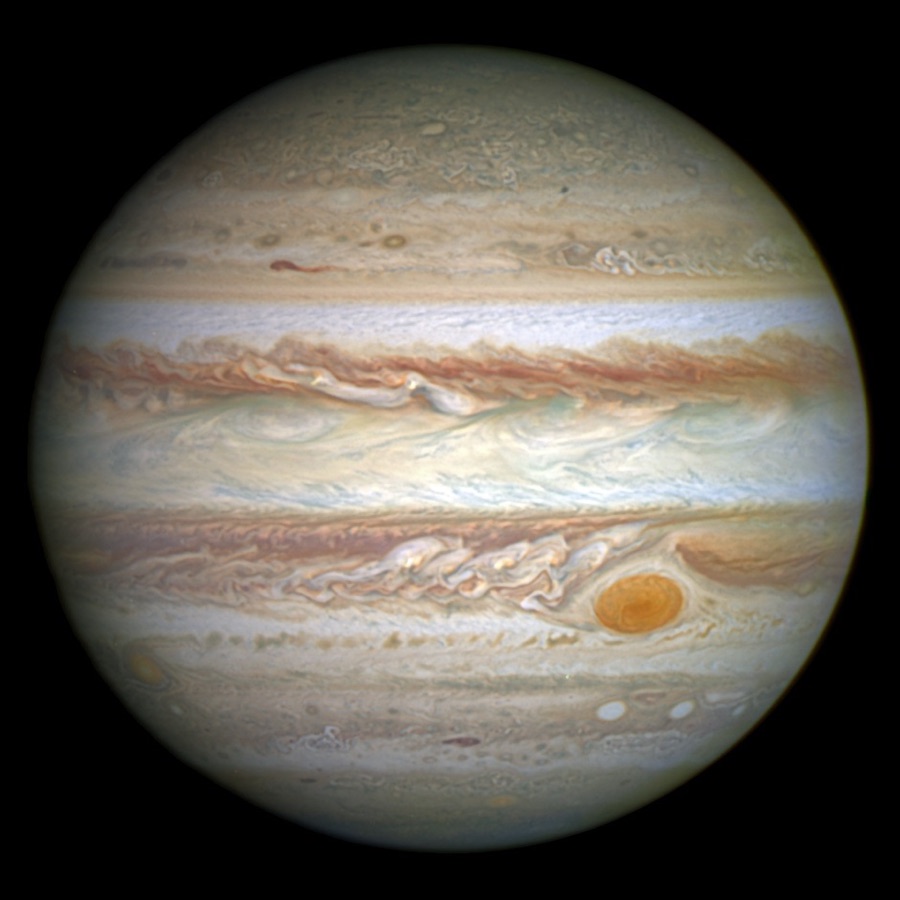
Jupiter is the fifth planet and by far the largest, with more mass than every other planet in the solar system combined. It orbits the Sun in about 11.86 years, which is why it spends roughly a year in each sign, and that near-twelve-year cycle is very likely why the Babylonians watched it so closely.
It has at least ninety-five confirmed moons. The four largest were seen by Galileo in 1610, and watching them circle Jupiter was among the first direct evidence that not everything orbits the Earth, which is a pointed thing to note on an astrological page. Jupiter retrogrades for about four months a year, an appearance caused entirely by Earth passing it on a faster inner orbit.
The positions astrologers use are tropical, measured from the equinox rather than from the stars, and precession has pulled that frame roughly one sign away from the constellations over about two thousand years. Sidereal astrology measures from the constellations instead. They disagree by design rather than by error. No mechanism has been shown by which any of this would affect a person, and this page does not assert one.
The common misreading
The commonest misreading is that Jupiter means good luck arriving. It is not a forecast and it does not describe events. What the tradition assigns to it is enlargement, and enlargement of a difficulty is still enlargement. A reader who reports a strong Jupiter as incoming fortune has replaced a description of manner with a prediction, which is the one thing this material cannot do.
The second is treating it as a licence for optimism. Because everything written about the planet is positive, it gets used to confirm a decision somebody had already made and wanted support for. That is the least useful thing a reading can do. The honest question a Jupiter placement raises is not whether to expand but whether the expansion has been checked against anything.
The third concerns the retrograde. Jupiter spends about a third of each year retrograde, so a very large fraction of people have it natally. Describing it as a significant affliction, or a period when growth is denied, ignores how ordinary it is. A feature shared by roughly a third of the population is not an explanation for anybody's particular circumstances.
Questions to sit with
- What have you recently said yes to, and did you check the size of it before agreeing?
- Where are you confident, and is the confidence coming from evidence or from enthusiasm?
- What in your life has grown past what anybody actually agreed to?
- What meaning have you assigned to a recent event that the event does not strictly support?
See where this sits in your own chart.