- Card number
- 10
- Arcana
- Major Arcana
- Suit
- Major Arcana
- Element
- Fire
- Rank
- Trump
- Roman numeral
- X
- Planetary attribution
- Jupiter
- Yes or no reading
- It depends
Wheel of Fortune
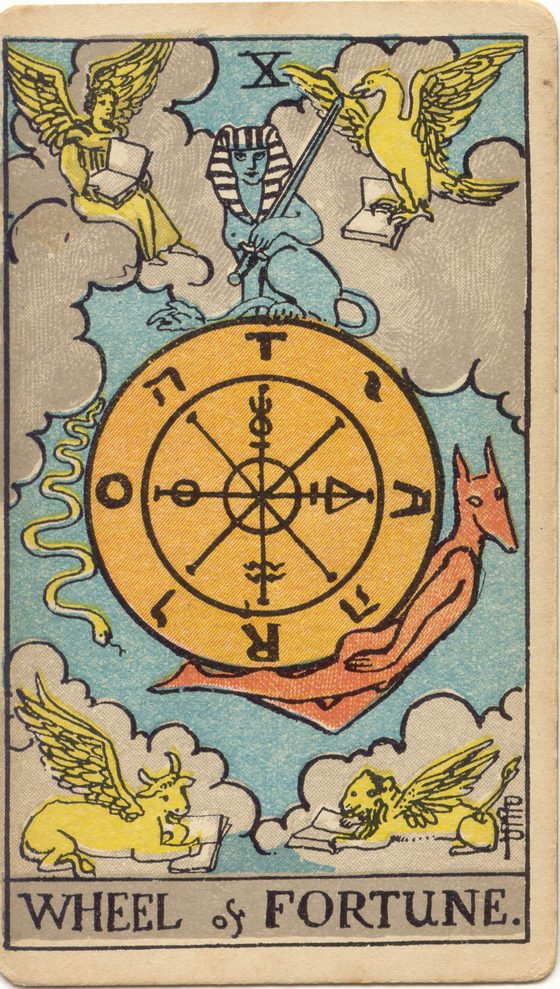
A great yellow wheel turning in a blue sky, with a sphinx above it and a snake sliding down its left side. The Wheel of Fortune is the card of the part of your situation you did not arrange and cannot argue with.
- change
- cycles
- turning point
- circumstance
- momentum
- resistance
- bad timing
- clinging
- upheaval
- stalling
What the card shows
A great yellow wheel hangs in a blue sky and takes up most of the card. Eight spokes radiate from a small hub. Around the outer rim four letters are spaced evenly, T, A, R and O, with four Hebrew letters set between them. Inside that rim are four alchemical marks: mercury, sulphur, water and salt.
A blue sphinx in a striped headdress sits above the wheel, upright, holding a sword angled up against its shoulder. A red jackal-headed figure rises along the right side. A yellow snake with a horned head descends on the left. In each corner of the card, resting on banks of grey cloud, sits a winged creature drawn in yellow with an open book: an angel, an eagle, a lion and a bull. There is no ground and no horizon.
Upright meaning
The Wheel of Fortune is about the part of a situation that nobody in it controls. Not luck in the sense of a prize, but the ordinary fact that circumstances change on their own schedule, and that the change is usually already under way before anyone notices. There is nobody ordinary in the picture, no mortal figure a querent could stand in for, and only emblems occupy it. That is the point of it.
Upright, it generally marks a turn happening now rather than one being awaited. Something has moved in the querent's favour, or the terms have simply changed. The card is poor at telling you which of those it is. What it is good at is saying that the current arrangement is not the permanent one, and that planning as though it were has a due date on it.
It is also the deck's least personal card: it describes weather, not character, so read the neighbours to find the person. Beside The Magician it is a turn someone is in a position to act on. Beside The Hanged Man it is change arriving for somebody who has stopped moving. Beside Ten of Pentacles it reads as circumstance settling rather than turning.
Upright in love
In a relationship reading the Wheel usually points at timing rather than feeling. Something outside the two people is changing: a job, a city, a family situation, a year ending. The relationship will be read differently on the other side of it.
It is a poor card for the question of whether somebody loves you, because it does not describe anyone's interior at all. It answers a different question well. Is this arrangement stable? No, and that is neutral rather than ominous. Some couples are held together by circumstances that are about to change, and some are held apart by them.
Upright in work
At work this is reorganisation, a market moving, a manager leaving, a contract landing for reasons nobody in the room engineered. The card marks the moment the terms change and is genuinely indifferent to whether the change is welcome.
The practical reading is about position rather than outcome: where are you standing when this turns? Someone who has been building quietly is in a different place from someone who has been coasting on an arrangement about to end. The Wheel does not reward merit. It moves, and people who prepared for movement fare better than people who did not.
Upright in money
Money that arrives or leaves for reasons outside the querent's decisions: a rate change, an inheritance, a client folding, a bill nobody forecast. The card describes variance itself, which is exactly why it gets misused.
It cannot be read as a forecast of gain, and nothing in it is investment advice. What it is honest about is that the present number is a snapshot of a moving thing. The useful question it raises is not how much is coming, but how exposed the querent is to a turn they do not control.
Upright as feelings
As feelings, the Wheel is unsettled rather than warm or cold. Something has shifted in how the person sees the situation and the shifting is not finished. It can also read as fatalism: an attraction treated as something happening to them rather than something they are choosing. That is worth naming plainly rather than romanticising.
Upright as advice
Stop optimising the current arrangement and write down what you would do if it ended next month. The Wheel's advice is preparation, not prediction. You are not being asked to guess the turn correctly. You are being asked to be standing somewhere survivable when it comes.
Reversed meaning
Reversed, the Wheel splits two ways, and neither of them is simply bad luck.
The first is a turn going against the querent, or a run of favourable circumstance ending. Read plainly, this is the card saying the thing that was carrying you has stopped carrying you. It is not punishment and it is not a lesson. It is the same wheel at a different point.
The second, and the more common in practice, is resistance to a turn that has already happened. The circumstances changed and the querent is still working the old terms, still spending the old budget, still waiting for a version of things that has gone. The wheel moved and they did not.
The spread decides which. A useful test is to ask whether the querent is describing something happening to them now or something that already happened and has not been accepted. In practice it is the second far more often than the books suggest.
Reversed in love
Either external circumstance pulling against a relationship, through distance, timing or other people's decisions, or two people running a relationship on terms that expired some time ago. Reversed, the card often marks a couple still arguing about a version of their life that has already ended. It rarely says the feeling has gone. It says the situation the feeling was built for has.
Reversed in work
A restructure that lands badly, a market turn nobody hedged for, or work continuing on a plan the facts have overtaken. The last of those is the more useful reading in most spreads. Ask when the plan was written and what has changed since. Reversed, the Wheel is frequently about a team executing a strategy that made sense a year ago and has not been revisited.
Reversed in money
Variance in the unwelcome direction, or a budget still built on income that has already changed. The card can forecast neither, and it is not advice about any particular decision. Where it earns its place is in pointing at exposure: what breaks first if the number moves by a third in either direction, and does the querent know the answer without having to work it out?
Reversed as feelings
Someone whose feelings are moving and who is presenting them as fixed. Or the reverse: a person holding on to how they felt about you a year ago rather than how they feel now. The reversal marks a mismatch between what has changed and what is being said about it.
Reversed as advice
Name the thing that has already ended and stop paying for it. Reversed, the Wheel is asking you to update rather than to endure. Write the plan for the situation you are actually in, not the one you budgeted for, and do it this week while the difference between the two is still fresh enough to describe.
Symbolism in the 1909 image
The letters on the rim. T, A, R and O, spaced so they can be read as ROTA, the Latin for wheel, or as TAROT, ORAT or TORA depending where you start. The ambiguity is deliberate on Waite's part. It is a puzzle set into the design rather than a message to be decoded.
The Hebrew letters. Yod, He, Vau, He, set between the Latin ones: the four-letter name of God. Waite is claiming the wheel is governed rather than random. Readers who take the card as pure chance are reading against its own iconography.
The sphinx. Blue, in a striped headdress, seated above the wheel with a sword against its shoulder, and the only one of the three creatures on the wheel that is not moving. Usually read as the still point, or as the riddle. Worth noting that it is armed; it is not merely serene.
The snake and the jackal-headed figure. One descending on the left, one rising on the right, both lifted from Egyptian revival imagery. Read as fall and rise, though neither is given a face you can actually read, which is a limit the confident books tend to skip.
The four winged creatures. Angel, eagle, lion and bull, one to each corner, each holding an open book. They are the fixed signs of the zodiac and the four evangelists at the same time. They are the only things on the card that stay still, and every one of them is reading.
Where this meaning came from
The wheel of fortune is not a tarot invention. It is a medieval European commonplace, the rota fortunae, carved on cathedral walls and written into Boethius long before playing cards reached Italy. Figures rise on one side, are crowned at the top and fall down the other, and the moral is always the same: fortune turns and nobody rides it forever.
The fifteenth-century Italian trumps carried it as one allegory among many in a trick-taking game with no divinatory content whatsoever. The occult reading arrives in eighteenth-century France with Antoine Court de Gebelin and Etteilla, who invented an Egyptian pedigree the deck never had. The Jupiter attribution most readers use comes from the Golden Dawn in the 1890s.
Smith's 1909 drawing is unusually dense with borrowed material: Eliphas Levi's Egyptianised wheel, the Hebrew tetragrammaton, alchemical marks, and the four creatures from Ezekiel and Revelation. Waite explains some of it in The Pictorial Key to the Tarot (1910) and pointedly declines to explain the rest, which has kept commentators busy ever since. Smith was paid a flat fee for the deck and credited only by her initials.
The common misreading
The Wheel is the card people most want to be a lottery ticket. It gets read as good luck arriving, and it says nothing of the kind. It describes movement, and movement has two directions. Waite's own text is careful about this in a way most modern summaries are not.
The second misreading is the fatalism it invites. Because there is no person in the picture to act, readers conclude the querent has no agency in the situation. That is a misreading of an absence. The card says circumstance is turning. It says nothing about what the querent may do while it turns, and treating it as permission to stop acting is a decision the reader has made, not one the card supports.
The third is timing. The Wheel gets used to answer when, and it cannot. There is no clock in the image and no way to read speed from it, so a reader who says the change comes in three months has invented that number. What can honestly be said is that the present arrangement is not stable. Compare The Tower, which describes a specific collapse; this card describes only that things move.
Questions to sit with
- What in your situation right now was not decided by you?
- What are you still budgeting for, in money or time or attention, that has already changed?
- If the current arrangement ended next month, what would break first?
- Are you describing something that is happening, or something that already happened?
Pull this card in a real spread.