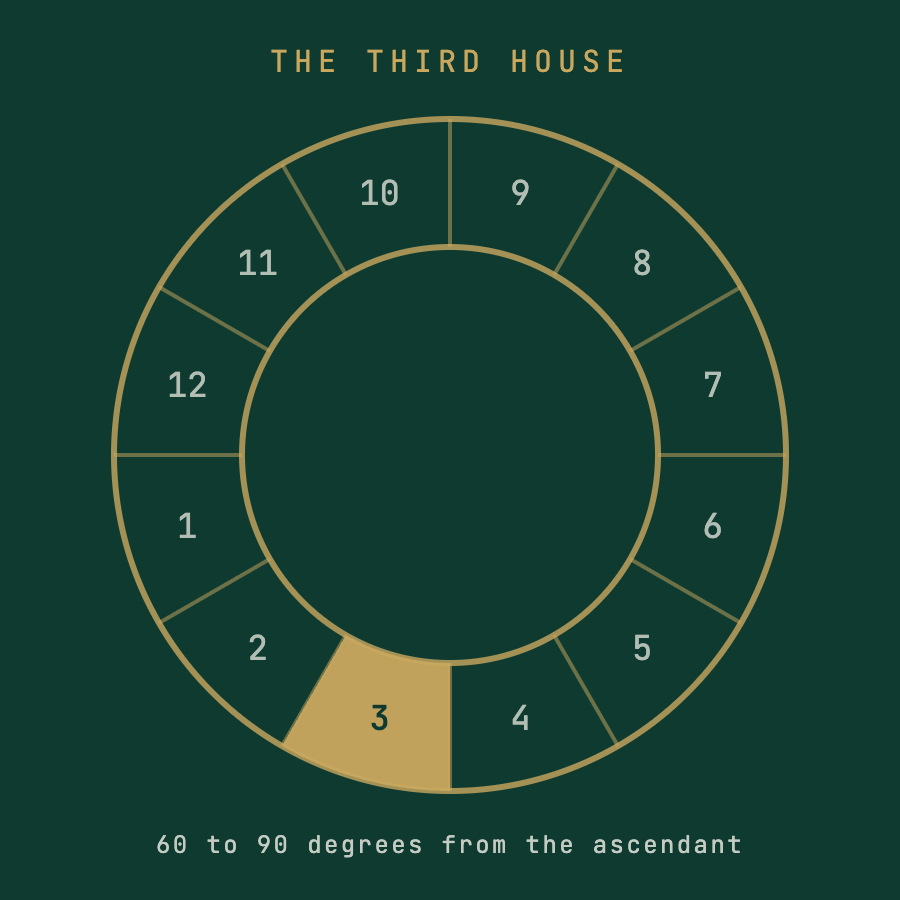
- Entry type
- House
- Number
- 3
- Element
- Air
- Modality
- Mutable
- Modern ruler
- Mercury
The Third House
The house of the immediate surroundings: siblings, neighbours, short journeys and everyday talk. The third house covers the part of a life so familiar that most people never think to examine it.
- communication
- siblings
- environment
- learning
- proximity
What this describes
The third house covers the near distance. Siblings, neighbours, the people you see because of where you are rather than because you chose them; short journeys, the daily route, the errand; and the ordinary traffic of speaking, writing and being told things. It is the least glamorous house in the chart and one of the most consequential, because it describes the conditions a person actually lives in for most hours of most days.
The older texts frame it as the house of what is near and repeated. Modern writing narrows it to communication, which is accurate and thin: the third house is not only how somebody talks but the whole environment they talk inside, including who taught them to and what was possible to say there. It takes Gemini as its natural sign and Mercury as its ruler, and both associations point the same way.
It is a cadent house, meaning it falls away from the angles, and the tradition treats cadent houses as weaker in influence. That is a statement about how visibly a house acts rather than about how much it matters. A great deal of a life gets decided in the third house without anybody noticing it happen.
What it does well
A well-supported third house shows up as ease in the near environment. Errands get done, messages get answered, the people nearby are known by name. That sounds trivial, and it is the infrastructure everything else runs on.
It also produces genuine fluency. Where the third house is well tenanted, a person can explain things to whoever is in front of them, adjust the register without thinking about it, and pick up practical knowledge by talking to people rather than by studying.
Third, it supplies mobility. Not travel in the ninth house sense, but the ordinary capacity to move around a place easily, know the routes, and treat leaving the house as unremarkable. That capacity is easy to overlook until it is missing.
Where it goes wrong
The third house goes wrong through volume. It governs the constant low-level traffic of information, and where it is overloaded a person is reachable at all times, informed about everything, and unable to think about any of it.
The second failure is with siblings and near-family, which this house has always covered. Relationships that were assigned rather than chosen are the hardest to renegotiate, and the third house is where somebody is still playing a role that was decided when they were nine.
Third, the near environment can shrink a life without a decision ever being made. Nothing in this house announces itself, so a person can spend a decade inside the same few streets and the same few conversations and experience it as circumstance rather than as a choice.
In relationships
In relationships the third house is about talk rather than attraction: the daily exchange, the texture of a conversation carried over years, whether two people find each other easy to be around in ordinary circumstances.
It is also the house of proximity. A great many relationships begin in third house territory, among the people at hand rather than anybody selected, and the tradition is unsentimental about that. Where a chart is read for a relationship question, this house says something about whether two people can talk. It says nothing about whether they should, which no house can, and partnership itself belongs to the seventh.
In work
At work the third house governs the everyday machinery: correspondence, briefings, the short trip to a client, the person at the next desk. It is not the house of vocation, which is the tenth, and it is very often the house that decides whether the tenth is bearable.
It also covers the skills that are picked up rather than trained: how somebody works out what is actually going on inside an organisation, which is almost never written down anywhere. Where the third house is strong, a person knows things about their workplace that their role does not entitle them to know, and that is frequently more useful than the role.
In money
The third house has no direct financial signification, and pages that give it one are inventing. What it covers is the traffic around money rather than money itself: the negotiation, the paperwork, the terms as they were actually described out loud.
Its practical contribution is that most financial trouble between people who know each other is a third house problem. Something was said, understood differently, and never written down. Getting the wording right is this house's own remedy, and it is worth more here than any prediction. None of it is guidance about anybody's finances.
How to read it in a chart
Three things change a house's reading, and none of them is the house number. First, the sign on its cusp, which describes the manner: a third house cusp in a fixed sign describes a near environment that does not change much, whatever else is true.
Second, the ruler of that sign and where it sits. If the third house cusp falls in Aries, Mars rules the house, and Mars's own placement says where the third house business actually plays out. Mars in the tenth would tie the near environment to public standing.
Third, any planets sitting in the house, which usually dominate the reading. Most houses in most charts are empty, since there are around ten planets and twelve houses, and an empty third house is not an absence of siblings or of conversation. It means the area gets read through the cusp ruler instead.
How it meets other placements
Houses meet across axes rather than in pairs of best matches. The third sits opposite the ninth house, and the two split a single function: the third gathers what is near and specific, the ninth what is distant and general. Information against meaning. A chart weighted heavily to one end usually has a characteristic blind spot at the other.
It also relates to the sixth house and the twelfth as the other cadent houses, which together describe the parts of a life that run below the level of decision.
Between two charts, planets falling in each other's third house describe people who talk easily. That is a real and underrated compatibility factor, and it is not a prediction of anything.
The part people leave out
The part popular astrology leaves out is that the third house is where a person's limits were set. The vocabulary available in childhood, what could be said at the table, which questions were answered and which produced a silence: all of that is third house material, and it shapes what somebody is able to think about long before they are choosing anything.
There is also the sibling question, which modern writing handles badly by treating it as a footnote. The tradition put siblings here for a reason. A relationship you did not choose, cannot leave, and were compared against throughout childhood is formative in a way friendships are not, and this is the only house that covers it.
Where the symbol comes from
The house names in the Hellenistic sources are more evocative than the modern ones, and the third house has the strangest of them. The Greek writers called it Thea, the Goddess, and its Latin name is Dea. The reason is technical: the third is where the Moon is said to have its joy, the place in the chart where the Moon's function operates most freely, and the house took its name from the planet.
That connection explains the house better than the modern label does. The Moon governs the habitual, the near and the cyclical, and the third house covers exactly that: the route walked daily, the people seen without arranging to see them, the conversation that repeats.
The doctrine of planetary joys assigns a house to each of the traditional planets. It is one of the older layers of the system, largely forgotten in twentieth-century practice and recovered fairly recently.
Where this meaning came from
Houses are a Hellenistic addition. Babylonian astrology worked with signs and planets and had nothing corresponding to a division of the local sky. The twelve-place scheme appears with the Greek and Egyptian synthesis from about the second century BCE, and it is the single largest thing the Hellenistic astrologers contributed.
The earliest system is what is now called whole sign houses: the sign containing the Ascendant is the first house entirely, the next sign is the second, and so on. It is the system used by Vettius Valens, by Firmicus Maternus, and throughout the early literature.
Quadrant systems, which divide the space between the angles rather than following sign boundaries, developed later and dominated European practice from the medieval period onward. Placidus, the system most modern software defaults to, dates from the seventeenth century.
Whole sign houses were effectively lost to Western practice for centuries and returned only in the late twentieth century, through translation projects working on the surviving Greek sources. Two systems roughly two thousand years apart are now both in ordinary use, and they frequently disagree about which house a planet is in.
What the astronomy actually says
A house is not a region of space. It is a division of the sky as seen from one place at one moment, defined against the local horizon and meridian, and it therefore depends on latitude, on longitude, and on the time to the minute.
The third house shows the consequence clearly, because it is cadent, and in quadrant systems the cadent houses are where the distortion collects. Quadrant systems divide the arc between the angles, and that arc is not evenly distributed: away from the equator, houses on one side of the chart become large while their opposites shrink. At fifty degrees north it is entirely ordinary for one house to span sixty degrees of the zodiac and its opposite to span twenty. The houses are not equal, and the tidy twelve-slice diagram is misleading about it.
Whole sign and equal house systems avoid the problem by ignoring the horizon geometry, at the cost of the thing quadrant systems were built to capture. Neither is correct. They are different constructions, and astrology has never demonstrated a mechanism for either.
The common misreading
The third house is most often reduced to communication, which loses most of what it covers. Siblings, neighbours, the daily route and the whole immediate environment sit here, and a reading that only discusses how somebody writes emails is using a twelfth of the chart to describe a hobby.
The second misreading is treating cadent as unimportant. The tradition ranks angular houses strongest and cadent weakest, and that is a statement about how directly a house acts, not about how much of a life it accounts for. Most people spend most of their time in cadent territory.
The third is the short journeys cliche. Modern lists reduce this to commuting, which makes a genuinely useful signification sound trivial. The older meaning is anything near enough to return from the same day, and the distinction it draws with the ninth house is between the world you can reach and the world you have to take reports about. That distinction is real, and it survives the fact that a plane now crosses it in an afternoon.
Questions to sit with
- Who do you see regularly because of proximity rather than choice, and what does that account for?
- What could not be said in the house you grew up in?
- Which role from childhood are you still playing with a sibling or a near-relative?
- How much of your world sits within a day's return, and when did you last go further?
See where this sits in your own chart.