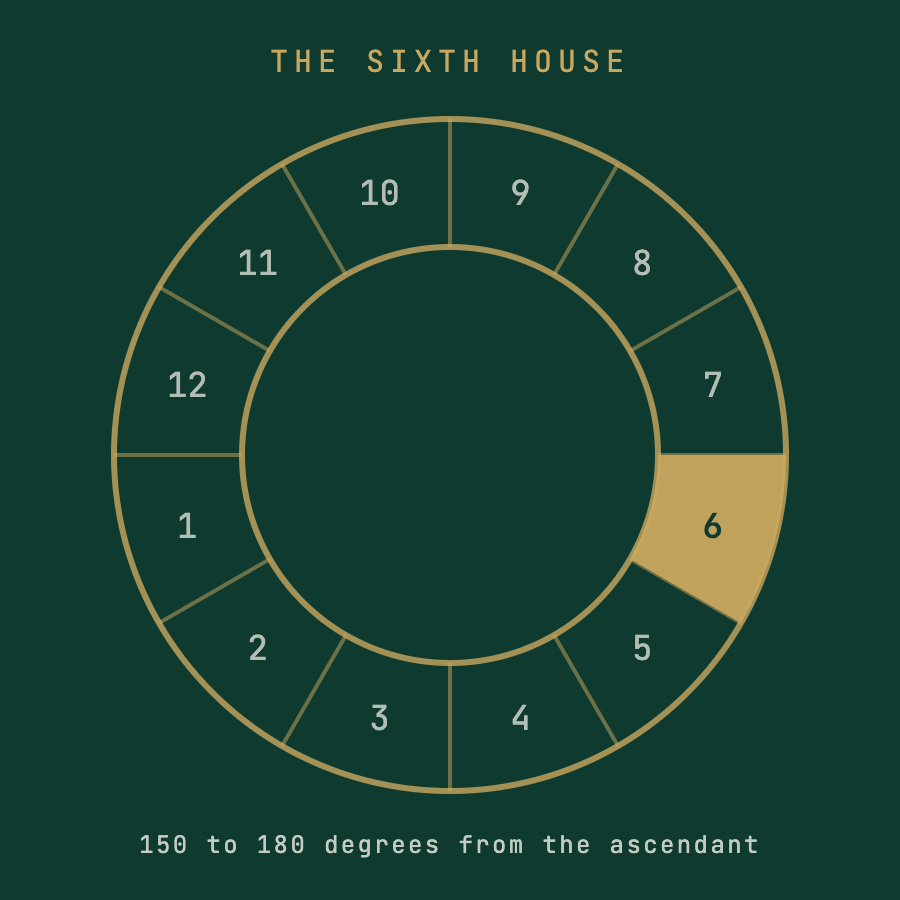
- Entry type
- House
- Number
- 6
- Element
- Earth
- Modality
- Mutable
- Modern ruler
- Mercury
The Sixth House
The house the Greeks called Bad Fortune: daily work, routine, illness and the people who do things for you. The sixth house covers the parts of a life that repeat whether or not anybody chose them.
- routine
- work
- service
- health
- maintenance
What this describes
The sixth house covers the daily. Work in the sense of the tasks rather than the vocation, routine, maintenance, the body's upkeep, and the people whose labour a life depends on. The Greek writers called it Kake Tyche, Bad Fortune, and they meant it. This was one of the difficult places in the chart, and the modern habit of describing it as wellness and self-care is a substantial softening.
The connecting idea is obligation. Everything in the sixth house has to be done again tomorrow and none of it is optional. That is what separates it from the tenth, which covers what a career amounts to: the sixth is what the job actually consists of on a Tuesday, and a person can have a distinguished tenth house and a miserable sixth with no contradiction at all.
It takes Virgo as its natural sign and Mercury as its ruler, and it is cadent, which the tradition treats as the weakest position. Mars is said to have its joy here, and that is where the unfortunate reputation came from.
What it does well
A well-supported sixth house shows up as a life that runs. The recurring things get done, the body is maintained rather than managed in emergencies, the work is competently executed rather than heroically rescued. It is the least celebrated capacity in the chart and among the most load-bearing.
It also produces real craft. The sixth house is where skill is acquired, because skill is repetition and this is the house of things done again. A strong sixth is somebody who has got good at something by doing it many times without much drama about it.
Third, it supplies the ability to work within other people's constraints: the practical, unglamorous cooperation that makes a workplace function rather than merely exist.
Where it goes wrong
The sixth house goes wrong through accumulation. Nothing here is individually significant, so nothing here gets attended to until the total becomes unmanageable, and by then the problem has no single cause to point at.
The second failure is the one the old name was describing. This is the house of what a person has to do regardless of whether they want to, and a difficult sixth is a life in which the proportion of obligation to choice has quietly gone wrong. The tradition was blunt about that being a hard position rather than an opportunity for growth.
Third, it produces a specific kind of self-neglect: somebody who maintains systems, equipment, other people and a schedule impeccably, and treats their own upkeep as the item that can be dropped.
In relationships
The sixth house is not a relationship house, and it accounts for a surprising amount of what happens inside relationships. It covers the division of labour: who does the recurring work, whether that division was ever discussed, and what happens when it was not.
Most long relationships are conducted in sixth house territory rather than seventh, because the seventh describes the arrangement and the sixth describes the days it is made of. Where a relationship question is really a question about resentment, this house is usually the relevant one. A chart cannot tell you how a particular household divides its work. It can tell you the division is a subject rather than a detail.
In work
The sixth is the working house and the tenth is the career house, and the distinction is worth keeping. The sixth covers the tasks, the colleagues, the routine and the conditions. The tenth covers what it all adds up to and how it looks from outside.
Traditional texts assign this house to servants and subordinates, meaning the people whose work a person relies on. That reads awkwardly now, and the underlying signification is exactly right: relationships with the people who do things for you are a real and under-examined part of working life, and this is the only house covering them.
Where a job is bearable in the abstract and unbearable in practice, the sixth house is where the answer sits.
In money
The sixth house is where money and time meet. It covers earned income in the sense of payment for labour done, as distinct from what somebody owns, which is the second house, or what is held jointly, which is the eighth.
Its practical signification is the rate: what an hour is worth, and how many of them a life is spending. Where a money question turns out to be a question about workload, this is the relevant house. That is an observation about how the tradition divides things up rather than advice about anybody's finances, which depend on facts a chart does not contain.
How to read it in a chart
Read the sixth as you read any house: the sign on its cusp, the ruler of that sign, and whatever occupies it.
The cusp sign describes the manner of the daily. A sixth cusp in a fire sign describes routine attacked in bursts; in an earth sign, routine that is genuinely steady. The ruler of that sign then says where the daily business is actually settled: a sixth cusp in Pisces puts the house under Jupiter traditionally, or Neptune in modern practice, and that planet's placement is where the working life is really decided.
Planets in the sixth take over the reading when present. Saturn there is the classic marker of work as endurance. An empty sixth house is ordinary and means nothing about anybody's health, which is not something a chart reports on in any case.
How it meets other placements
The sixth sits opposite the twelfth, and the tradition took the axis seriously: the sixth is the obligation you can see and schedule, the twelfth is what is going on out of sight. Both are houses of things that happen to a person rather than things they choose, and a chart weighted heavily toward one usually has an unexamined version of the other.
As a cadent house it groups with the third, the ninth and the twelfth, the places that operate below the level of decision.
Between two charts, planets falling in each other's sixth house describe people who work well together in a practical sense. That is a genuine form of compatibility and not a romantic one.
The part people leave out
The part popular astrology leaves out is the name. This was Bad Fortune, one of the three places Hellenistic writers regarded as unfortunate, and the modern rebranding of it as wellness and daily rituals has removed the content. The tradition was describing the part of a life that is not chosen and does not stop, which is a harder subject than a morning routine.
The second omission is the health signification, which modern writing either drops or handles carelessly. The older texts treat this as the place of illness, and they were making claims about the body from a chart. Those claims were wrong. Dropping them is right. Pretending the tradition never made them is not.
Where the symbol comes from
The Greek name is Kake Tyche, Bad Fortune, and the Latin is Mala Fortuna. It is the counterpart of the fifth house, Good Fortune, and the two sit either side of the descending half of the chart as a matched pair.
The name comes from the doctrine of joys. Mars is said to have its joy in the sixth house, and the place took the character of the planet assigned to it. Mars in the Hellenistic scheme is the lesser malefic, associated with injury, conflict and things going wrong, and a house carrying that character was never going to be read as pleasant.
There is a second and more technical reason. In the Hellenistic system a house is strengthened by aspecting the Ascendant, and the sixth forms no classical aspect to the first at all. It cannot see the house of the self, and places that could not see it were regarded as where things happen unobserved.
Where this meaning came from
The twelve houses arrive with the Hellenistic synthesis in Egypt from about the second century BCE, and the sixth was a difficult place in the scheme from the outset. Vettius Valens and Firmicus Maternus both treat it as the house of illness, injury and servitude.
That grouping says something about the society the system was built in. Illness, subordinate labour and bodily damage were classed together as the misfortunes a person did not choose, and one house covered all of them.
The medieval Arabic and Latin traditions kept the sixth house medical, and it stayed medical for a very long time. Medical astrology was a serious professional practice in Europe into the seventeenth century, with physicians casting charts to time treatment. It did not work, and it faded with the development of clinical medicine rather than through any change in astrological doctrine.
The modern reading of the sixth house as routine, service and wellbeing is a twentieth-century reframing. It kept the daily-work signification and quietly set aside the diagnostic claims.
What the astronomy actually says
Houses depend on the exact minute of birth, and this is a reasonable place to spell out what that means.
The Ascendant moves through the entire zodiac once a day, which works out at roughly one degree every four minutes. A birth time recorded only to the nearest hour is therefore uncertain by about fifteen degrees of Ascendant, which is half a sign, and every house cusp moves with it. Two charts for the same day and the same city, an hour apart, can disagree about which house every planet falls in.
If a birth time is genuinely unknown, the honest position is that the houses cannot be calculated. Planetary positions by sign survive, though the Moon may be uncertain, since it crosses a sign in about two and a half days. What many sites do instead is silently substitute a chart with the Sun on the first cusp and present the result as house placements. That is a convention rather than a calculation, and it should be labelled as one. Astrology has never demonstrated a mechanism for any of it.
The common misreading
The sixth house attracts the most dangerous misreading in astrology: this house is not a diagnostic instrument. The tradition assigned illness here and made specific medical judgements from it for well over a thousand years. Those judgements were not reliable. Nothing in a chart indicates what is wrong with a body, what will go wrong with one, or what to do about it, and a reader who offers that is doing harm rather than astrology. Symptoms are a matter for a doctor.
The second misreading is the wellness rebrand. Modern writing has converted Bad Fortune into self-care, which makes the house pleasant and empties it. What it actually describes is the non-negotiable part of a life, and a page that turns that into a discussion of morning routines is not softening the tradition so much as replacing it.
The third is confusing the sixth with the tenth. The sixth is the work; the tenth is the career. A person can be doing well in one and badly in the other, and reading them as a single subject is why so much astrological career advice fails to describe anybody's actual job.
Questions to sit with
- What in your week is not optional, and did you ever actually agree to it?
- Which recurring task have you been treating as temporary for more than a year?
- Whose labour is your daily life running on, and how do you treat them?
- What upkeep of your own is the first thing you drop when you get busy?
See where this sits in your own chart.